Mitteilung
ESO unterzeichnet Vereinbarung über MOSAIC-Instrument für das ELT
1. Dezember 2025
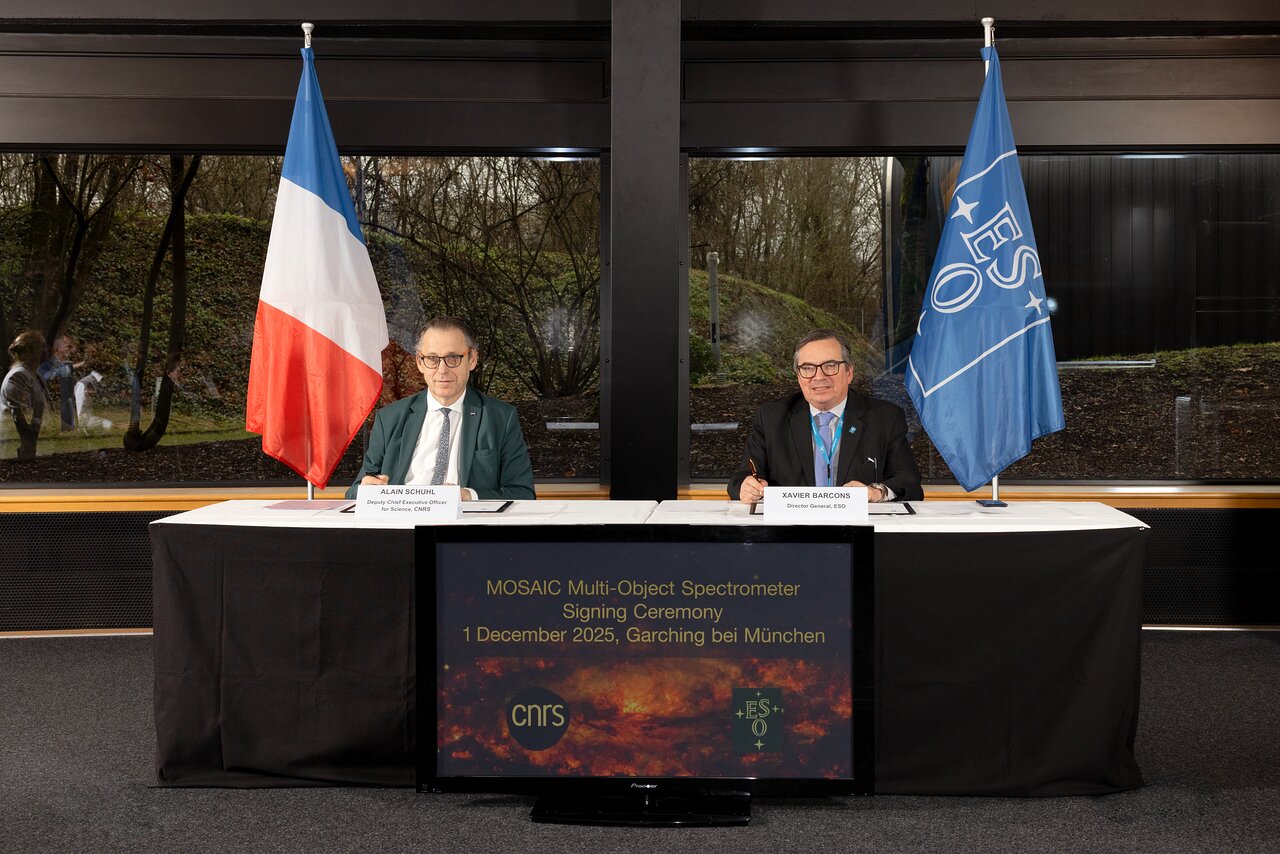
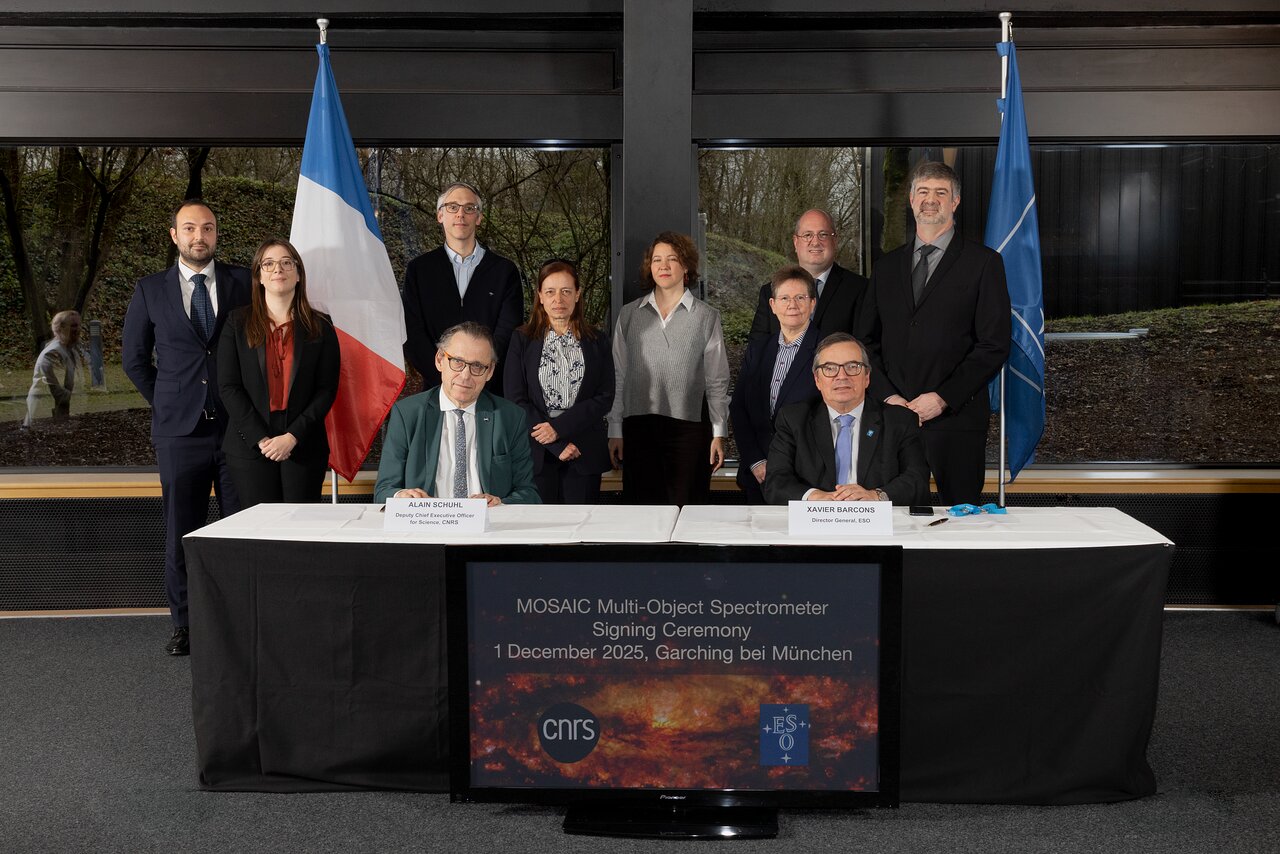
Heute hat die ESO eine Vereinbarung mit einem großen internationalen Konsortium über die Konstruktion und den Bau des Multi-Object Spectrograph (MOSAIC) unterzeichnet, einem Instrument für das Extremely Large Telescope (ELT) der ESO. MOSAIC kann das Licht von mehr als zweihundert Quellen gleichzeitig messen und wird dazu verwendet werden, das Wachstum von Galaxien und die Verteilung von Materie vom Urknall bis zur Gegenwart zu verfolgen.
Die Vereinbarung wurde von Xavier Barcons, Generaldirektor der ESO, und Alain Schuhl, stellvertretender Generaldirektor für Wissenschaft am französischen Nationalen Zentrum für wissenschaftliche Forschung (CNRS), der führenden Institution des MOSAIC-Konsortiums, unterzeichnet. Anwesend waren auch die MOSAIC-Projektleiterin Roser Pello vom Astrophysikalischen Laboratorium Marseille und der stellvertretende Projektleiter Mathieu Puech vom Pariser Observatorium sowie weitere Würdenträger der ESO, des CNRS und des MOSAIC-Konsortiums [1]. Die Unterzeichnung fand am Hauptsitz der ESO in Garching statt.
MOSAIC ist ein leistungsstarker Spektrograf, ein Instrument, das Licht in seine einzelnen Wellenlängen zerlegt, damit Astronomen wichtige Eigenschaften astronomischer Objekte wie ihre chemische Zusammensetzung oder Temperatur bestimmen können. Das Instrument wird das größtmögliche Sichtfeld des ELT nutzen, sowohl im sichtbaren als auch im nahen Infrarotbereich arbeiten und in der Lage sein, das Licht von mehr als zweihundert Objekten gleichzeitig zu analysieren.
MOSAIC wird die erste umfassende Bestandsaufnahme der Materie im frühen Universum durchführen, Aufschluss darüber geben, wie Materie innerhalb und zwischen Galaxien verteilt ist, und unser Verständnis davon, wie sich heutige Galaxien gebildet und entwickelt haben, erheblich verbessern. Außerdem wird es möglich sein, das Gas, das Galaxien umgibt, genau zu untersuchen und die darin enthaltenen chemischen Elemente zu identifizieren.
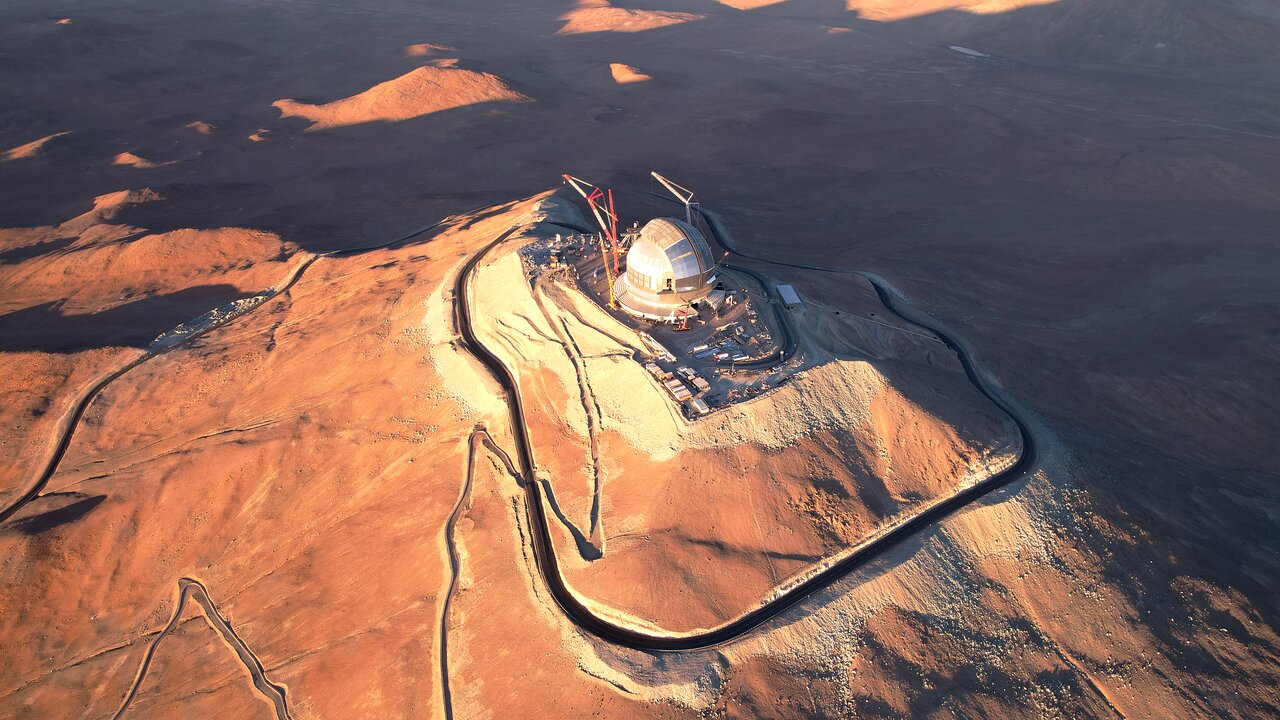
Das ELT der ESO befindet sich derzeit im Bau in der chilenischen Atacama-Wüste, einem weltweit einzigartigen Ort für die Beobachtung des Himmels. Wenn es später in diesem Jahrzehnt in Betrieb genommen wird, wird das ELT unser Wissen über das Universum revolutionieren und uns dazu bringen, unseren Platz im Kosmos neu zu überdenken.
Fußnoten
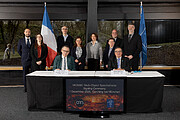
[1] An der Unterzeichnungszeremonie nahmen Pascal Chevrot (Leiter der Direktion für innovative instrumentelle Entwicklungen für Forschung und Beobachtung des CNRS), Myriam Rodrigues (MOSAIC-Systemingenieurin, Pariser Observatorium), Hermine Schnetler (MOSAIC-Projektmanagerin, Observatoire de Paris), Jesus Gallego (Co-Vorsitzender des MOSAIC-Vorstands, Universidad Complutense de Madrid), Michiel Rodenhuis (Geschäftsführer von NOVA und Mitglied des institutionellen Vorstands) sowie die beiden ESO-Ratsdelegierten für Frankreich: Karine Perraut (CNRS INSU) und Guy Perrin (Ministerium für Hochschulbildung, Forschung und Innovation, Paris).
Von der ESO sind neben Xavier Barcons auch Suzanne Ramsay (stellvertretende Leiterin des Instrumentenprogramms), Michele Cirasuolo (Leiterin des Instrumentenprogramms), Jarle Brinchmann (Direktor für Wissenschaft), Claudia Burger (Verwaltungsdirektorin), Andreas Kaufer (Betriebsleiter), Sara Krauss (Technikdirektorin), Adrian Russell (Programmdirektor), Patrick Caillier (MOSAIC-Projektleiter), Alessandro Meoli (MOSAIC-Detektorsystem-Arbeitspaketleiter), Oliver Pfuhl (MOSAIC-Projektingenieur), Alain Delorme (stellvertretender Leiter für Verträge und Beschaffung), Cyrielle Blanc (Vertrags- und Beschaffungsbeauftragte), Roberto Tamai (ELT-Programmmanager), Enrico Marchetti (Instrumentierungsprogrammingenieur) und Joël Vernet (stellvertretender ELT-Programmwissenschaftler) anwesend.
Weitere Informationen
Das MOSAIC-Projekt wird von einem internationalen Konsortium aus Forschungsinstituten in 13 Ländern geleitet. Diese sind:
- Brasilien: National Laboratory for Astrophysics; University of São Paulo;
- Deutschland: Leibniz-Institut für Astrophysik Potsdam; LSW Heidelberg;
- Finnland: University of Helsinki; Finnish Centre for Astronomy with ESO, University of Turku;
- Frankreich: National Institute for Earth Sciences and Astronomy at the National Centre for Scientific Research (CNRS-INSU) ; UNité d'Ingénierie et de Développements Instrumentaux pour l'Astrophysique (UNIDIA) and Laboratoire d'étude de l'Univers et des phénomènes eXtrêmes (LUX) at Paris Observatory-PSL; Institute for Research in Astrophysics and Planetology at the University of Toulouse; Marseille Astrophysics Laboratory. Laboratoire Joseph-Louis Lagrange (LAGRANGE);
- Großbritannien: Durham University; University of Oxford / RAL Space;
- Italien: INAF - Italian national Institute of Astrophysics;
- Niederlande: Netherlands Research School for Astronomy (NOVA); University of Amsterdam
- Österreich: Universität Wien; Institute of Science and Technology Austria (ISTA);
- Portugal: Centro de Investigação em Astronomia/Astrofísica da Universidade do Porto; FCiências.ID - Universidade de Lisboa;
- Schweden: Stockholm University; Lund University; Uppsala University;
- Schweiz: University of Geneva; École polytechnique fédérale de Lausanne;
- Spanien: Universidad Complutense de Madrid (UCM); Instituto de Astrofísica de Andalucía (IAA-CSIC); Centro de Astrobiología (CAB, CSIC-INTA), Universidad Politécnica de Madrid (UPM);
- USA: University of Michigan; Space Telescope Science Institute.
Links
Kontaktinformationen
Bárbara Ferreira
ESO Media Manager
Garching bei München
Tel: +49 89 3200 6670
Email: press@eso.org
Über die Mitteilung
| ID: | ann25008 |
Bilder


Our use of Cookies
We use cookies that are essential for accessing our websites and using our services. We also use cookies to analyse, measure and improve our websites’ performance, to enable content sharing via social media and to display media content hosted on third-party platforms.
ESO Cookies Policy
The European Organisation for Astronomical Research in the Southern Hemisphere (ESO) is the pre-eminent intergovernmental science and technology organisation in astronomy. It carries out an ambitious programme focused on the design, construction and operation of powerful ground-based observing facilities for astronomy.
This Cookies Policy is intended to provide clarity by outlining the cookies used on the ESO public websites, their functions, the options you have for controlling them, and the ways you can contact us for additional details.
What are cookies?
Cookies are small pieces of data stored on your device by websites you visit. They serve various purposes, such as remembering login credentials and preferences and enhance your browsing experience.
Categories of cookies we use
Essential cookies (always active): These cookies are strictly necessary for the proper functioning of our website. Without these cookies, the website cannot operate correctly, and certain services, such as logging in or accessing secure areas, may not be available; because they are essential for the website’s operation, they cannot be disabled.
Functional Cookies: These cookies enhance your browsing experience by enabling additional features and personalization, such as remembering your preferences and settings. While not strictly necessary for the website to function, they improve usability and convenience; these cookies are only placed if you provide your consent.
Analytics cookies: These cookies collect information about how visitors interact with our website, such as which pages are visited most often and how users navigate the site. This data helps us improve website performance, optimize content, and enhance the user experience; these cookies are only placed if you provide your consent. We use the following analytics cookies.
Matomo Cookies:
This website uses Matomo (formerly Piwik), an open source software which enables the statistical analysis of website visits. Matomo uses cookies (text files) which are saved on your computer and which allow us to analyze how you use our website. The website user information generated by the cookies will only be saved on the servers of our IT Department. We use this information to analyze www.eso.org visits and to prepare reports on website activities. These data will not be disclosed to third parties.
On behalf of ESO, Matomo will use this information for the purpose of evaluating your use of the website, compiling reports on website activity and providing other services relating to website activity and internet usage.
Matomo cookies settings:
Additional Third-party cookies on ESO websites: some of our pages display content from external providers, e.g. YouTube.
Such third-party services are outside of ESO control and may, at any time, change their terms of service, use of cookies, etc.
YouTube: Some videos on the ESO website are embedded from ESO’s official YouTube channel. We have enabled YouTube’s privacy-enhanced mode, meaning that no cookies are set unless the user actively clicks on the video to play it. Additionally, in this mode, YouTube does not store any personally identifiable cookie data for embedded video playbacks. For more details, please refer to YouTube’s embedding videos information page.
Cookies can also be classified based on the following elements.
Regarding the domain, there are:
- First-party cookies, set by the website you are currently visiting. They are stored by the same domain that you are browsing and are used to enhance your experience on that site;
- Third-party cookies, set by a domain other than the one you are currently visiting.
As for their duration, cookies can be:
- Browser-session cookies, which are deleted when the user closes the browser;
- Stored cookies, which stay on the user's device for a predetermined period of time.
How to manage cookies
Cookie settings: You can modify your cookie choices for the ESO webpages at any time by clicking on the link Cookie settings at the bottom of any page.
In your browser: If you wish to delete cookies or instruct your browser to delete or block cookies by default, please visit the help pages of your browser:
Please be aware that if you delete or decline cookies, certain functionalities of our website may be not be available and your browsing experience may be affected.
You can set most browsers to prevent any cookies being placed on your device, but you may then have to manually adjust some preferences every time you visit a site/page. And some services and functionalities may not work properly at all (e.g. profile logging-in, shop check out).
Updates to the ESO Cookies Policy
The ESO Cookies Policy may be subject to future updates, which will be made available on this page.
Additional information
For any queries related to cookies, please contact: pdprATesoDOTorg.
As ESO public webpages are managed by our Department of Communication, your questions will be dealt with the support of the said Department.