
Comunicato Stampa
La stella più veloce della Via Lattea orbita così vicino al buco nero supermassiccio centrale che ne percepisce la rotazione
19 Agosto 2026
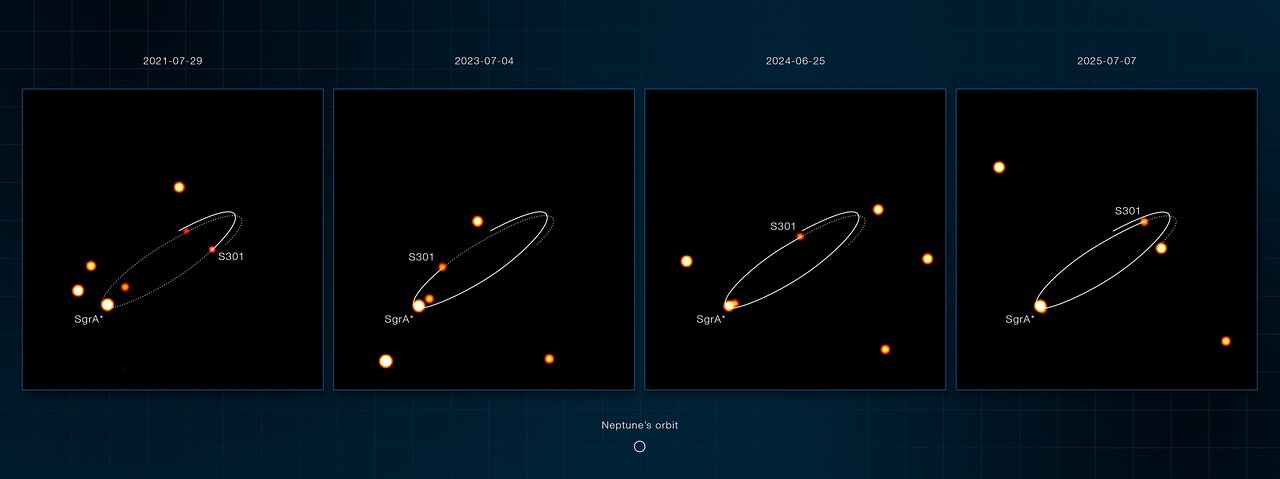
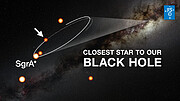
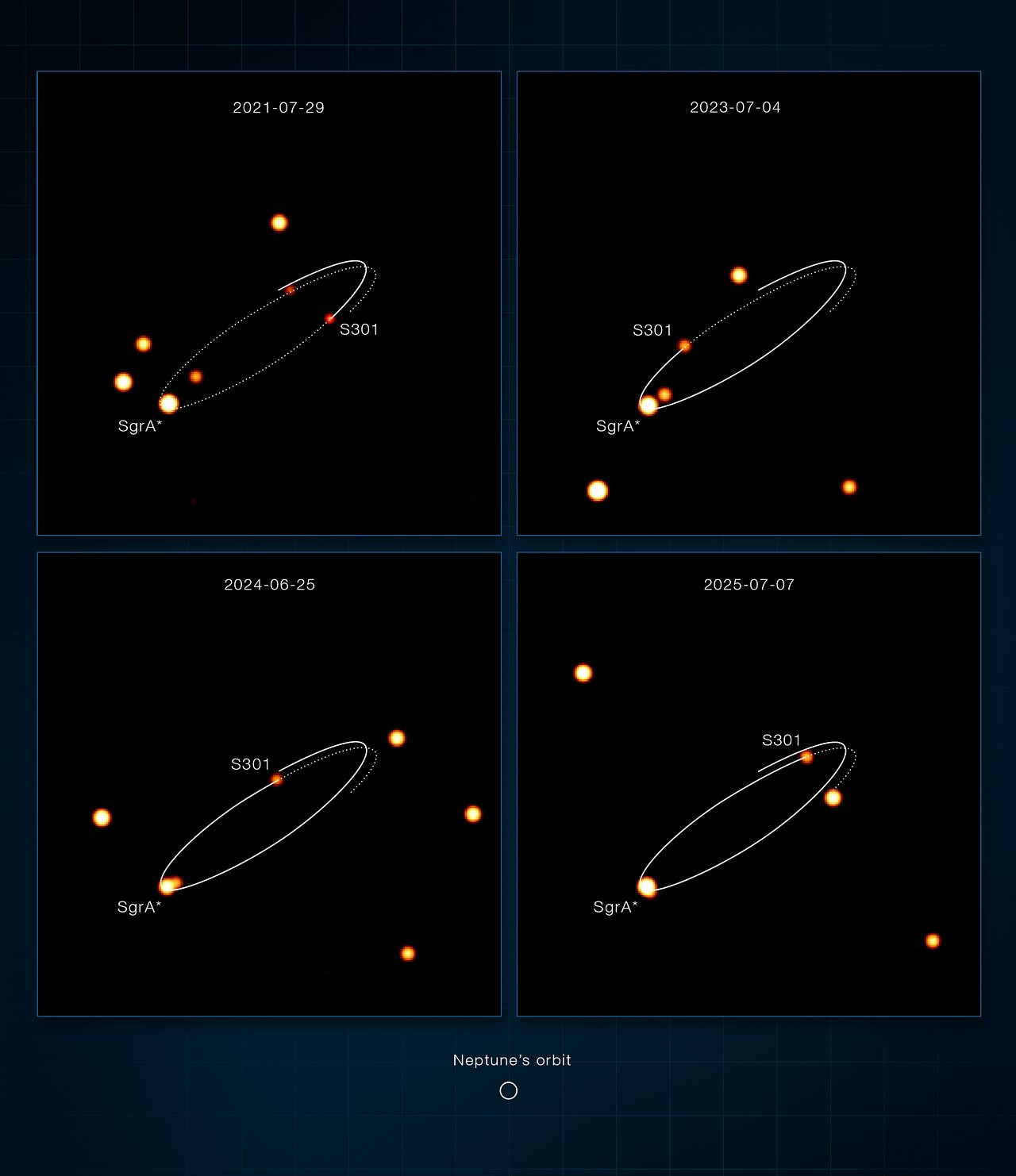
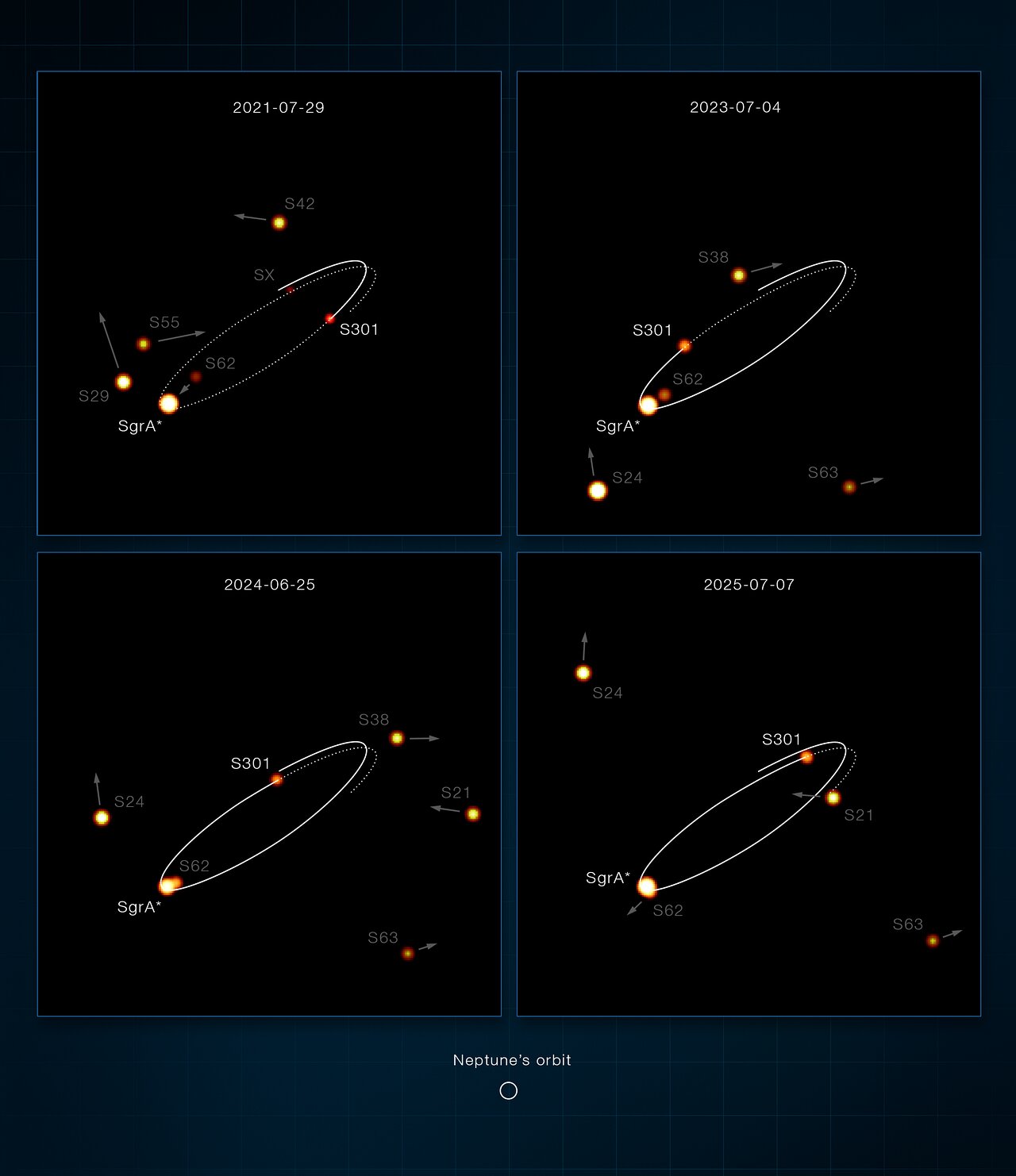
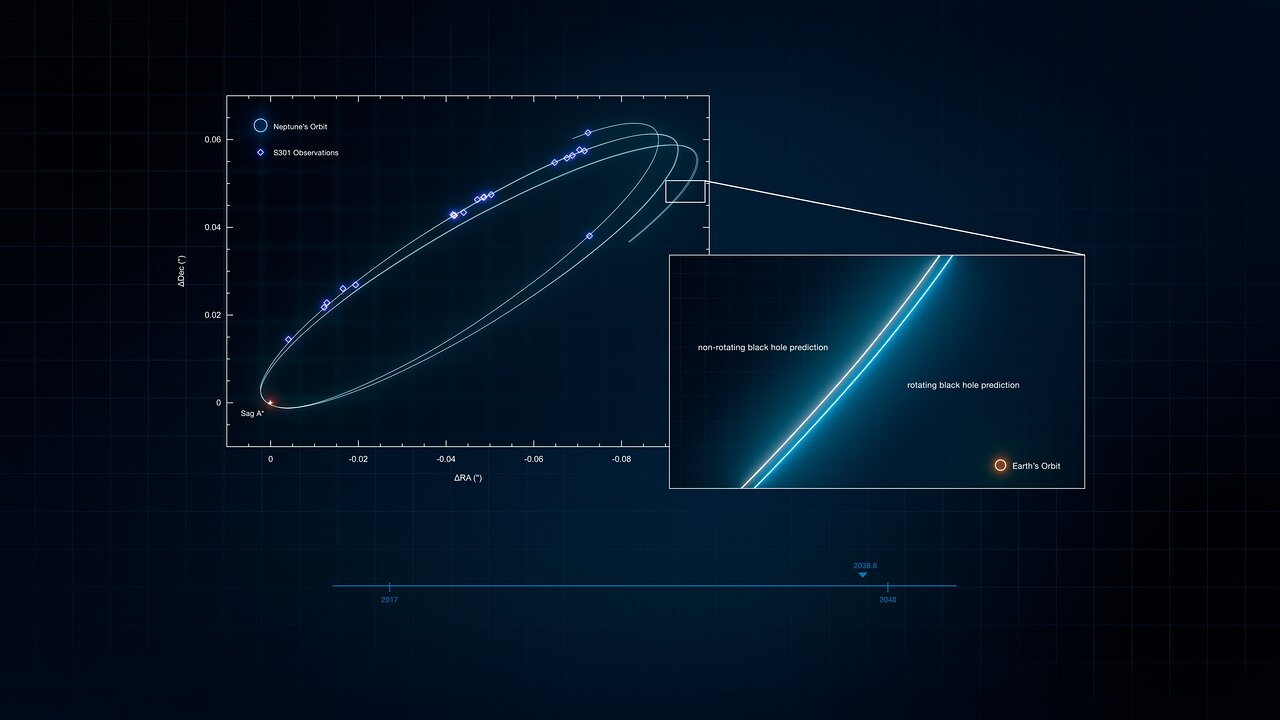
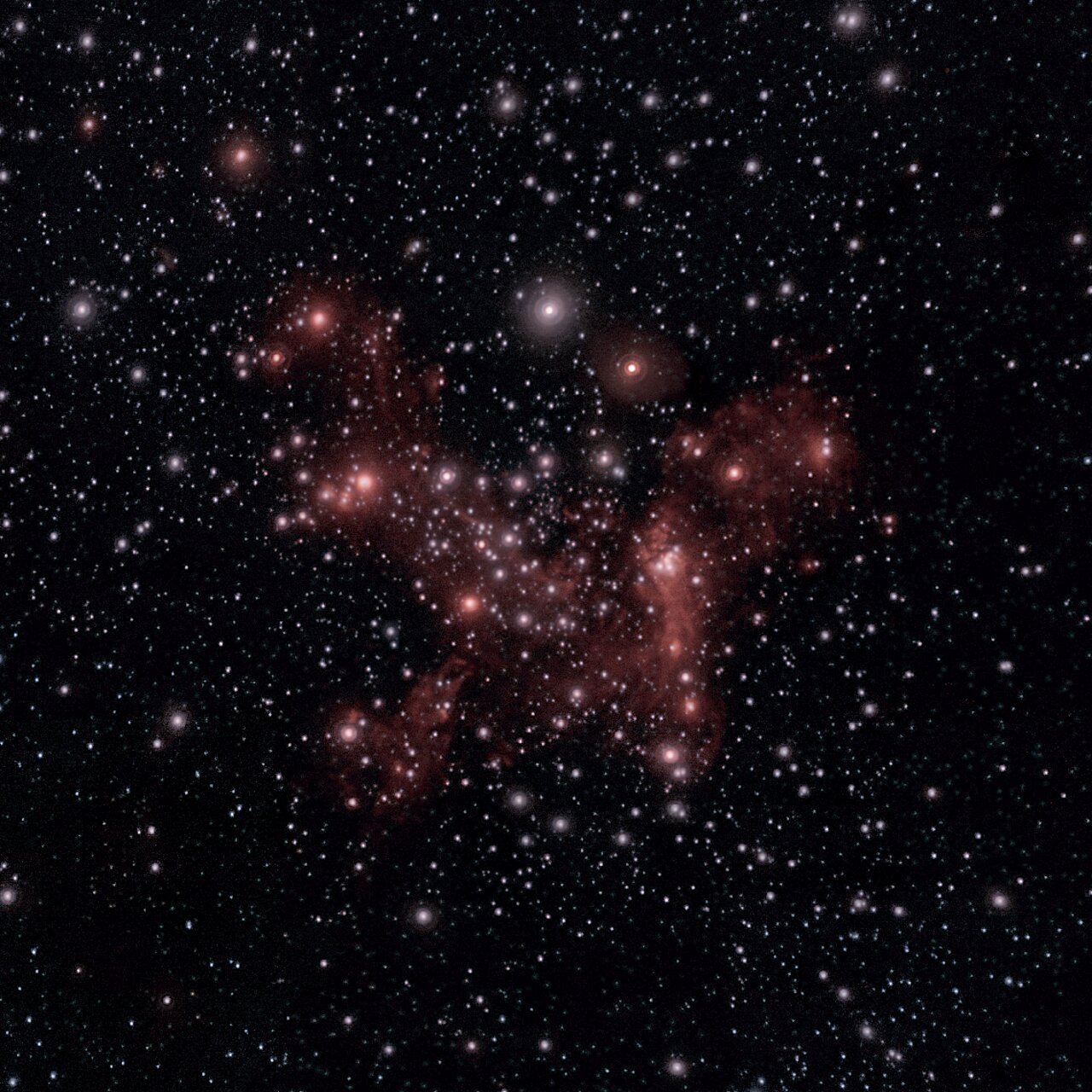
Gli astronomi hanno scoperto la stella più veloce finora nella nostra galassia, la Via Lattea, stella che orbita intorno al buco nero centrale. La stella, chiamata S301, è stata scoperta con il VLTI (Very Large Telescope Interferometer) dell'ESO (Osservatorio Europeo Australe) e raggiunge una velocità di 25.000 km/s girando intorno al buco nero da quattro milioni di masse solari. Si avvicina a esso più di qualsiasi altro oggetto osservato prima, così vicino da sentire gli effetti della rotazione del buco nero.
"Decenni di attento monitoraggio delle stelle in orbita intorno a Sagittarius A*, il buco nero centrale della nostra galassia, hanno portato a questa scoperta rivoluzionaria di una stella carica di promesse. Grazie all'orbita così vicina a Sagittarius A*, S301 apre una nuova finestra sulle proprietà fondamentali dello spaziotempo in questo ambiente estremo nei pressi del buco nero", afferma il premio Nobel Reinhard Genzel, direttore del Max Planck Institute for Extraterrestrial Physics (MPE) di Garching, in Germania, e membro fondatore della collaborazione che ha effettuato le nuove osservazioni.
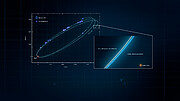
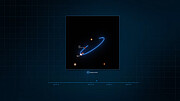
"La particolarità di questa stella è che orbita attorno a Sagittarius A* su un'orbita molto stretta, infatti impiega solo 8,7 anni per completarla, e si avvicina al buco nero a una distanza pari ad appena 12 volte quella tra la Terra e il Sole. È un cosa mai vista", aggiunge Felix Mang, dottorando presso l'MPE e primo autore dello studio pubblicato oggi su Nature.
Durante il suo passaggio più ravvicinato al buco nero, la stella viaggia a circa 25.000 chilometri al secondo, ovvero 100.000 volte più veloce di un aereo di linea, o anche oltre l'8% della velocità della luce, ottenendo il record di stella più veloce della Via Lattea. S301 inoltre si avvicina a Sagittarius A* più di qualsiasi altra stella osservata finora, fino a una distanza simile a quella tra Saturno e il Sole. [1] Proprio per la sua vicinanza a Sagittarius A*, S301 è la prima stella che conosciamo che potrebbe essere utilizzata per misurare direttamente la rotazione di un buco nero.
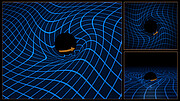
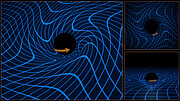
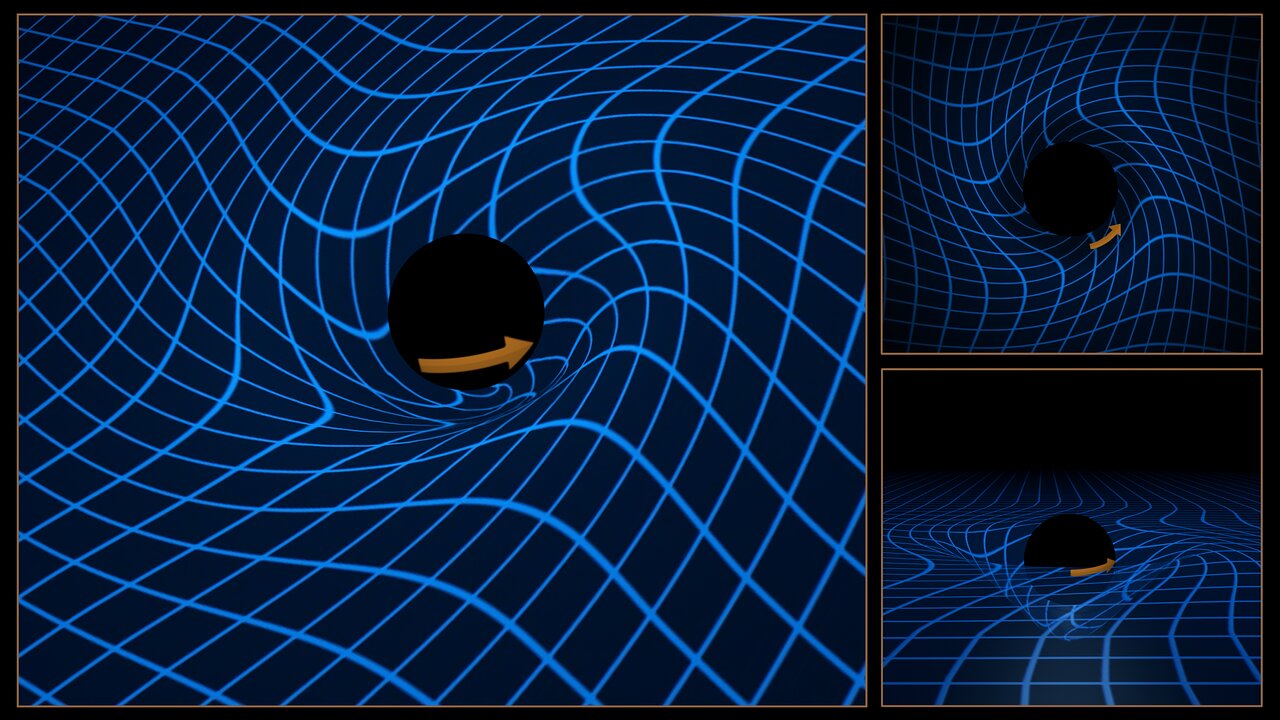
Come la maggior parte degli oggetti nell'Universo, gli astronomi prevedono che Sagittarius A* ruoti. Secondo la teoria della relatività generale di Einstein, un buco nero in rotazione trascina con sé lo spaziotempo e lo deforma, influenzando le orbite delle stelle circostanti. L'effetto è più marcato per gli oggetti che orbitano a distanza ravvicinata da buchi neri in rapida rotazione.
"Con questa stella speriamo di misurare, entro i prossimi 10 anni, la rotazione del buco nero", afferma Mang. Stefan Gillessen, ricercatore del MPE e figura di spicco del nuovo studio, aggiunge: "Per la prima volta, saremmo in grado di misurare direttamente la rotazione di un buco nero massiccio, il che rappresenterebbe un test fondamentale per la teoria di Einstein". Juan Osorno, astronomo del LIRA Observatoire de Paris–PSL, in Francia, anch'egli con un ruolo chiave nello studio, incalza: "Senza questa stella, avremmo bisogno di misurare il moto di altre stelle per diversi decenni per avvicinarci anche solo lontanamente alla misura della rotazione del buco nero".
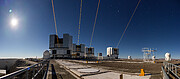
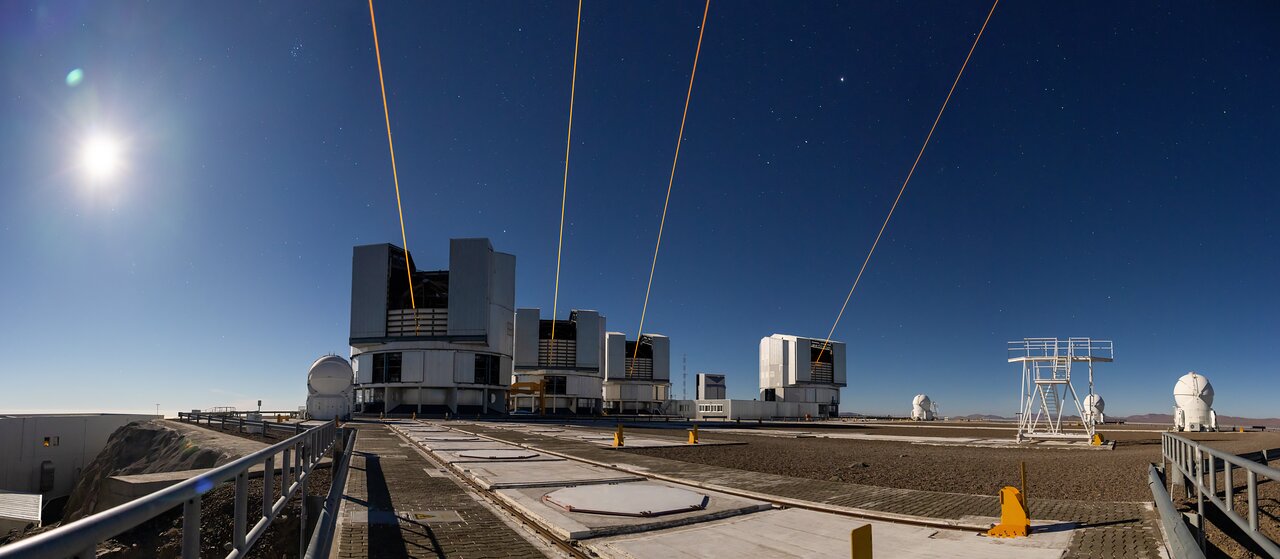
Trovare S301, che ci appare due miliardi di volte più debole di Betelgeuse (la stella arancione nella costellazione di Orione), non è stata un'impresa facile. L'equipe ha utilizzato il VLTI, strumento dell'Osservatorio del Paranal dell'ESO in Cile, equipaggiato con GRAVITY, ora noto come GRAVITY+ in seguito a un aggiornamento dell'infrastruttura. [2] Il punto di forza del VLTI risiede nella sua capacità di combinare la luce di quattro telescopi da 8 metri per creare un telescopio "virtuale" con una risoluzione spaziale 15 volte superiore a quella di un singolo telescopio da 8 metri.
"A livello mondiale, Paranal è l'unico luogo in cui è possibile effettuare questo tipo di osservazioni, perché nessun altro osservatorio al mondo possiede quattro telescopi da 8 metri che possano agire insieme come un interferometro", commenta il coautore Frank Eisenhauer, Responsabile Principale di GRAVITY+ e Direttore all'MPE.
Con GRAVITY, e successivamente con GRAVITY+, l'equipe è riuscita a gettare il primo sguardo sulla nuova stella nella primavera del 2023 e da allora l'ha seguita per determinarne l'orbita. Hanno inoltre potuto ricostruire la storia orbitale di S301 fino al 2017, scoprendo che l'ultimo avvicinamento al buco nero centrale risale all'inizio del 2023. Le proprietà orbitali di S301 e il fatto che le stelle non possano formarsi così vicino a un buco nero massiccio, indicano che la stella faceva probabilmente parte di un sistema binario che è stato disgregato dalle forze mareali di Sagittarius A*. In questo processo, S301 è rimasta intrappolata dalla gravità del buco nero, mentre la sua compagna è stata espulsa ad alta velocità, velocità probabilmente sufficiente a farla uscire completamente dalla galassia.
Le osservazioni di approfondimento realizzate con GRAVITY+ e con lo strumento MICADO che sarà installato sull'ELT (Extremely Large Telescope) dell'ESO saranno cruciali per tracciare la traiettoria di S301 nel prossimo decennio, in vista del prossimo passaggio ravvicinato previsto per il 2031. Osservare almeno due orbite complete di S301 permetterà di definirne la traiettoria con una precisione tale da consentire al gruppo di lavoro di determinare direttamente, per la prima volta, la rotazione di Sagittarius A*. "Sarebbe un sogno che si avvera", conclude Mang.
Note
[1] Nel punto di massimo avvicinamento, la stella passa a soli 1,78 miliardi di km dal buco nero, circa 12 volte la distanza Terra-Sole o appena il 20% in più della distanza Saturno-Sole.
[2] Dopo decenni di mappatura delle stelle in orbita intorno al centro della Via Lattea utilizzando diversi strumenti dell'ESO, a partire dal 2017 il gruppo ha utilizzato a questo scopo lo strumento GRAVITY del VLTI. Una serie di aggiornamenti, chiamati GRAVITY+, effettuati sia sullo strumento che sull'interferometro, sono stati implementati gradualmente negli ultimi anni e hanno permesso di individuare oggetti sempre più deboli.
Ulteriori Informazioni
Il risultato di questo studio è stato descritto nell'articolo della Collaborazione GRAVITY+ intitolato “Discovery of a star sensitive to the spin of Sgr A*” pubblicato su Nature (doi: 10.1038/s41586-026-10894-w).
L'equipe è composta da: K. Abd El Dayem (LIRA, Observatoire de Paris, Universitê PSL, CNRS, Sorbonne Université, Université de Paris, Francia), R. Abuter (European Southern Observatory, Garching, Germania [ESO Germania]), N. Aimar (Faculdade de Engenharia, Universidade do Porto, Portogallo [FEUP], e Centro de Astrofísica e Gravitação, IST, Universidade de Lisboa, Portogallo [CENTRA]), P. Amaro-Seoane (Universitat Politècnica de València, Spagna e Max Planck Institute for Extraterrestrial Physics, Garching, Germania [MPE]), A. Berdeu (ESO e LIRA), J. P. Berger (Univ. Grenoble Alpes, CNRS, Grenoble, Francia [IPAG]), G. Bourdarot (MPE), W. Brandner (Max Planck Institute for Astronomy, Heidelberg, Germania [MPIA]), A. Burkert (University Observatory, Faculty of Physics, Ludwig-Maximilians-Universität, Munich, Germany [LMU] and MPE), D. Calderon (Max Planck Institute for Astrophysics [MPA], Garching, Germania), C. Correia (FEUP e CENTRA), J. Cuadra (Universidad Adolfo Ibañez, Viña del Mar, Cile e Millennium Nucleus on Transversal Research and Technology to Explore Supermassive Black Holes [TITANS], Cile), R. Davies (MPE), D. Defrère (Institute of Astronomy, KU Leuven, Belgio [KU Leuven]), L. Delit (LIRA), A. Drescher (IPAG e MPE), F. Eisenhauer (MPE e Department of Physics, Technical University of Munich, Germania [TUM]), L. Esteras Otal (ESO Germania), M. Fabricius (MPE), H. Feuchtgruber (MPE), N. M. Förster Schreiber (MPE), A. Foschi (LIRA), P. Garcia (FEUP e CENTRA), R. Garcia Lopez (School of Physics, University College Dublin, Irlanda), A. Generozov Astronomy Dept. and Oden Institute, University of Texas at Austin, USA), R. Genzel (MPE e Departments of Physics & Astronomy, Le Conte Hall, University of California, Berkeley, USA) S. Gillessen (MPE), F. Gonté (ESO Germany), X. Haubois (European Southern Observatory, Santiago, Cile [ESO Cile]), S. F. Hönig (School of Physics & Astronomy, University of Southampton, Regno Unito [Southampton]), M. Houllé (IPAG), S. Joharle (MPE), A. Kaufer (ESO Cile), J. Kammerer (ESO Germania), P. Kervella (LIRA), J. Kolb (ESO Germania), L. Kreidberg (MPIA), R. Laugier (KU Leuven), S. Lacour (LIRA), O. Lai (Université Côte d’Azur, Observatoire de la Côte d’Azur, CNRS, Laboratoire Lagrange [Lagrange]), J.-B. Le Bouquin (IPAG), J. Leftley (Southampton) B. Lopez (Lagrange), D. Lutz (MPE), F. Mang (MPE and TUM), A. Mérand (ESO Germany), F. Millour (Lagrange), M. Montargès (LIRA), N. Morujão (FEUP e CENTRA), H. Nowacki (Lagrange), M. Nowak (LIRA), S. Oberti (ESO Germania), J. Osorno (LIRA), T. Ott (MPE), T. Paumard (LIRA), C. Paladini (ESO Cile), H. B. Perets (Physics department, Technion - Israel Institute of Technology, Haifa, Israele), K. Perraut (IPAG), G. Perrin (LIRA), R. Petrov (Lagrange) P. O. Petrucci (IPAG), T. Piran (Racah Institute of Physics, The Hebrew University of Jerusalem, Israel [Racah]), N. Pourré (IPAG), S. Rabien (MPE), D. C. Ribeiro (MPE), S. Robbe-Dubois (Lagrange), M. Sadun Bordoni (MPE), J. Sánchez Bermúdez (Instituto de Astronomía, National Autonomous University of Mexico, Messico), D. Santos (MPE), R. Sari (Racah), J. Sauter (MPIA), S. Scheithauer (MPIA), J. Scigliuto (Lagrange), J. Shangguan (MPE), T. T. Shimizu (MPE), F. Soulez (Univ. Lyon, Univ. Lyon 1, ENS de Lyon, CNRS, Centre de Recherche Astrophysique de Lyon, Francia), J. Stadler (LMU), C. Straubmeier (1st Institute of Physics, University of Cologne, Germania), E. Sturm (MPE), M. Subroweit (Cologne), C. Sykes (Southampton), L. J. Tacconi (MPE), P. Thévenet (LIRA), I. Urso (LIRA), F. Vincent (LIRA), J. Woillez (ESO Germania), e G. Zins (ESO Chile).
L'ESO (European Southern Observatory o Osservatorio Europeo Australe) consente agli scienziati di tutto il mondo di scoprire i segreti dell'Universo a beneficio di tutti. Progettiamo, costruiamo e gestiamo da terra osservatori di livello mondiale - che gli astronomi utilizzano per affrontare temi interessanti e diffondere il fascino dell'astronomia - e promuoviamo la collaborazione internazionale per l'astronomia. Fondato come organizzazione intergovernativa nel 1962, oggi l'ESO è sostenuto da 16 Stati membri (Austria, Belgio, Danimarca, Francia, Finlandia, Germania, Irlanda, Italia, Paesi Bassi, Polonia, Portogallo, Regno Unito, Repubblica Ceca, Spagna, Svezia e Svizzera), insime con il paese che ospita l'ESO, il Cile, e l'Australia come partner strategico. Il quartier generale dell'ESO e il Planetario e Centro Visite Supernova dell'ESO si trovano vicino a Monaco, in Germania, mentre il deserto cileno di Atacama, un luogo meraviglioso con condizioni uniche per osservare il cielo, ospita i nostri telescopi. L'ESO gestisce tre siti osservativi: La Silla, Paranal e Chajnantor. Sul Paranal, l’ESO gestisce il VLT (Very Large Telescope) e il VLTI (Very Large Telescope Interferometer), così come due telescopi per survey, VISTA, che lavora nell'infrarosso, e VST (VLT Survey Telescope) in luce visibile. Sempre a Paranal l'ESO ospiterà e gestirà la schiera meridionale di telescopi di CTA, il Cherenkov Telescope Array Sud, il più grande e sensibile osservatorio di raggi gamma del mondo. Insieme con partner internazionali, l’ESO gestisce APEX e ALMA a Chajnantor, due strutture che osservano il cielo nella banda millimetrica e submillimetrica. A Cerro Armazones, vicino a Paranal, stiamo costruendo "il più grande occhio del mondo rivolto al cielo" - l'ELT (Extremely Large Telescope, che significa Telescopio Estremamente Grande) dell'ESO. Dai nostri uffici di Santiago, in Cile, sosteniamo le operazioni nel paese e collaboriamo con i nostri partner e la società cileni.
La traduzione dall'inglese dei comunicati stampa dell'ESO è un servizio dalla Rete di Divulgazione Scientifica dell'ESO (ESON: ESO Science Outreach Network) composta da ricercatori e divulgatori scientifici da tutti gli Stati Membri dell'ESO e altri paesi. Il nodo italiano della rete ESON è gestito da Anna Wolter.
Links
- Articolo scientifico
- Fotografie del VLT/I
- Scoprite ulteriori informazioni sull'ELT (Extremely Large Telescope) dell'ESO's sul sito dedicato e nella cartella stampa
- Per i giornalisti: iscrivetevi per ricevere i nostri comunicati sotto embargo nella vostra lingua
- Per i ricercatori: avete una storia da raccontare? Promuovete il vostro articolo scientifico
Contatti
Felix Mang
Max Planck Institute for Extraterrestrial Physics
Garching bei München, Germany
Tel.: +49 89 30000-3713
E-mail: fmang@mpe.mpg.de
Stefan Gillessen
Max Planck Institute for Extraterrestrial Physics
Garching bei München, Germany
Tel.: +49 89 30000 3839
Cell.: +49 176 99 66 41 39
E-mail: ste@mpe.mpg.de
Juan Osorno
Laboratory for Instrumentation and Research in Astrophysics (LIRA), Observatoire de Paris, PSL University
Meudon, France
E-mail: Juan.Osorno@observatoiredeparis.psl.eu
Frank Eisenhauer
Director, Max Planck Institute for Extraterrestrial Physics
Garching bei München, Germany
Tel.: +49 89 30000-3100
E-mail: eisenhau@mpe.mpg.de
Reinhard Genzel
Director, Max Planck Institute for Extraterrestrial Physics
Garching bei München, Germany
Tel.: +49 89 30000 3281
E-mail: genzel@mpe.mpg.de
Xavier Haubois (for questions on VLTI)
European Southern Observatory
Paranal Observatory, Atacama Desert, Chile
E-mail: Xavier.Haubois@eso.org
Bárbara Ferreira
ESO Media Manager
Garching bei München, Germany
Tel.: +49 89 3200 6670 (unavailable before 17 August)
Cell.: +49 151 241 664 00 (unavailable before 17 August)
E-mail: press@eso.org
Anna Wolter (press contact Italia)
Rete di divulgazione scientifica dell'ESO
e INAF-Osservatorio Astronomico di Brera
Milano, Italy
Tel.: +39 02 72320321
E-mail: eson-italy@eso.org
Sul Comunicato Stampa
| Comunicato Stampa N": | eso2612it |
| Nome: | S301, Sagittarius A* |
| Tipo: | Milky Way : Galaxy : Component : Central Black Hole |
| Facility: | Very Large Telescope Interferometer |
| Instruments: | GRAVITY+ |
| Science data: | 2026Natur.657..359A |
Immagini
soltanto in inglese
soltanto in inglese
soltanto in inglese


Video
soltanto in inglese


Our use of Cookies
We use cookies that are essential for accessing our websites and using our services. We also use cookies to analyse, measure and improve our websites’ performance, to enable content sharing via social media and to display media content hosted on third-party platforms.
ESO Cookies Policy
The European Organisation for Astronomical Research in the Southern Hemisphere (ESO) is the pre-eminent intergovernmental science and technology organisation in astronomy. It carries out an ambitious programme focused on the design, construction and operation of powerful ground-based observing facilities for astronomy.
This Cookies Policy is intended to provide clarity by outlining the cookies used on the ESO public websites, their functions, the options you have for controlling them, and the ways you can contact us for additional details.
What are cookies?
Cookies are small pieces of data stored on your device by websites you visit. They serve various purposes, such as remembering login credentials and preferences and enhance your browsing experience.
Categories of cookies we use
Essential cookies (always active): These cookies are strictly necessary for the proper functioning of our website. Without these cookies, the website cannot operate correctly, and certain services, such as logging in or accessing secure areas, may not be available; because they are essential for the website’s operation, they cannot be disabled.
Functional Cookies: These cookies enhance your browsing experience by enabling additional features and personalization, such as remembering your preferences and settings. While not strictly necessary for the website to function, they improve usability and convenience; these cookies are only placed if you provide your consent.
Analytics cookies: These cookies collect information about how visitors interact with our website, such as which pages are visited most often and how users navigate the site. This data helps us improve website performance, optimize content, and enhance the user experience; these cookies are only placed if you provide your consent. We use the following analytics cookies.
Matomo Cookies:
This website uses Matomo (formerly Piwik), an open source software which enables the statistical analysis of website visits. Matomo uses cookies (text files) which are saved on your computer and which allow us to analyze how you use our website. The website user information generated by the cookies will only be saved on the servers of our IT Department. We use this information to analyze www.eso.org visits and to prepare reports on website activities. These data will not be disclosed to third parties.
On behalf of ESO, Matomo will use this information for the purpose of evaluating your use of the website, compiling reports on website activity and providing other services relating to website activity and internet usage.
Matomo cookies settings:
Additional Third-party cookies on ESO websites: some of our pages display content from external providers, e.g. YouTube.
Such third-party services are outside of ESO control and may, at any time, change their terms of service, use of cookies, etc.
YouTube: Some videos on the ESO website are embedded from ESO’s official YouTube channel. We have enabled YouTube’s privacy-enhanced mode, meaning that no cookies are set unless the user actively clicks on the video to play it. Additionally, in this mode, YouTube does not store any personally identifiable cookie data for embedded video playbacks. For more details, please refer to YouTube’s embedding videos information page.
Cookies can also be classified based on the following elements.
Regarding the domain, there are:
- First-party cookies, set by the website you are currently visiting. They are stored by the same domain that you are browsing and are used to enhance your experience on that site;
- Third-party cookies, set by a domain other than the one you are currently visiting.
As for their duration, cookies can be:
- Browser-session cookies, which are deleted when the user closes the browser;
- Stored cookies, which stay on the user's device for a predetermined period of time.
How to manage cookies
Cookie settings: You can modify your cookie choices for the ESO webpages at any time by clicking on the link Cookie settings at the bottom of any page.
In your browser: If you wish to delete cookies or instruct your browser to delete or block cookies by default, please visit the help pages of your browser:
Please be aware that if you delete or decline cookies, certain functionalities of our website may be not be available and your browsing experience may be affected.
You can set most browsers to prevent any cookies being placed on your device, but you may then have to manually adjust some preferences every time you visit a site/page. And some services and functionalities may not work properly at all (e.g. profile logging-in, shop check out).
Updates to the ESO Cookies Policy
The ESO Cookies Policy may be subject to future updates, which will be made available on this page.
Additional information
For any queries related to cookies, please contact: pdprATesoDOTorg.
As ESO public webpages are managed by our Department of Communication, your questions will be dealt with the support of the said Department.