Mededeling
Nieuw SOXS-instrument klaar om vluchtige kosmische gebeurtenissen waar te nemen
16 december 2025

De nieuwe spectrograaf SOXS (Son Of X-Shooter) heeft met succes zijn eerste waarnemingen gedaan vanaf de ESO-sterrenwacht op La Silla. SOXS kan flexibel en snel worden ingezet voor waarnemingen van tijdgevoelige astronomische gebeurtenissen, zoals gammaflitsen, supernova’s en planetoïden die dicht langs de aarde scheren.
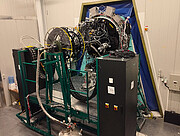
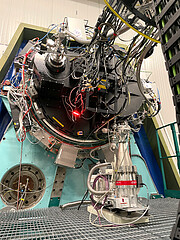
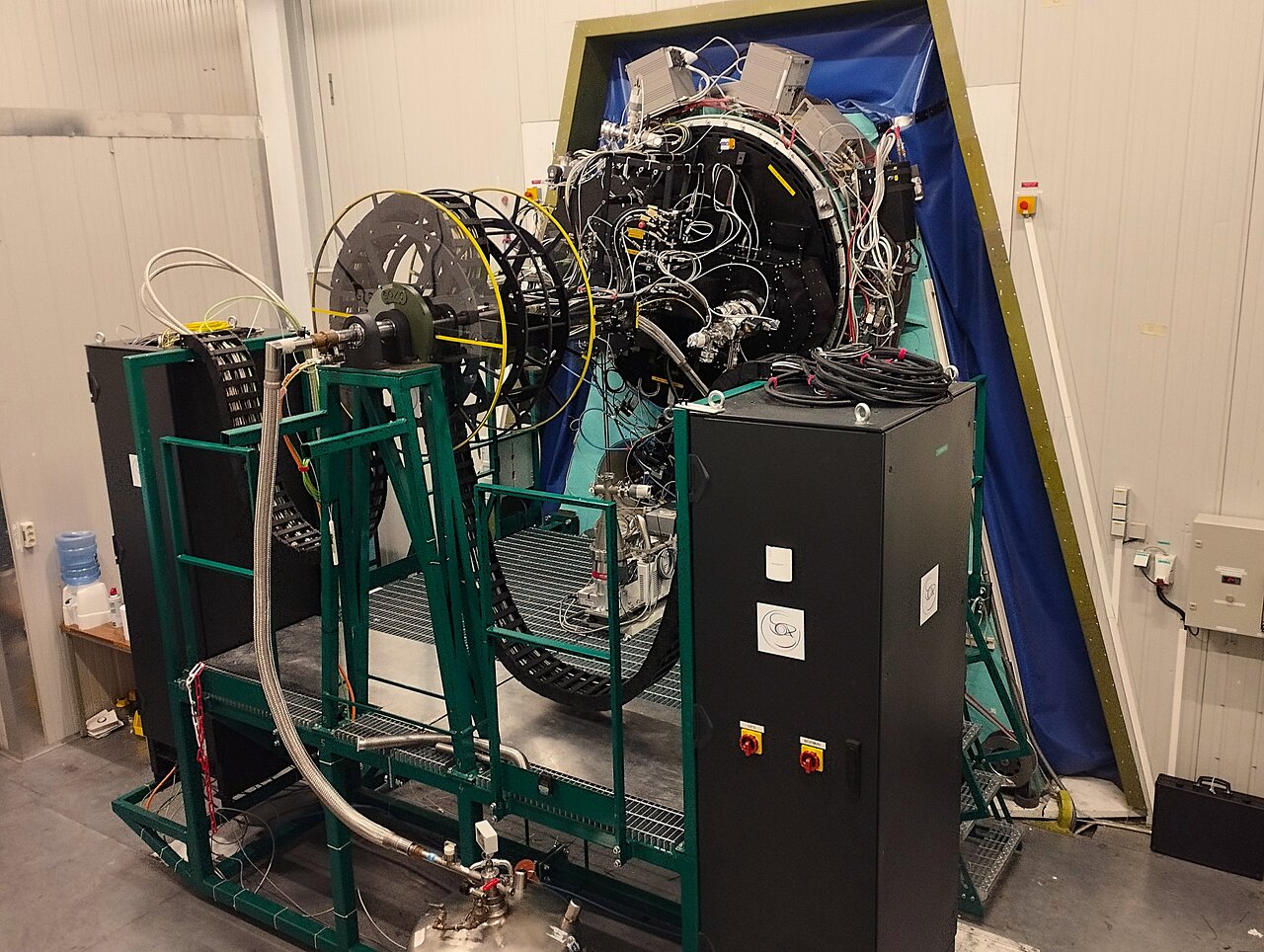
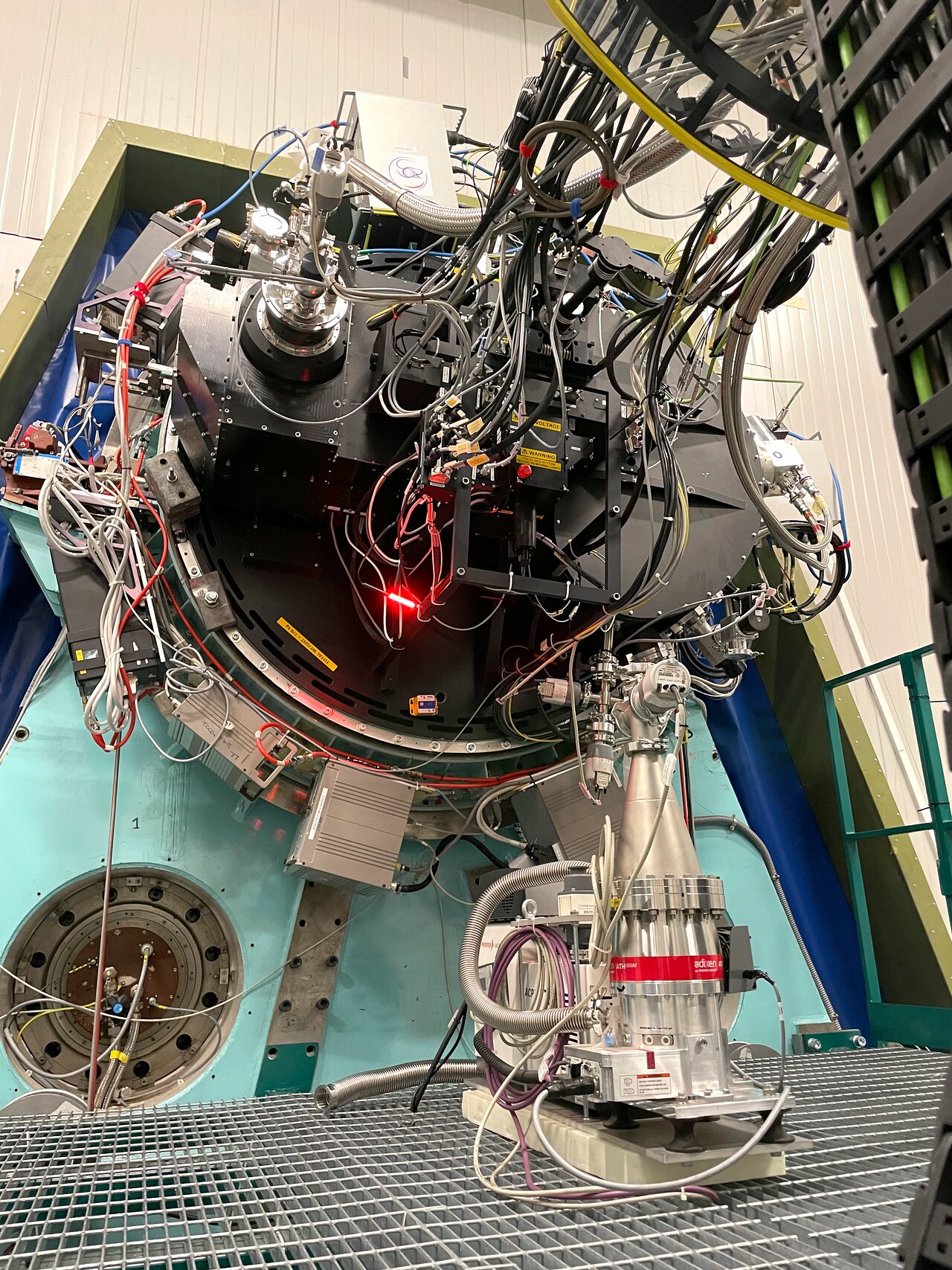
SOXS, die gekoppeld is aan de 3,58 meter New Technology Telescope (NTT, zie bijgaande foto) van ESO, is een unieke spectrograaf die kan worden ingezet om kortstondige kosmische gebeurtenissen waar te nemen, zowel op grote afstand als dichter bij huis. Hij is ontworpen om tegelijkertijd op zowel optische als nabij-infrarode golflengten te kijken en is gebaseerd op het X-shooter-instrument dat momenteel in gebruik is op ESO’s Very Large Telescope.
‘SOXS is tien jaar geleden bedacht met het oog op wat tegenwoordig tijddomein-astronomie wordt genoemd’, zegt hoofdonderzoeker Sergio Campana van de Brera-sterrenwacht, onderdeel van het Italiaanse Nationale Instituut voor Astrofysica (INAF). ‘Na jaren van hard werken zijn we nu in staat om een belangrijke rol te spelen in het onderzoek van zogeheten transients.’
Transients zijn astronomische verschijnselen die vrij plotseling verschijnen of van helderheid en/of uiterlijk veranderen. Hieronder vallen supernova-explosies, sterren die uit elkaar worden getrokken door superzware zwarte gaten, uitbarstingen van gammastraling in het verre heelal en snel bewegende planetoïden in ons zonnestelsel, die allemaal door SOXS zullen worden bestudeerd. Net als X-shooter op de VLT heeft het instrument een breed scala aan toepassingen, maar SOXS is specifiek ontworpen om vervolgwaarnemingen te doen van transients die op groothoekopnamen zijn ontdekt of te reageren op actuele meldingen vanuit de astronomische gemeenschap.
Omdat transients slechts een fractie van een seconde duren, soms zelfs maar enkele milliseconden, is het van cruciaal belang dat ontdekkingen van deze kosmische verschijnselen binnen enkele minuten of uren worden gevolgd met speciale instrumenten. De aard van deze objecten verandert ook in de loop van de tijd, soms zelfs drastisch. Om deze veranderingen te bestuderen en te begrijpen, hebben astronomen behoefte aan ononderbroken waarneemtijd op een speciaal voor dit doel gereserveerd instrument – iets wat niet vaak beschikbaar is gezien de grote vraag naar waarneemtijd op professionele telescopen. SOXS zal deze leemte opvullen en zorgen voor een ongekende continue registratie van deze ongrijpbare, maar fascinerende astronomische objecten.
‘De inzet van een middelgrote telescoop zoals de NTT voor een specifieke taak, zoals het opsporen van transiënts, is de sleutel tot succes’, zegt SOXS-projectmanager Pietro Schipani van de Capodimonte-sterrenwacht van INAF. ‘We zijn erg trots op de mensen die al vele jaren werken om onze droom waar te maken.’
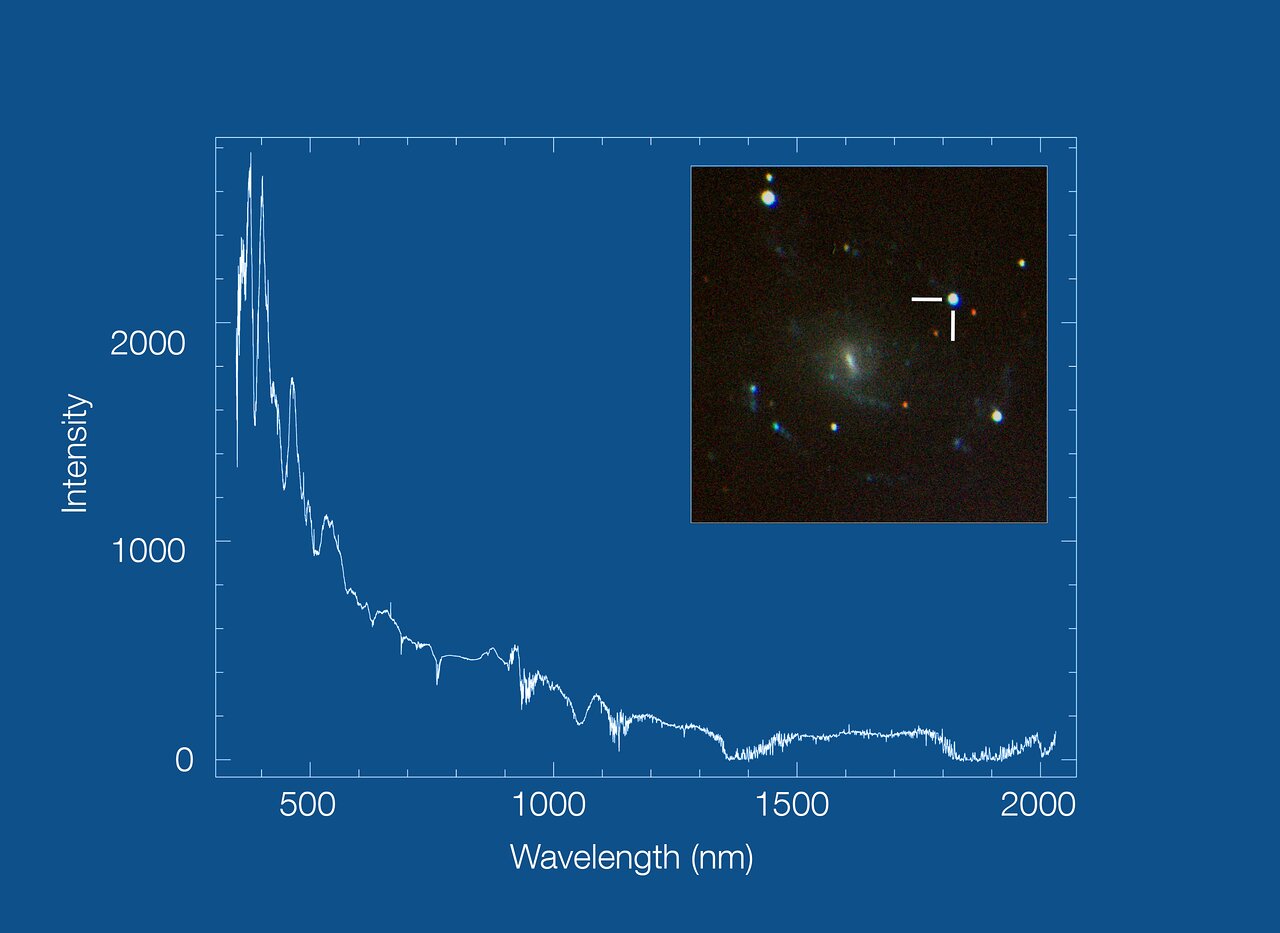
SOXS vervangt de twee vorige spectrografen van de NTT, SOFI (Son of Isaac) en EFOSC2 (ESO Faint Object Spectrograph and Camera 2). ‘In feite zijn het twee instrumenten in één’, zegt SOXS-instrument-wetenschapper Paolo D'Avanzo van INAF-Brera, ‘met een dubbele spectrograaf die is ontworpen om het hele optische en nabij-infrarode golflengte-bereik in één keer te bestrijken, waardoor de efficiëntie van de NTT aanzienlijk wordt vergroot.’ Dit apparaat werkt op dezelfde manier als een prisma dat licht splitst, waardoor astronomen de kenmerken van de waargenomen gebeurtenissen kunnen ontsluieren, zoals de chemische samenstelling of de afstand tot de bron. Bovendien maakt het ook waarnemingen in beeldmodus in het optische bereik mogelijk. Het instrument bevindt zich momenteel in de laatste testfase bij de telescoop onder toezicht van het ESO-team, in afwachting van de start van de wetenschappelijke waarnemingen van zowel het consortium als de bredere ESO-gemeenschap.
Meer informatie
Het SOXS consortium bestaat uit:
- Italië: INAF (Osservatorio astronomico di Brera, Osservatorio astronomico di Capodimonte, Osservatorio astronomico di Padova, Osservatorio astronomico di Catania, Osservatorio astronomico di Roma and Fundación Galileo Galilei) — consortium-leider.
- Israël: Het Weizmann-Instituut en de Universiteit van Tel Aviv.
- VK: Queen’s Universiteit van Belfast en de Universiteit van Oxford
- Finland: Universiteit van Turku en het Finse Centrum voor Astronomie met ESO (FINCA).
- Chili: Millennium Institute of Astrophysics
- Denemarken: Het Niels Bohr Instituut en de Universiteit van Aarhus
Links
- Always ready: how the new SOXS instrument will capture fleeting events (ESO blogpost)
- Meer algemene informatie over SOXS
- Meer technische informatie over SOXS
- Afbeeldingen met betrekking tot de New Technology Telescope
- Voor wetenschappers: report on SOXS Day, een evenement om het SOXS-instrument en de wetenschappelijke mogelijkheden ervan aan de gemeenschap te presenteren (SOXS Day-website)
Over de Mededeling
| Id: | ann25011 |
Afbeeldingen

Our use of Cookies
We use cookies that are essential for accessing our websites and using our services. We also use cookies to analyse, measure and improve our websites’ performance, to enable content sharing via social media and to display media content hosted on third-party platforms.
ESO Cookies Policy
The European Organisation for Astronomical Research in the Southern Hemisphere (ESO) is the pre-eminent intergovernmental science and technology organisation in astronomy. It carries out an ambitious programme focused on the design, construction and operation of powerful ground-based observing facilities for astronomy.
This Cookies Policy is intended to provide clarity by outlining the cookies used on the ESO public websites, their functions, the options you have for controlling them, and the ways you can contact us for additional details.
What are cookies?
Cookies are small pieces of data stored on your device by websites you visit. They serve various purposes, such as remembering login credentials and preferences and enhance your browsing experience.
Categories of cookies we use
Essential cookies (always active): These cookies are strictly necessary for the proper functioning of our website. Without these cookies, the website cannot operate correctly, and certain services, such as logging in or accessing secure areas, may not be available; because they are essential for the website’s operation, they cannot be disabled.
Functional Cookies: These cookies enhance your browsing experience by enabling additional features and personalization, such as remembering your preferences and settings. While not strictly necessary for the website to function, they improve usability and convenience; these cookies are only placed if you provide your consent.
Analytics cookies: These cookies collect information about how visitors interact with our website, such as which pages are visited most often and how users navigate the site. This data helps us improve website performance, optimize content, and enhance the user experience; these cookies are only placed if you provide your consent. We use the following analytics cookies.
Matomo Cookies:
This website uses Matomo (formerly Piwik), an open source software which enables the statistical analysis of website visits. Matomo uses cookies (text files) which are saved on your computer and which allow us to analyze how you use our website. The website user information generated by the cookies will only be saved on the servers of our IT Department. We use this information to analyze www.eso.org visits and to prepare reports on website activities. These data will not be disclosed to third parties.
On behalf of ESO, Matomo will use this information for the purpose of evaluating your use of the website, compiling reports on website activity and providing other services relating to website activity and internet usage.
Matomo cookies settings:
Additional Third-party cookies on ESO websites: some of our pages display content from external providers, e.g. YouTube.
Such third-party services are outside of ESO control and may, at any time, change their terms of service, use of cookies, etc.
YouTube: Some videos on the ESO website are embedded from ESO’s official YouTube channel. We have enabled YouTube’s privacy-enhanced mode, meaning that no cookies are set unless the user actively clicks on the video to play it. Additionally, in this mode, YouTube does not store any personally identifiable cookie data for embedded video playbacks. For more details, please refer to YouTube’s embedding videos information page.
Cookies can also be classified based on the following elements.
Regarding the domain, there are:
- First-party cookies, set by the website you are currently visiting. They are stored by the same domain that you are browsing and are used to enhance your experience on that site;
- Third-party cookies, set by a domain other than the one you are currently visiting.
As for their duration, cookies can be:
- Browser-session cookies, which are deleted when the user closes the browser;
- Stored cookies, which stay on the user's device for a predetermined period of time.
How to manage cookies
Cookie settings: You can modify your cookie choices for the ESO webpages at any time by clicking on the link Cookie settings at the bottom of any page.
In your browser: If you wish to delete cookies or instruct your browser to delete or block cookies by default, please visit the help pages of your browser:
Please be aware that if you delete or decline cookies, certain functionalities of our website may be not be available and your browsing experience may be affected.
You can set most browsers to prevent any cookies being placed on your device, but you may then have to manually adjust some preferences every time you visit a site/page. And some services and functionalities may not work properly at all (e.g. profile logging-in, shop check out).
Updates to the ESO Cookies Policy
The ESO Cookies Policy may be subject to future updates, which will be made available on this page.
Additional information
For any queries related to cookies, please contact: pdprATesoDOTorg.
As ESO public webpages are managed by our Department of Communication, your questions will be dealt with the support of the said Department.