Mededeling
ALMA-upgrade: ESO tekent contract voor een geavanceerde processor
24 augustus 2026
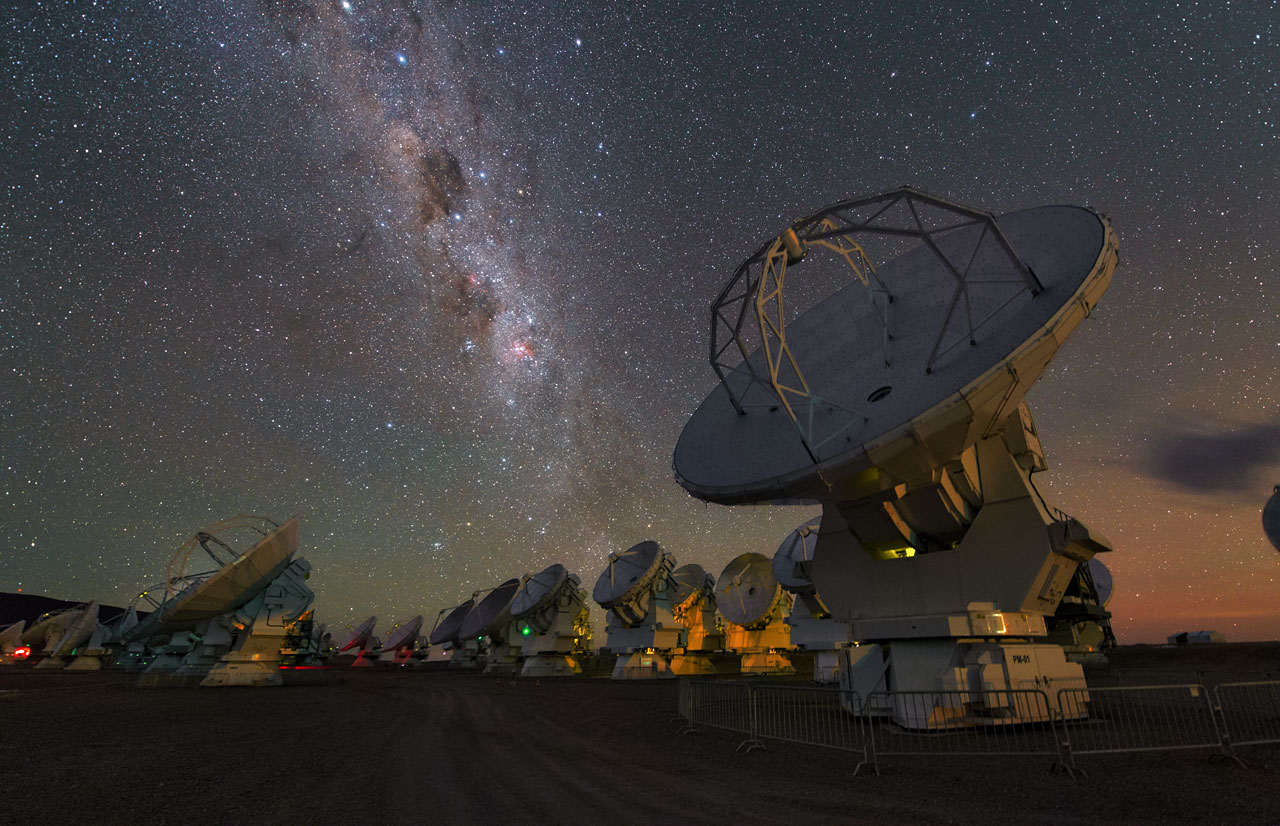
Vorige week heeft ESO, tijdens een virtuele ceremonie, een overeenkomst ondertekend met het Franse Nationaal Centrum voor Wetenschappelijk Onderzoek (CNRS) voor de ontwikkeling van een breedband-tussenfrequentieprocessor (WIFP) voor de Atacama Large Millimeter/submillimeter Array
(ALMA). De ceremonie werd bijgewoond door Eric Villard van ESO, Martin Zwaan van het ALMA-ontwikkelingsteam bij ESO, en Europees ALMA-programmamanager Elizabeth Humphreys. Vanuit Bordeaux (Frankrijk) waren Sean Raymond, Benoit Lavraud en Benjamin Quertier-Dagorn bij de ondertekening aanwezig, evenals Álvaro González, de adjunct-directeur ontwikkeling van ALMA, die werkzaam is bij het Joint ALMA Observatory in Chili.
ALMA is gestationeerd in de Atacama-woestijn in Chili, en ondergaat momenteel een ingrijpende modernisering – de zogeheten ‘Wideband Sensitivity Upgrade’ Deze heeft tot doel om het observatorium op technologisch topniveau te houden. De upgrade omvat de meest uiteenlopende onderdelen van het observatorium, van aanpassingen aan de elektronica in de 66 antennes tot wijzigingen in de correlator (de supercomputer waarin de signalen van de antennes worden samengevoegd) en de glasvezelsystemen. De upgrade zal de bandbreedte van ALMA – dat wil zeggen het frequentiebereik waarin het gelijktijdig waarnemingen kan doen – in eerste instantie verdubbelen, en na voltooiing verviervoudigen. Ook zal de gevoeligheid van ALMA aanzienlijk verbeteren, waardoor astronomen sneller zwakkere en verder weg gelegen objecten kunnen onderzoeken.
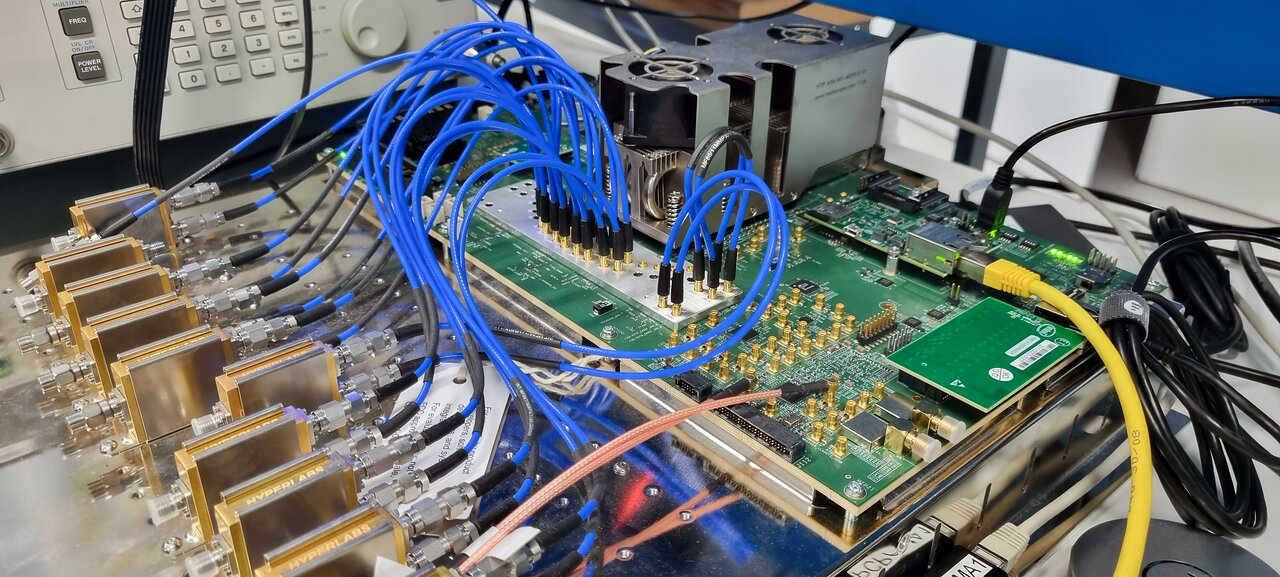
De ALMA-antennes ontvangen signalen uit het heelal op golflengten in het millimeter- en submillimeterbereik, wat overeenkomt met frequenties van tientallen gigahertz tot één terahertz. Omdat deze frequenties zeer hoog zijn, worden ze omgezet naar lagere ‘tussenfrequenties’ die gemakkelijker kunnen worden verwerkt. Het WIFP-project heeft tot doel de apparatuur te ontwikkelen en te leveren die nodig is om de analoge IF-signalen van de antennes te digitaliseren en voor te bereiden voor hun overdracht naar de correlator, waar de signalen worden gecombineerd. Het WIFP is daarom een cruciaal onderdeel van de Wideband Sensitivity Upgrade.
Als Europese partner in ALMA is ESO verantwoordelijk voor een aanzienlijk deel van de upgrade. Het WIFP-project is een van de belangrijkste Europese bijdragen aan de upgrade. Het zal elke ALMA-antenne voorzien van digitalisering van de ontvangstsignalen, digitale signaalverwerking en uiterst nauwkeurige time stamps (een reeks tekens die, tot op een fractie van een seconde aangeeft wanneer een bepaalde gebeurtenis plaatsvond).In vergelijking met het bestaande systeem zal het signaal worden bemonsterd met een frequentie van 40 miljard samples per seconde – tien keer zoveel als nu het geval is.
Al met al zal de WIFP de gegevensdoorvoer en de observatie-efficiëntie van ALMA aanzienlijk verbeteren. Het eindresultaat zal vergelijkbaar zijn met het toevoegen van zes extra antennes. De processor wordt ontwikkeld in samenwerking tussen ESO en het Laboratoire d’Astrophysique de Bordeaux (Frankrijk), dat deel uitmaakt van de Universiteit van Bordeaux en het CNRS, en zal naar verwachting medio 2028 gereed zijn.
Meer informatie
ALMA is een samenwerkingsverband tussen ESO (namens haar lidstaten), NSF (VS) en NINS (Japan), samen met NRC (Canada), NSTC en ASIAA (Taiwan) en KASI (Republiek Korea), in samenwerking met de Republiek Chili. Het Joint ALMA Observatory wordt beheerd door ESO, AUI/NRAO en NAOJ.
Links
Over de Mededeling
| Id: | ann26005 |
Afbeeldingen



Our use of Cookies
We use cookies that are essential for accessing our websites and using our services. We also use cookies to analyse, measure and improve our websites’ performance, to enable content sharing via social media and to display media content hosted on third-party platforms.
ESO Cookies Policy
The European Organisation for Astronomical Research in the Southern Hemisphere (ESO) is the pre-eminent intergovernmental science and technology organisation in astronomy. It carries out an ambitious programme focused on the design, construction and operation of powerful ground-based observing facilities for astronomy.
This Cookies Policy is intended to provide clarity by outlining the cookies used on the ESO public websites, their functions, the options you have for controlling them, and the ways you can contact us for additional details.
What are cookies?
Cookies are small pieces of data stored on your device by websites you visit. They serve various purposes, such as remembering login credentials and preferences and enhance your browsing experience.
Categories of cookies we use
Essential cookies (always active): These cookies are strictly necessary for the proper functioning of our website. Without these cookies, the website cannot operate correctly, and certain services, such as logging in or accessing secure areas, may not be available; because they are essential for the website’s operation, they cannot be disabled.
Functional Cookies: These cookies enhance your browsing experience by enabling additional features and personalization, such as remembering your preferences and settings. While not strictly necessary for the website to function, they improve usability and convenience; these cookies are only placed if you provide your consent.
Analytics cookies: These cookies collect information about how visitors interact with our website, such as which pages are visited most often and how users navigate the site. This data helps us improve website performance, optimize content, and enhance the user experience; these cookies are only placed if you provide your consent. We use the following analytics cookies.
Matomo Cookies:
This website uses Matomo (formerly Piwik), an open source software which enables the statistical analysis of website visits. Matomo uses cookies (text files) which are saved on your computer and which allow us to analyze how you use our website. The website user information generated by the cookies will only be saved on the servers of our IT Department. We use this information to analyze www.eso.org visits and to prepare reports on website activities. These data will not be disclosed to third parties.
On behalf of ESO, Matomo will use this information for the purpose of evaluating your use of the website, compiling reports on website activity and providing other services relating to website activity and internet usage.
Matomo cookies settings:
Additional Third-party cookies on ESO websites: some of our pages display content from external providers, e.g. YouTube.
Such third-party services are outside of ESO control and may, at any time, change their terms of service, use of cookies, etc.
YouTube: Some videos on the ESO website are embedded from ESO’s official YouTube channel. We have enabled YouTube’s privacy-enhanced mode, meaning that no cookies are set unless the user actively clicks on the video to play it. Additionally, in this mode, YouTube does not store any personally identifiable cookie data for embedded video playbacks. For more details, please refer to YouTube’s embedding videos information page.
Cookies can also be classified based on the following elements.
Regarding the domain, there are:
- First-party cookies, set by the website you are currently visiting. They are stored by the same domain that you are browsing and are used to enhance your experience on that site;
- Third-party cookies, set by a domain other than the one you are currently visiting.
As for their duration, cookies can be:
- Browser-session cookies, which are deleted when the user closes the browser;
- Stored cookies, which stay on the user's device for a predetermined period of time.
How to manage cookies
Cookie settings: You can modify your cookie choices for the ESO webpages at any time by clicking on the link Cookie settings at the bottom of any page.
In your browser: If you wish to delete cookies or instruct your browser to delete or block cookies by default, please visit the help pages of your browser:
Please be aware that if you delete or decline cookies, certain functionalities of our website may be not be available and your browsing experience may be affected.
You can set most browsers to prevent any cookies being placed on your device, but you may then have to manually adjust some preferences every time you visit a site/page. And some services and functionalities may not work properly at all (e.g. profile logging-in, shop check out).
Updates to the ESO Cookies Policy
The ESO Cookies Policy may be subject to future updates, which will be made available on this page.
Additional information
For any queries related to cookies, please contact: pdprATesoDOTorg.
As ESO public webpages are managed by our Department of Communication, your questions will be dealt with the support of the said Department.