
- Why engineers have built a new instrument with a thousand robotic arms
- How this new instrument will help the VLT study galaxies both far away and close to home
- The challenges of building and testing a complex infrared spectrograph
ESO’s Very Large Telescope (VLT) at Paranal Observatory has a brand new instrument to observe the night sky: MOONS, short for the Multi Object Optical and Near-infrared Spectrograph. Built by a consortium led by the UK Astronomy Technology Centre (UK ATC), MOONS will study the formation and evolution of the distant galaxies, and reach deep into the recesses of our own Milky Way to uncover our galactic history.
A once in a blue MOONS idea
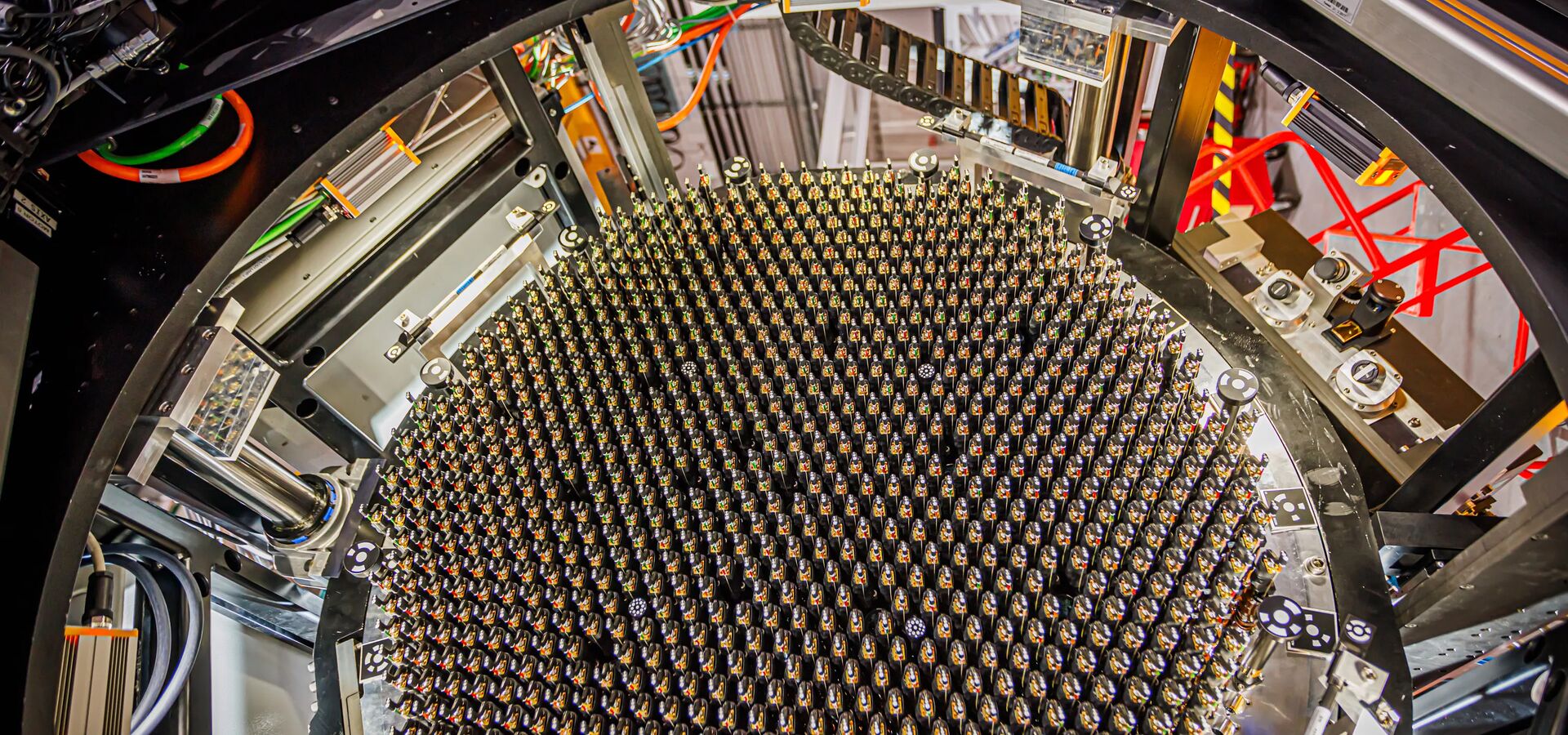
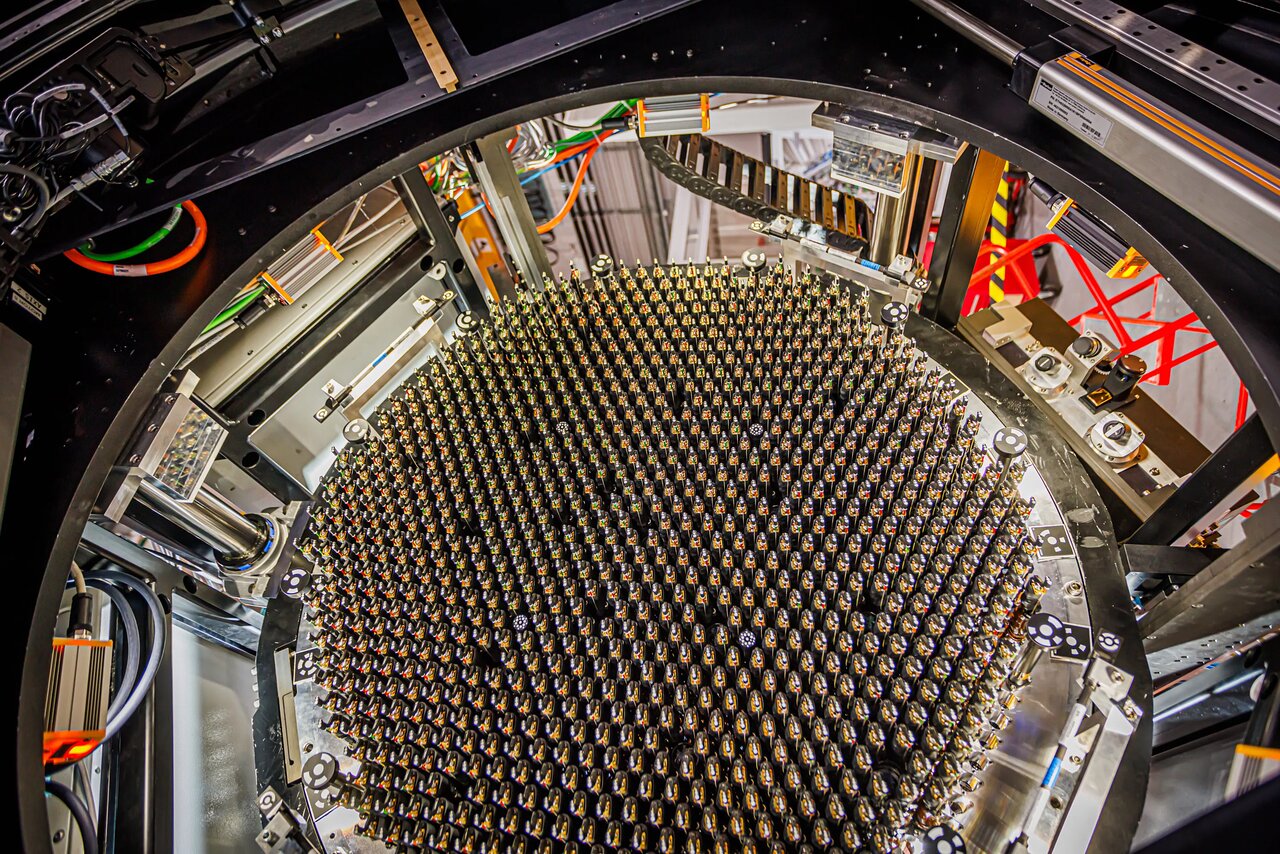
MOONS is an odd-looking instrument. At its front end, a thousand robotic arms stand at attention, each holding onto a small length of fibre-optic wire. These little robots have only one job: to position their fibres in the direction of specific stars or galaxies, so that MOONS can capture the light of a thousand objects at once.
Martin Black, systems engineer on the project, explains how the many arms of MOONS will make life much easier for astronomers, by describing how previous generations used to aim for the stars.
“They used to literally have plates of metal… and they drilled holes in the plates,” he says. Astronomers would have to know the position of their targets, isolate their location on a map, and create a physical way to block out all other light. Then, he says, they would “literally plug fibres onto each [of] those plates by hand during the day, and then at night you would put that plate in position,” repeating the process for as many plates as were needed.
With the rise of robotics, this job was soon handed over to new technology, but it still took quite a bit of effort to watch a single mechanical arm move each fibre, one thin wire at a time. Astronomers also got more ambitious in their studies, wanting to target more and more objects at once. This made the number of fibres increasingly difficult to manage, and the odds of crossed wires — and damaged instruments — got worse.
So, to both save time and avoid potential collisions, engineers began designing instruments like MOONS: where hundreds of fibres are always ready, moved around by individual robotic arms for each new observation in a complex dance.
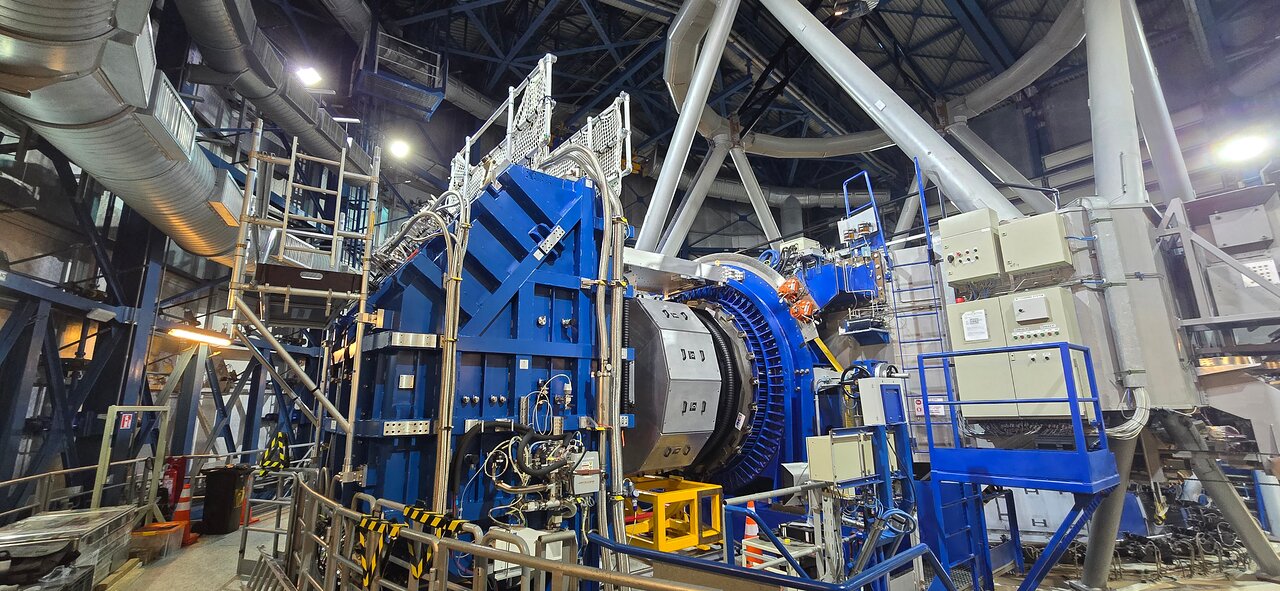
But an army of fibre-optic robots isn’t all MOONS will have going for it. In the back of the instrument, all of its fibres are fed into an 8-tonne, 4-metre tall box containing two identical spectrographs, each one receiving half of the optical fibres. A spectrograph is a device that splits starlight into its constituent colours, or wavelengths, in the same way a prism creates a rainbow when the Sun shines through it. They’re a very popular tool in astronomy, since the spectrum of light from an object shows a unique pattern from which astronomers can glean information, like their target’s chemical make-up or its speed.
Being able to capture a thousand spectra over the VLT’s entire field of view, MOONS is set to collect an enormous amount of data every night. William Taylor, MOONS instrument scientist at UK ATC, describes how much of a step forward making so many observations will be: “In the past, an astronomer would go and get their single spectrum of their favourite star and they would pore over it in great detail, whereas now… I mean, we're going to get 10 000 spectra a night probably.”
Shoot for the MOONS, land amongst the stars (and galaxies)
“There's a generation of about four or five instruments around the world which are going to have thousands of fibres at once… MOONS is part of that family,” William says. One of these new instruments is 4MOST, also at Paranal Observatory, which captures thousands of spectra in visible light. However, MOONS will be observing the Universe at longer infrared wavelengths. This will enable it to pierce through the dustier regions of space, equipping it for a number of exciting science goals, one of which is to study our own Milky Way galaxy.
“When you look at the galaxy, you see these kinds of dark bands across the middle,” William says, “that's just dust lying along the plane of the galaxy.” While these bands obscure our view in visible light, MOONS should see right through them with its thousand infrared eyes. According to William, “to really map out large numbers of stars in the centre of our galaxy, you've got to have MOONS. It's essential for that.”
Astronomers will use MOONS to study the chemical properties and movements of a massive number of targets that are hidden beyond these dusty clouds. They’ll then work backwards from their results, reconstructing the history of the Milky Way on a grand scale in a process known as galactic archaeology.
This method of retracing history has been used with previous instruments. William says that MOONS will specifically owe a lot to the work of the now-retired VIRCAM infrared camera at the VISTA telescope, also at Paranal. “It took an awful lot of images of the centre of the Galaxy; we're building on that significantly.”
But the goals of MOONS extend far beyond our own galaxy. The instrument will also target distant, ancient galaxies in an attempt to understand how they formed. It will take spectra to analyse their motions and composition, and the rate at which they form stars, a key indicator for uncovering galactic histories.
MOONS will try and piece together how these distant galaxies fit into the grand structure of the Universe. “You see this remarkable kind of filamentary structure,” William says, adding that “it is believed it's mapping out the dark matter structure of the Universe.” Dark matter, although invisible, can still exert its gravitational effects on nearby objects, and astronomers believe that it holds galaxies in place like flies caught in a grand cosmic web. But as researchers observe further out into space, the expansion of the universe makes light from distant galaxies shift towards longer infrared wavelengths, which is where MOONS comes in.
So, while some surveys using visible light can only see so far back into cosmic history, “we will go further,” William says. “We will extend those surveys into higher redshift regions, which you can't do without going further infrared.”
The dark side of MOONS
MOONS is already at the VLT, but the journey to get there hasn’t always been a smooth one. One particular obstacle, according to Martin, was testing the instrument’s thousand robotic arms.
“You've got a very big overlap region between all these different positioners, which means that we're trying to work out how to move them all around, [and] the chances of them bashing into each other is very high,” Martin says, helpfully pointing out that “hitting each other is bad.”
To deal with this issue, the engineers at UK ATC devised a way to detect the lightest of touches and shut the whole system down before anything gets damaged. Their solution is for each arm to carry an electrical voltage across it, and to coat each one with highly conductive paint so that the system can detect the small current generated when two arms graze each other.
The testing of this system requires a very steady hand to avoid causing any permanent damage. Martin says: “There's been a lot of trying to work out how we simulate a collision by hitting them together, without actually hitting them together.” If that sounds like the world's most expensive game of Operation, Martin may not disagree — he even says that “you have to admit at some point that it's fun.”
And the complexities don’t stop there. As an infrared spectrograph, MOONS can only function at temperatures far below freezing (some parts of it reach a bone-chilling -140 ºC), which stops the instrument’s heat from disrupting any measurements. However, this cryogenic cooling has an unintentional effect on the physical shape and size of the instrument. Each of its components will shrink and warp in slightly different ways, depending on their material, when cooled to such low temperatures.
To get around this shrinkage problem, Martin says, “we use metrology equipment, laser trackers and arms to very accurately put things in the wrong place, so that when it's cold, they go to the right place.” It’s a careful balancing act, requiring intimate knowledge of how every glass lens, prism, gear and spring is going to react when chilled. Even a small misstep here can prove to be costly, not only financially but also in terms of time.
“It's a big vessel, it takes 48 hours and 5000 tonnes of liquid nitrogen to get it [to] temperature, and then about 10 days of waiting for the whole thing to thermalise…” Martin says. “If you then found out you did the maths wrong, and everything's in the wrong place, you've got another week of warming it back up.”
To the MOONS and back
With MOONS ready to start collecting thousands of spectra, it’s important to acknowledge the many astronomers and engineers “who have spent in some cases decades of their life actually designing [and] building this piece of kit,” as William says.
“One of the biggest things that I've loved about MOONS is the team,” Martin says. “It's been such a good sort of camaraderie amongst everyone…. even when there's problems, even when there's things not working, it's seen as a sort of a challenge and it's really enjoyable. I think it's a real testament to that team that's been put together.”
More information
The MOONS instrument was designed and built by a consortium of universities and research institutes in Europe and Chile, namely:
- Science and Technology Facilities Council's UK Astronomy Technology Centre (UK ATC), United Kingdom (consortium lead)
- Centro de Astro-ingenieria UC (AIUC), Pontificia Universidad Catolica de Chile, Chile
- ETH Zürich, Switzerland
- Galaxies, Etoiles, Physique et Instrumentation (GEPI), Observatoire de Paris-PSL CNRS, France
- INAF, Italy
- Institute of Astronomy (IoA), University of Cambridge, United Kingdom
- Instituto de Astrofísica e Ciências do Espaço (IA), Portugal
- Université de Genève, Switzerland
ESO is an associate member of the consortium and provided the sensitive scientific detector systems used by MOONS.
Links
Biography Sean Bromilow
Sean studied physics at university, and has always loved doing outreach work to get people excited about his favourite topics. He’s brought science into the classroom, working with kids of all ages, and taken astronomy on the road by giving travelling planetarium shows. Now, he’s exploring new ways to spark some enthusiasm for astronomy as one of ESO’s Science Communication Interns.