Meddelande
ESO tecknar avtal för MOSAIC-instrumentet på ELT
1 december 2025
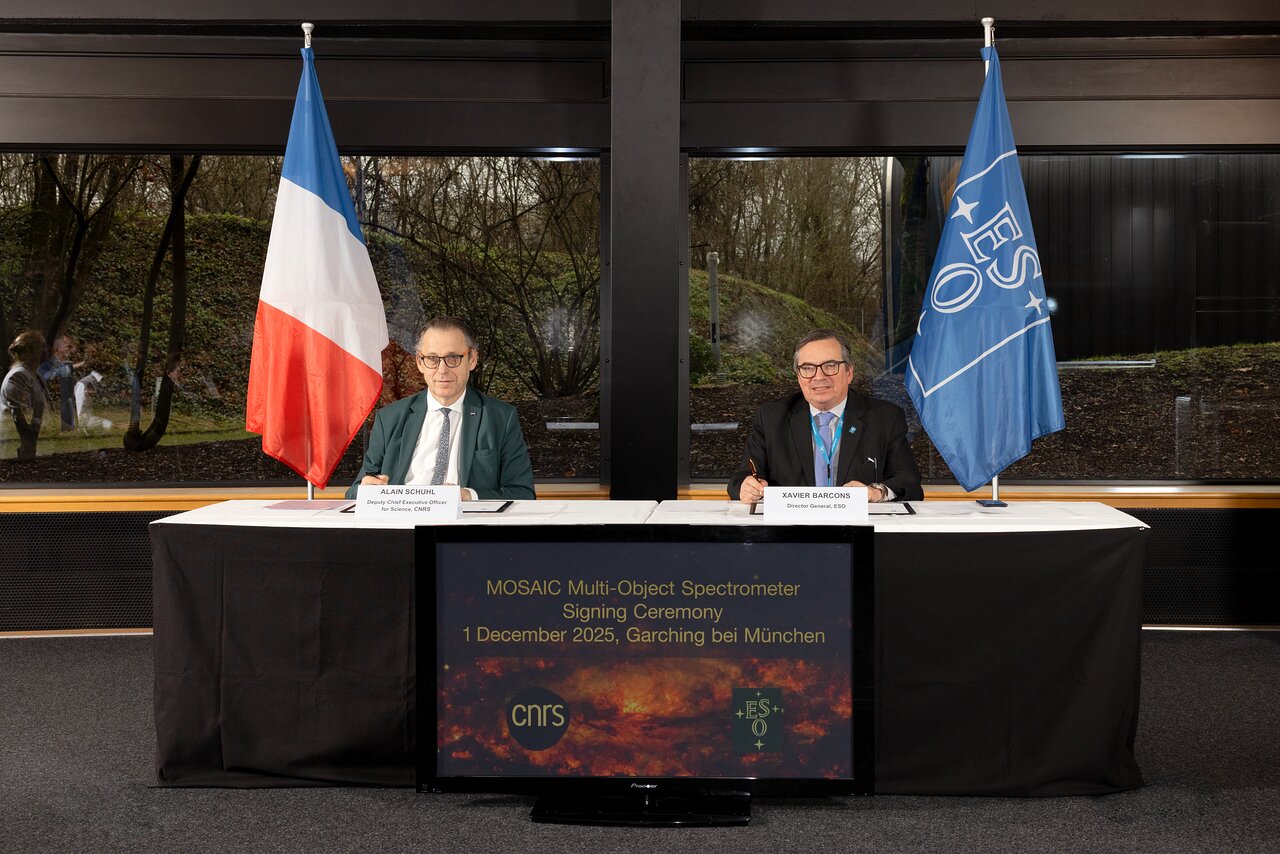
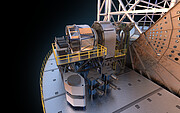
I dag har ESO tecknat ett avtal med ett stort internationellt konsortium för design och konstruktion av Multi-Object Spectrograph (MOSAIC), ett instrument för ESO:s Extremely Large Telescope (ELT). MOSAIC ska analysera strålningen från mer än tvåhundra källor samtidigt och kommer att användas för att spåra galaxers tillväxt och fördelningen av materia från Big Bang till i dag.
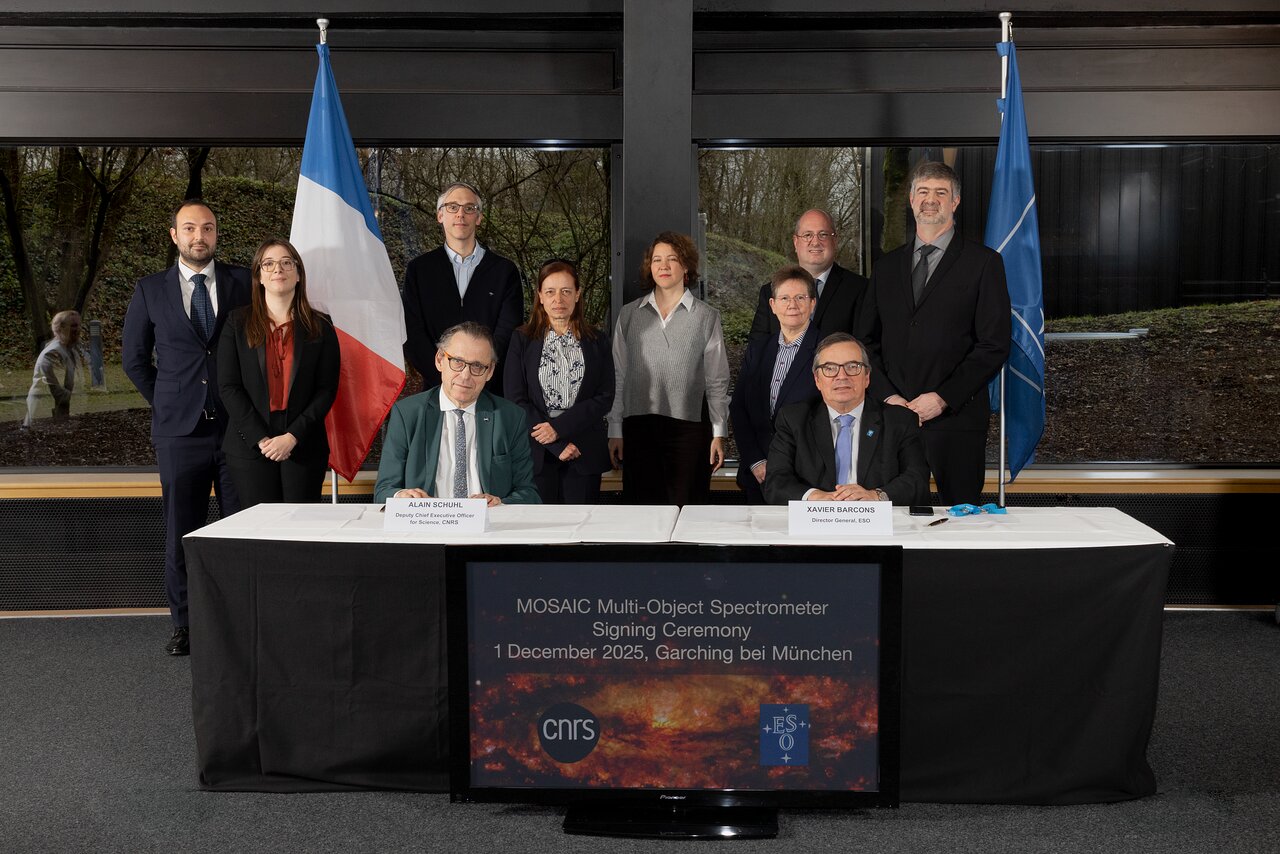
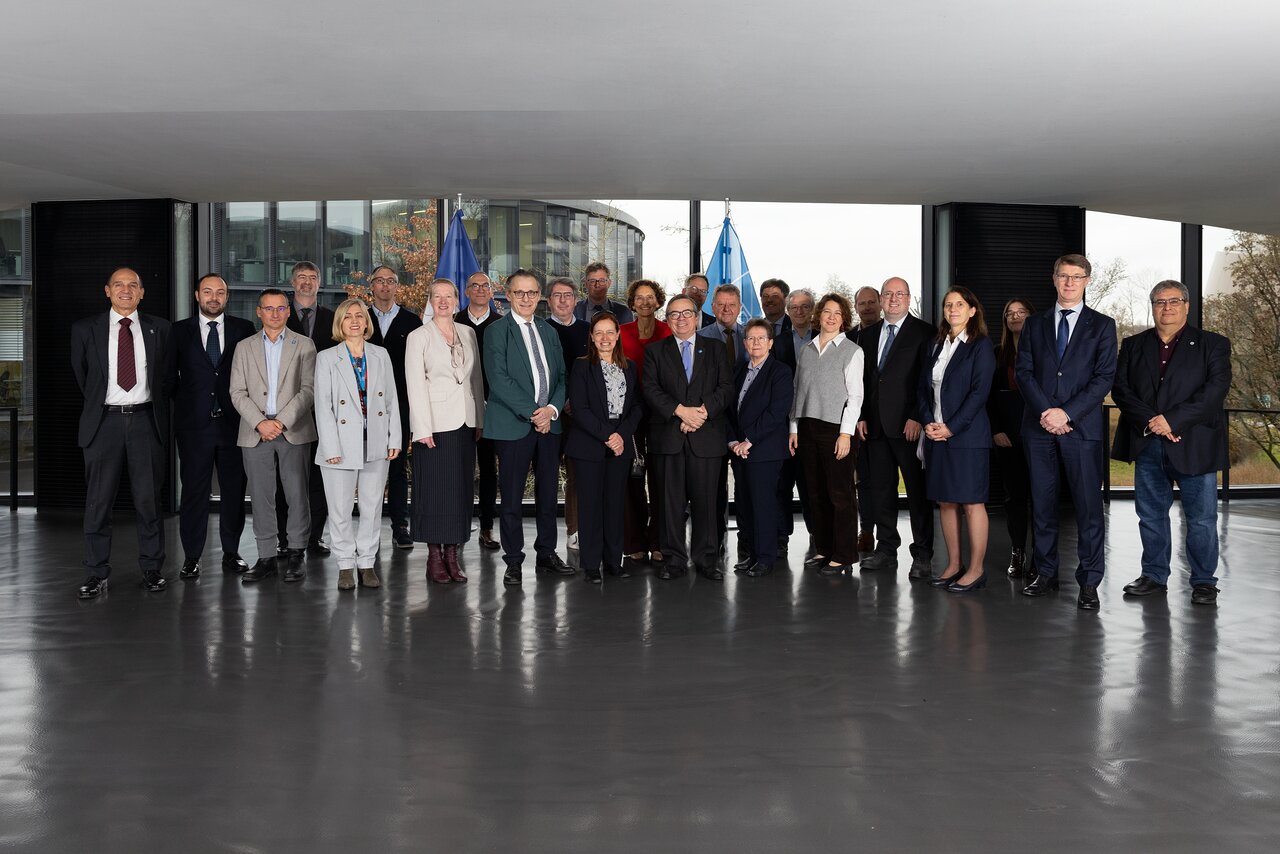
Avtalet undertecknades av ESO:s generaldirektör Xavier Barcons och Alain Schuhl, vice VD för vetenskap vid det franska nationella centret för vetenskaplig forskning (CNRS), den institution som leder MOSAIC-konsortiet. Även MOSAIC:s chefsforskare Roser Pello från astrofysiklaboratoriet i Marseille och Mathieu Puech från Parisobservatoriet deltog, liksom representanter från ESO, CNRS och MOSAIC-konsortiet [1]. Undertecknandet ägde rum vid ESO:s högkvarter i Garching, Tyskland.
MOSAIC är en kraftfull spektrograf, ett instrument som delar upp ljuset i dess komponentvåglängder för att bestämma viktiga egenskaper hos astronomiska objekt, såsom kemisk sammansättning och temperatur. Instrumentet kommer att utnyttjade det maximala synfältet som ELT kan tillhandahålla i både synligt och nära infrarött ljus, och kommer simultant att kunna analysera strålningen från mer än två hundra objekt.
Planen för MOSAIC är att genomföra den första grundläggande inventeringen av materians fördelning inom och mellan galaxerna i det tidiga universum, och därmed avsevärt förbättra vår förståelse av hur dagens galaxer bildades och utvecklades. Instrumentet kommer också att studera den gas som omger galaxerna och identifiera dess kemisk grundämnen.
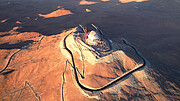
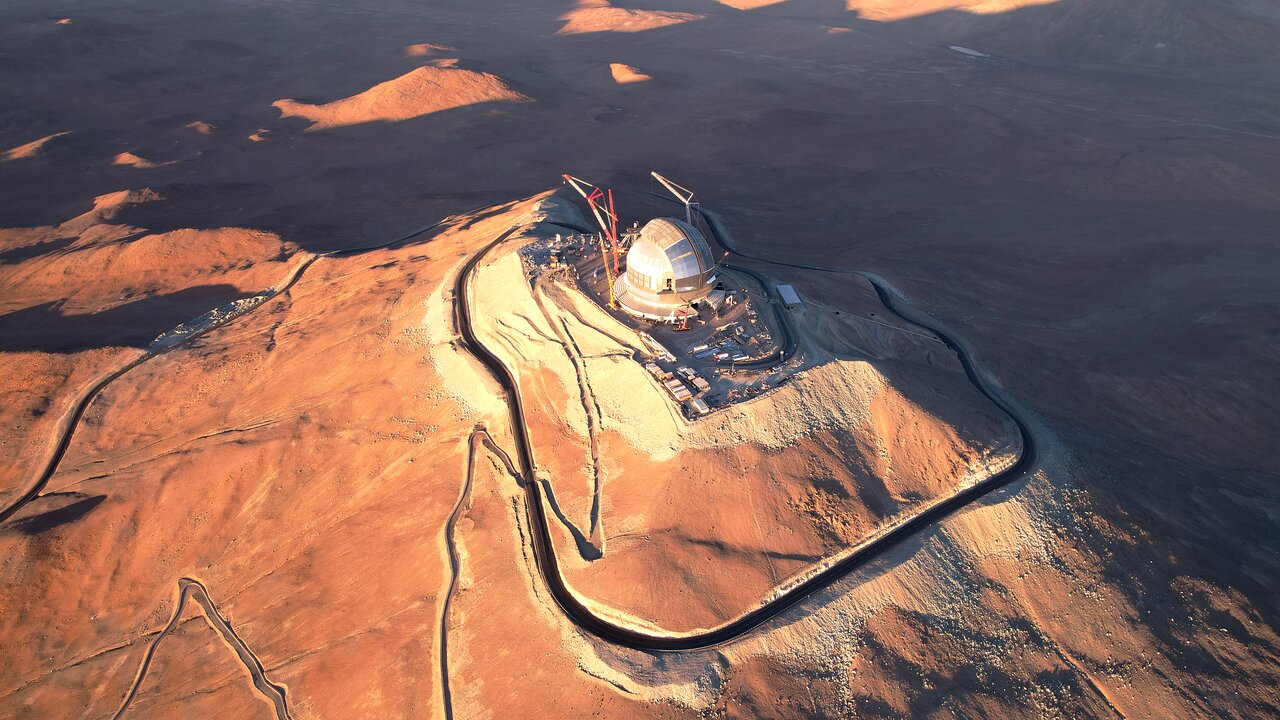
ESO:s ELT är för närvarande under uppbyggnad i Chiles Atacamaöken, en unik plats för att observera himlen. Vid de första tekniska premiärobservationerna senare detta decennium kommer ELT att revolutionera vår förståelse av universum och få oss att ompröva vår plats i kosmos.
Noter
[1] Bland deltagarna vid undertecknandet fanns Pascal Chevrot (chef för CNRS-direktoratet för innovativ instrumentutveckling för forskning och observation), Myriam Rodrigues (systemingenjör för MOSAIC, Parisobservatoriet), Hermine Schnetler (projektledare för MOSAIC, Parisobservatoriet), Jesus Gallego (ordförande i MOSAIC-styrelsen, Universidad Complutense de Madrid), Michiel Rodenhuis (verkställande direktör för NOVA och medlem i institutionsstyrelsen) och de två ESO-rådsdelegaterna för Frankrike: Karine Perraut (CNRS INSU) och Guy Perrin (Ministeriet för högre utbildning, forskning och innovation, Paris).
Från ESO deltog förutom Xavier Barcons även Suzanne Ramsay (biträdande programchef för instrumentering), Michele Cirasuolo (programchef för instrumentering), Jarle Brinchmann (vetenskapschef), Claudia Burger (administrationschef), Andreas Kaufer (verksamhetschef), Sara Krauss (teknikchef), Adrian Russell (programchef), Patrick Caillier (projektledare för MOSAIC), Alessandro Meoli (chef för MOSAIC:s detektorsystem), Oliver Pfuhl (projektingenjör för MOSAIC), Alain Delorme (tillförordnad chef för kontrakt och upphandling), Cyrielle Blanc (kontrakts- och upphandlingsansvarig), Roberto Tamai (programchef för ELT), Enrico Marchetti (programingenjör för instrumentering) och Joël Vernet (tillförordnad forskare för ELT-programmet).
Mer information
MOSAIC-projektet leds av ett internationellt konsortium bestående av forskningsinstitut i 13 länder. Dessa är:
Österrike: Universitetet i Wien; Institute of Science and Technology Austria (ISTA); Brasilien: Nationella laboratoriet för astrofysik; São Paulo universitet;
Finland: Helsingfors universitet; Finlands centrum för astronomi med ESO, Åbo universitet;
Frankrike: Nationella institutet för geovetenskaper och astronomi vid det Nationella forskningscentret (CNRS-INSU); UNITÉ d'Ingénierie et de Développements Instrumentaux pour l'Astrophysique (UNIDIA) och Laboratoire d'étude de l'Univers et des phénomènes eXtrêmes (LUX) vid Parisobservatoriet-PSL; Institutet för forskning inom astrofysik och planetologi vid Toulouse universitet; Marseilles astrofysiklaboratorium. Laboratoire Joseph-Louis Lagrange (LAGRANGE);
Tyskland: Leibnizinstitutet för astrofysik Potsdam; LSW Heidelberg;
Italien: INAF - Italiens nationella astrofysikinstitut;
Nederländerna: Nederländska forskarskolan för astronomi (NOVA); Amsterdams universitet
Portugal: Centro de Investigação em Astronomia/Astrofísica da Universidade do Porto; FCiências.ID - Universidade de Lisboa;
Spanien: Universidad Complutense de Madrid (UCM); Instituto de Astrofísica de Andalucía (IAA-CSIC); Centro de Astrobiología (CAB, CSIC-INTA), Universidad Politécnica de Madrid (UPM)
Sverige: Stockholms universitet; Lunds universitet; Uppsala universitet
Schweiz: Genèves universitet; École polytechnique fédérale de Lausanne
Storbritannien: Durham University; University of Oxford / RAL Space
USA: University of Michigan; Space Telescope Science Institute.
Länkar
Om meddelandet
| ID: | ann25008 |
Bilder

Our use of Cookies
We use cookies that are essential for accessing our websites and using our services. We also use cookies to analyse, measure and improve our websites’ performance, to enable content sharing via social media and to display media content hosted on third-party platforms.
ESO Cookies Policy
The European Organisation for Astronomical Research in the Southern Hemisphere (ESO) is the pre-eminent intergovernmental science and technology organisation in astronomy. It carries out an ambitious programme focused on the design, construction and operation of powerful ground-based observing facilities for astronomy.
This Cookies Policy is intended to provide clarity by outlining the cookies used on the ESO public websites, their functions, the options you have for controlling them, and the ways you can contact us for additional details.
What are cookies?
Cookies are small pieces of data stored on your device by websites you visit. They serve various purposes, such as remembering login credentials and preferences and enhance your browsing experience.
Categories of cookies we use
Essential cookies (always active): These cookies are strictly necessary for the proper functioning of our website. Without these cookies, the website cannot operate correctly, and certain services, such as logging in or accessing secure areas, may not be available; because they are essential for the website’s operation, they cannot be disabled.
Functional Cookies: These cookies enhance your browsing experience by enabling additional features and personalization, such as remembering your preferences and settings. While not strictly necessary for the website to function, they improve usability and convenience; these cookies are only placed if you provide your consent.
Analytics cookies: These cookies collect information about how visitors interact with our website, such as which pages are visited most often and how users navigate the site. This data helps us improve website performance, optimize content, and enhance the user experience; these cookies are only placed if you provide your consent. We use the following analytics cookies.
Matomo Cookies:
This website uses Matomo (formerly Piwik), an open source software which enables the statistical analysis of website visits. Matomo uses cookies (text files) which are saved on your computer and which allow us to analyze how you use our website. The website user information generated by the cookies will only be saved on the servers of our IT Department. We use this information to analyze www.eso.org visits and to prepare reports on website activities. These data will not be disclosed to third parties.
On behalf of ESO, Matomo will use this information for the purpose of evaluating your use of the website, compiling reports on website activity and providing other services relating to website activity and internet usage.
Matomo cookies settings:
Additional Third-party cookies on ESO websites: some of our pages display content from external providers, e.g. YouTube.
Such third-party services are outside of ESO control and may, at any time, change their terms of service, use of cookies, etc.
YouTube: Some videos on the ESO website are embedded from ESO’s official YouTube channel. We have enabled YouTube’s privacy-enhanced mode, meaning that no cookies are set unless the user actively clicks on the video to play it. Additionally, in this mode, YouTube does not store any personally identifiable cookie data for embedded video playbacks. For more details, please refer to YouTube’s embedding videos information page.
Cookies can also be classified based on the following elements.
Regarding the domain, there are:
- First-party cookies, set by the website you are currently visiting. They are stored by the same domain that you are browsing and are used to enhance your experience on that site;
- Third-party cookies, set by a domain other than the one you are currently visiting.
As for their duration, cookies can be:
- Browser-session cookies, which are deleted when the user closes the browser;
- Stored cookies, which stay on the user's device for a predetermined period of time.
How to manage cookies
Cookie settings: You can modify your cookie choices for the ESO webpages at any time by clicking on the link Cookie settings at the bottom of any page.
In your browser: If you wish to delete cookies or instruct your browser to delete or block cookies by default, please visit the help pages of your browser:
Please be aware that if you delete or decline cookies, certain functionalities of our website may be not be available and your browsing experience may be affected.
You can set most browsers to prevent any cookies being placed on your device, but you may then have to manually adjust some preferences every time you visit a site/page. And some services and functionalities may not work properly at all (e.g. profile logging-in, shop check out).
Updates to the ESO Cookies Policy
The ESO Cookies Policy may be subject to future updates, which will be made available on this page.
Additional information
For any queries related to cookies, please contact: pdprATesoDOTorg.
As ESO public webpages are managed by our Department of Communication, your questions will be dealt with the support of the said Department.