Meddelande
BlueMUSE: ESO tecknar avtal för nytt VLT-instrument
30 januari 2026
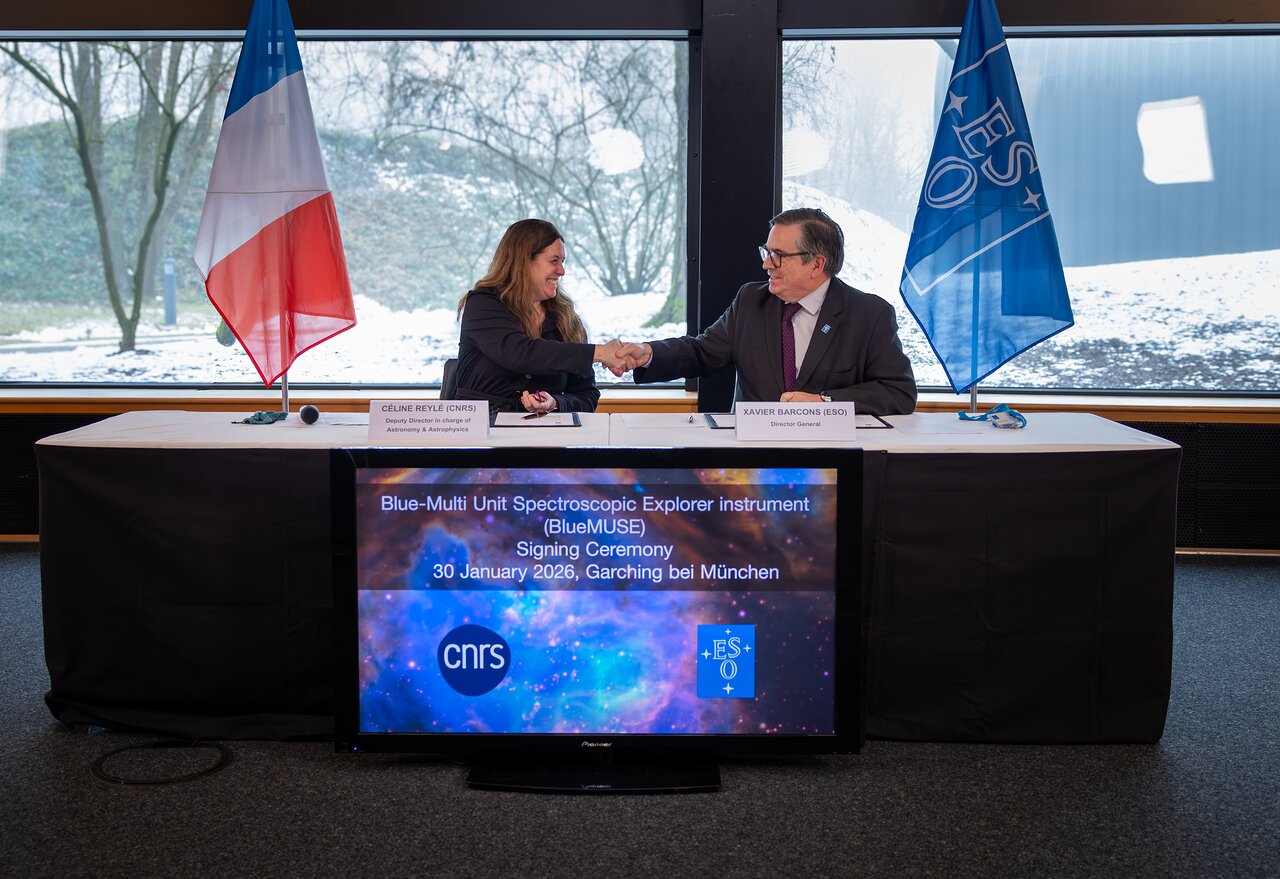
I dag har ESO undertecknat avtalet för byggandet av Blue Multi Unit Spectroscopic Explorer (BlueMUSE), ett kommande instrument för ESO:s Very Large Telescope (VLT). Undertecknandet markerar ett viktigt första steg i utvecklingen av BlueMUSE, som kommer att erbjuda nya och unika vetenskapliga möjligheter för astronomer. Dess avancerade teknik kommer att möjliggöra detaljerade observationer inom vår galax, vilket hjälper till att studera högst varierade objekt som massiva stjärnor, nebulosor och kometer. Instrumentet kommer också att revolutionera studiet av det avlägsna universum genom att möjliggöra detektionen av diffust materia i rymden mellan galaxerna och hjälpa oss att förstå hur denna materia rör sig.
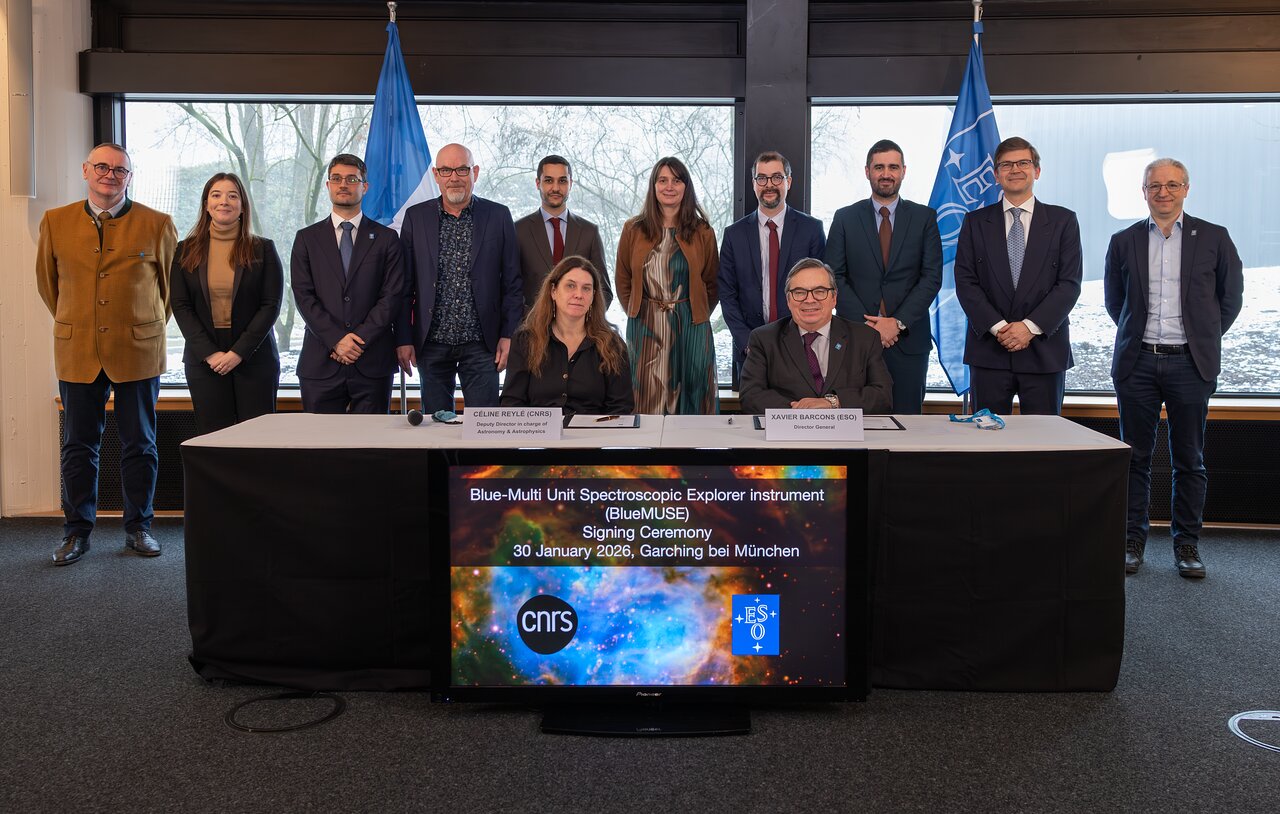
Tidigare idag undertecknade ESO:s generaldirektör Xavier Barcons och Céline Reylé, biträdande direktör för astronomi och astrofysik vid det franska nationella centret för vetenskaplig forskning (CNRS), BlueMUSE-avtalet vid ESO:s högkvarter i Garching, Tyskland. CNRS Centre de Recherche Astrophysique de Lyon (CRAL – CNRS/ENS de Lyon/Claude Bernard Lyon 1 University) är den institution som leder instrumentkonsortiet, som består av flera institut från Europa och Australien. Även den franske attachén för vetenskap och högre utbildning i södra Tyskland, Emmanuel Delille, huvudforskaren för BlueMUSE Johan Richard och projektledaren Rémi Giroud, båda från CRAL, deltog liksom andra dignitärer från ESO och BlueMUSE-konsortiet [1], för att fira detta steg i instrumentets konstruktion.
BlueMUSE, som är baserad på den framgångsrika tekniken hos MUSE-instrumentet som installerats på VLT, är en integralfältspektrograf. Den är utformad för att inte bara fånga en 2D-bild av ett eller flera objekt utan även dela upp ljuset i dess komponentfärger eller våglängder i varje pixel, vilket resulterar i komplett 3D-information om objekten. I takt med att MUSE har blivit ett av ESO:s mest produktiva och efterfrågade instrument har astronomivärlden efterfrågat ett liknande instrument – och nu blir det verklighet.
Liksom MUSE i många avseenden kommer BlueMUSE att observera i kortare och därmed blåare våglängder, med högre spektral upplösning (separationen mellan olika våglängder). Detta innebär att den kommer att komplettera stora mark- och rymdbaserade anläggningar, såsom ESO:s kommande Extremely Large Telescope och James Webb Space Telescope, som är optimerade för att observera i infrarött.
BlueMUSE, som förväntas göra de flrsta observationerna 2034, kommer att ge nya vetenskapliga möjligheter utöver de som är möjliga med MUSE. Instrumentet kommer att kartlägga massiva stjärnor i Vintergatan och dess galaktiska grannskap, vilket hjälper till att besvara viktiga frågor om stjärnornas utveckling. På större avstånd kommer instrumentet att observera svaga galaxer, liksom sådana med kraftig stjärnbildning, och undersöka deras extrema stjärnbildningsmiljö. BlueMUSE kommer också att vara idealiskt lämpad för att studera det avlägsna universum, särskilt för att upptäcka den mycket diffusa, svårfångade materia som genomsyrar rymden mellan galaxerna och för att undersöka uppkomsten av de första galaxhoparna.
Noter
[1] Bland deltagarna i undertecknandeceremonin fanns Karine Perraut (fransk ESO-rådsdelegat från Institut national des sciences de l’Univers (INSU), CNRS Earth & Space, Frankrike), Florence Laurent (BlueMUSE-systemingenjör vid CNRS), Davor Krajnović (BlueMUSE-projektforskare, Leibniz-Institut für Astrophysik Potsdam, Tyskland), Alexandre Jeanneau (BlueMUSE:s huvudoptikingenjör vid CNRS).
Från ESO deltog förutom Xavier Barcons, Frédéric Derie (projektledare), Francesco Belfiore (projektforskare), Reinhold Dorn (projektingenjör), Michele Cirasuolo (programchef för instrumentation), Suzanne Ramsay (biträdande programchef för instrumentation), Céline Péroux (programforskare), Andrea Capardi (programcontroller), Enrico Marchetti (programingenjör för instrumentation), Emanuela Ciattaglia (programingenjör för instrumentation), Diogo Rio Fernandes (programingenjör för instrumentation), Alain Delorme (tillförordnad chef för kontrakt och upphandling) och Cyrielle Blanc (kontrakts- och upphandlingsansvarig).
Länkar
Om meddelandet
| ID: | ann26001 |
Bilder


Our use of Cookies
We use cookies that are essential for accessing our websites and using our services. We also use cookies to analyse, measure and improve our websites’ performance, to enable content sharing via social media and to display media content hosted on third-party platforms.
ESO Cookies Policy
The European Organisation for Astronomical Research in the Southern Hemisphere (ESO) is the pre-eminent intergovernmental science and technology organisation in astronomy. It carries out an ambitious programme focused on the design, construction and operation of powerful ground-based observing facilities for astronomy.
This Cookies Policy is intended to provide clarity by outlining the cookies used on the ESO public websites, their functions, the options you have for controlling them, and the ways you can contact us for additional details.
What are cookies?
Cookies are small pieces of data stored on your device by websites you visit. They serve various purposes, such as remembering login credentials and preferences and enhance your browsing experience.
Categories of cookies we use
Essential cookies (always active): These cookies are strictly necessary for the proper functioning of our website. Without these cookies, the website cannot operate correctly, and certain services, such as logging in or accessing secure areas, may not be available; because they are essential for the website’s operation, they cannot be disabled.
Functional Cookies: These cookies enhance your browsing experience by enabling additional features and personalization, such as remembering your preferences and settings. While not strictly necessary for the website to function, they improve usability and convenience; these cookies are only placed if you provide your consent.
Analytics cookies: These cookies collect information about how visitors interact with our website, such as which pages are visited most often and how users navigate the site. This data helps us improve website performance, optimize content, and enhance the user experience; these cookies are only placed if you provide your consent. We use the following analytics cookies.
Matomo Cookies:
This website uses Matomo (formerly Piwik), an open source software which enables the statistical analysis of website visits. Matomo uses cookies (text files) which are saved on your computer and which allow us to analyze how you use our website. The website user information generated by the cookies will only be saved on the servers of our IT Department. We use this information to analyze www.eso.org visits and to prepare reports on website activities. These data will not be disclosed to third parties.
On behalf of ESO, Matomo will use this information for the purpose of evaluating your use of the website, compiling reports on website activity and providing other services relating to website activity and internet usage.
Matomo cookies settings:
Additional Third-party cookies on ESO websites: some of our pages display content from external providers, e.g. YouTube.
Such third-party services are outside of ESO control and may, at any time, change their terms of service, use of cookies, etc.
YouTube: Some videos on the ESO website are embedded from ESO’s official YouTube channel. We have enabled YouTube’s privacy-enhanced mode, meaning that no cookies are set unless the user actively clicks on the video to play it. Additionally, in this mode, YouTube does not store any personally identifiable cookie data for embedded video playbacks. For more details, please refer to YouTube’s embedding videos information page.
Cookies can also be classified based on the following elements.
Regarding the domain, there are:
- First-party cookies, set by the website you are currently visiting. They are stored by the same domain that you are browsing and are used to enhance your experience on that site;
- Third-party cookies, set by a domain other than the one you are currently visiting.
As for their duration, cookies can be:
- Browser-session cookies, which are deleted when the user closes the browser;
- Stored cookies, which stay on the user's device for a predetermined period of time.
How to manage cookies
Cookie settings: You can modify your cookie choices for the ESO webpages at any time by clicking on the link Cookie settings at the bottom of any page.
In your browser: If you wish to delete cookies or instruct your browser to delete or block cookies by default, please visit the help pages of your browser:
Please be aware that if you delete or decline cookies, certain functionalities of our website may be not be available and your browsing experience may be affected.
You can set most browsers to prevent any cookies being placed on your device, but you may then have to manually adjust some preferences every time you visit a site/page. And some services and functionalities may not work properly at all (e.g. profile logging-in, shop check out).
Updates to the ESO Cookies Policy
The ESO Cookies Policy may be subject to future updates, which will be made available on this page.
Additional information
For any queries related to cookies, please contact: pdprATesoDOTorg.
As ESO public webpages are managed by our Department of Communication, your questions will be dealt with the support of the said Department.