Meddelande
Över 1100 studier med ESO-data publicerade 2025
10 mars 2026
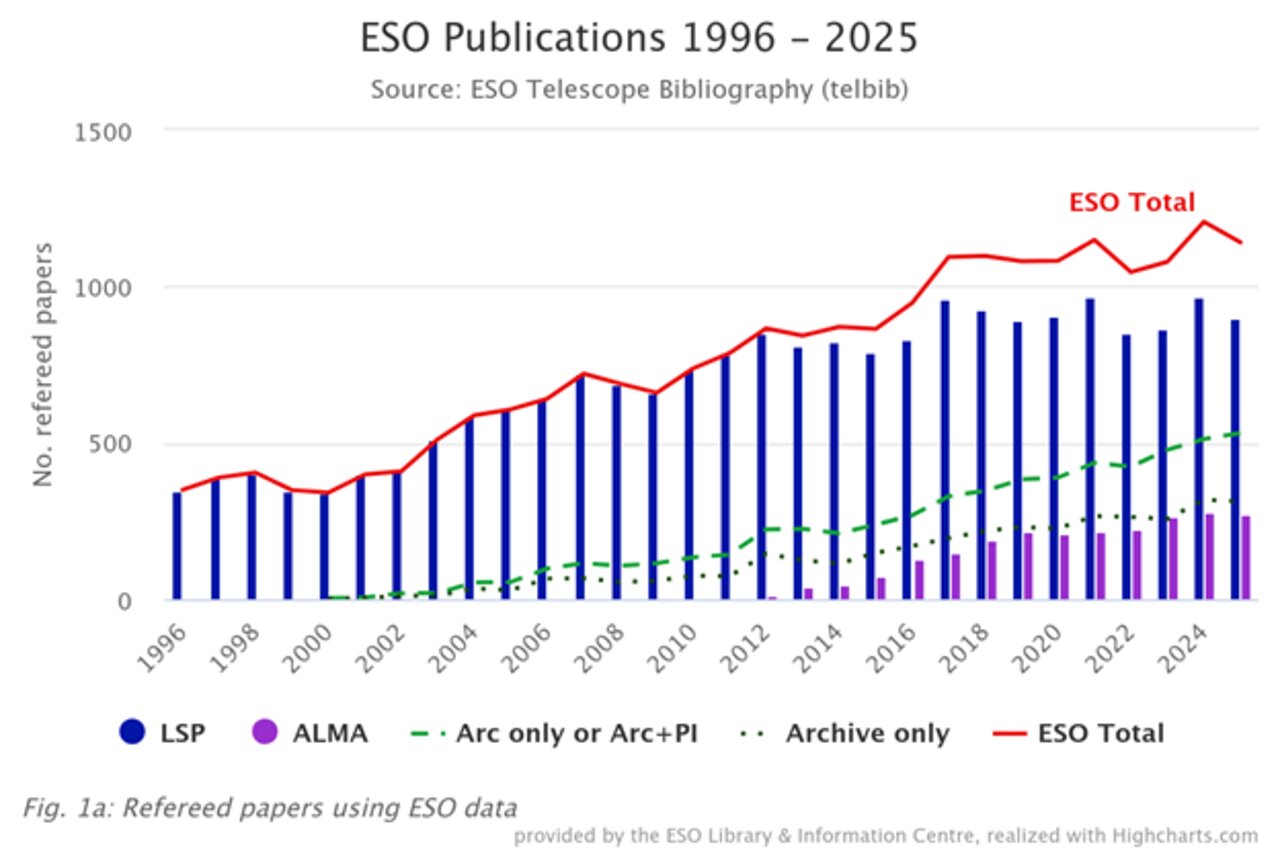
Omkring 1150 studier med data som samlats in vid ESO:s observatorier publicerades förra året – det andra året i rad som antalet publikationer har överstigit 1100. Det är också det nionde året i rad då observationerna vid ESO:s anläggningar har lett till mer än 1 000 publicerade studier. ESO:s biblioteks-, dokumentations- och informationsavdelning har uppdaterat sin publikationsstatistik för 2025 med en detaljerad uppdelning av bidragen från varje ESO-anläggning [1].
Precis som tidigare år har data från ESO:s Very Large Telescope (VLT) och VLT-interferometern (VLTI) dominerat och bidragit till cirka 670 studier under 2025. Anläggningarnas breda utbud av instrument, plus läget vid Paranalobservatoriet i Chiles Atacamaöken – en plats med unika observationsförhållanden inklusive orörd mörk himmel – gör dem till ett flaggskepp inom markbaserad astronomi. Multi Unit Spectroscopic Explorer (MUSE) fortsätter sin sexåriga svit som det mest produktiva VLT/I-instrumentet, med data i över 200 artiklar. En höjdpunkt från MUSE förra året var publiceringen av en ultradetaljerad tusenfärgsbild av Sculptorgalaxen. En annan höjdpunkt från VLT under förra året var data från Ultraviolet and Visual Echelle Spectrograph (UVES), det näst mest produktiva VLT-instrumentet som bidragit med data till över 120 artiklar under 2025, för att hitta en planet i en vinkelrät bana kring ett stjärnpar.
ESO:s kartläggningsanläggningar Visible and Infrared Survey Telescope for Astronomy (VISTA) och VLT Survey Telescope (VST) [2], som också finns vid Paranalobservatoriet, producerade data till över 100 artiklar. Data från ESO:s första observatorium, La Silla, bidrog till cirka 200 studier förra året, en ökning från 177 år 2024. Detta visar hur observatoriet fortfarande ligger i forskningsfronten, särskilt tack vare instrument som HARPS, High Accuracy Radial velocity Planet Searcher, på ESO:s 3,6-metersteleskop.
Atacama Large Millimeter/Submillimeter Array (ALMA), som ägs av ESO, tillhandahöll data för över 550 publikationer år 2025. Ungefär hälften av dessa artiklar förlitade sig på observationstid som beviljats astronomer baserade i Europa. Höjdpunkter från ALMA-studier som publicerades förra året inkluderar upptäckten av syre i den mest avlägsna kända galaxen och observationer av bildandet av ett nytt solsystem. Observationer från Atacama Pathfinder Experiment (APEX), som drevs av ESO till slutet av 2025, ledde till cirka 45 artiklar. Av dessa använde närmare 20 data som erhållits under ESO:s observationstid.
Ett rekordstort antal publikationer använde data från ESO Science Archive Facility. Omkring 530 artiklar förlitade sig helt eller delvis på arkivdata. Därmed blev 2025 året med den hittills högsta andelen ESO-publikationer som använde arkivet, 46 %, vilket understryker värdet av äldre observationer för banbrytande astronomisk forskning. Dessutom förlitade sig över en fjärdedel av alla publikationer från 2025 enbart på arkivdata, utan att författarna gjorde egna ESO-observationer.
De imponerande publikationssiffrorna betonar den viktiga roll som ESO spelar för att fördjupa vår förståelse av universum. Detta är möjligt tack vare arbetet från det astronomiska samfundet och ESO-personalen, den avancerade tekniken i ESO:s anläggningar och det fortsatta stödet från ESO:s medlemsstater och Chile.
Noter
[1] Artiklar kan vara baserade på data från mer än en anläggning, varför det totala antalet inte kan beräknas genom att lägga ihop alla publikationer från de enskilda platserna.
[2] VST-projektet var ett samarbete mellan ESO och Capodimonte Astronomical Observatory vid det italienska nationella institutet för astrofysik (INAF). Från och med den 1 oktober 2022 är detta ett enda INAF-projektet som drivs av ESO på Paranal. Endast artiklar baserade (helt eller delvis) på ESO:s VST-tid ingår i statistiken.
Mer information
Statistiken som presenteras här är hämtad från ESO Telescope Bibliography (telbib), en databas med forskargranskade artiklar publicerade av ESO-användarna. Telbib utvecklas och kureras av ESO:s avdelning för bibliotek, dokumentation och informationstjänster. Artiklarna granskas noggrant av kuratorerna innan de läggs till i databasen för att säkerställa att alla telbib-artiklar delvis eller uteslutande använder data från ESO:s anläggningar för vilka observationstid delgavs av ESO. Det offentliga telbib-gränssnittet ger visualiseringar av sökresultat, inklusive grafer och fördefinierade diagram.
Länkar
Om meddelandet
| ID: | ann26002 |
Bilder
text på engelska
Our use of Cookies
We use cookies that are essential for accessing our websites and using our services. We also use cookies to analyse, measure and improve our websites’ performance, to enable content sharing via social media and to display media content hosted on third-party platforms.
ESO Cookies Policy
The European Organisation for Astronomical Research in the Southern Hemisphere (ESO) is the pre-eminent intergovernmental science and technology organisation in astronomy. It carries out an ambitious programme focused on the design, construction and operation of powerful ground-based observing facilities for astronomy.
This Cookies Policy is intended to provide clarity by outlining the cookies used on the ESO public websites, their functions, the options you have for controlling them, and the ways you can contact us for additional details.
What are cookies?
Cookies are small pieces of data stored on your device by websites you visit. They serve various purposes, such as remembering login credentials and preferences and enhance your browsing experience.
Categories of cookies we use
Essential cookies (always active): These cookies are strictly necessary for the proper functioning of our website. Without these cookies, the website cannot operate correctly, and certain services, such as logging in or accessing secure areas, may not be available; because they are essential for the website’s operation, they cannot be disabled.
Functional Cookies: These cookies enhance your browsing experience by enabling additional features and personalization, such as remembering your preferences and settings. While not strictly necessary for the website to function, they improve usability and convenience; these cookies are only placed if you provide your consent.
Analytics cookies: These cookies collect information about how visitors interact with our website, such as which pages are visited most often and how users navigate the site. This data helps us improve website performance, optimize content, and enhance the user experience; these cookies are only placed if you provide your consent. We use the following analytics cookies.
Matomo Cookies:
This website uses Matomo (formerly Piwik), an open source software which enables the statistical analysis of website visits. Matomo uses cookies (text files) which are saved on your computer and which allow us to analyze how you use our website. The website user information generated by the cookies will only be saved on the servers of our IT Department. We use this information to analyze www.eso.org visits and to prepare reports on website activities. These data will not be disclosed to third parties.
On behalf of ESO, Matomo will use this information for the purpose of evaluating your use of the website, compiling reports on website activity and providing other services relating to website activity and internet usage.
Matomo cookies settings:
Additional Third-party cookies on ESO websites: some of our pages display content from external providers, e.g. YouTube.
Such third-party services are outside of ESO control and may, at any time, change their terms of service, use of cookies, etc.
YouTube: Some videos on the ESO website are embedded from ESO’s official YouTube channel. We have enabled YouTube’s privacy-enhanced mode, meaning that no cookies are set unless the user actively clicks on the video to play it. Additionally, in this mode, YouTube does not store any personally identifiable cookie data for embedded video playbacks. For more details, please refer to YouTube’s embedding videos information page.
Cookies can also be classified based on the following elements.
Regarding the domain, there are:
- First-party cookies, set by the website you are currently visiting. They are stored by the same domain that you are browsing and are used to enhance your experience on that site;
- Third-party cookies, set by a domain other than the one you are currently visiting.
As for their duration, cookies can be:
- Browser-session cookies, which are deleted when the user closes the browser;
- Stored cookies, which stay on the user's device for a predetermined period of time.
How to manage cookies
Cookie settings: You can modify your cookie choices for the ESO webpages at any time by clicking on the link Cookie settings at the bottom of any page.
In your browser: If you wish to delete cookies or instruct your browser to delete or block cookies by default, please visit the help pages of your browser:
Please be aware that if you delete or decline cookies, certain functionalities of our website may be not be available and your browsing experience may be affected.
You can set most browsers to prevent any cookies being placed on your device, but you may then have to manually adjust some preferences every time you visit a site/page. And some services and functionalities may not work properly at all (e.g. profile logging-in, shop check out).
Updates to the ESO Cookies Policy
The ESO Cookies Policy may be subject to future updates, which will be made available on this page.
Additional information
For any queries related to cookies, please contact: pdprATesoDOTorg.
As ESO public webpages are managed by our Department of Communication, your questions will be dealt with the support of the said Department.