Mitteilung
ALMA-Upgrade: ESO unterzeichnet Vertrag über hochmodernen Prozessor
24. August 2026
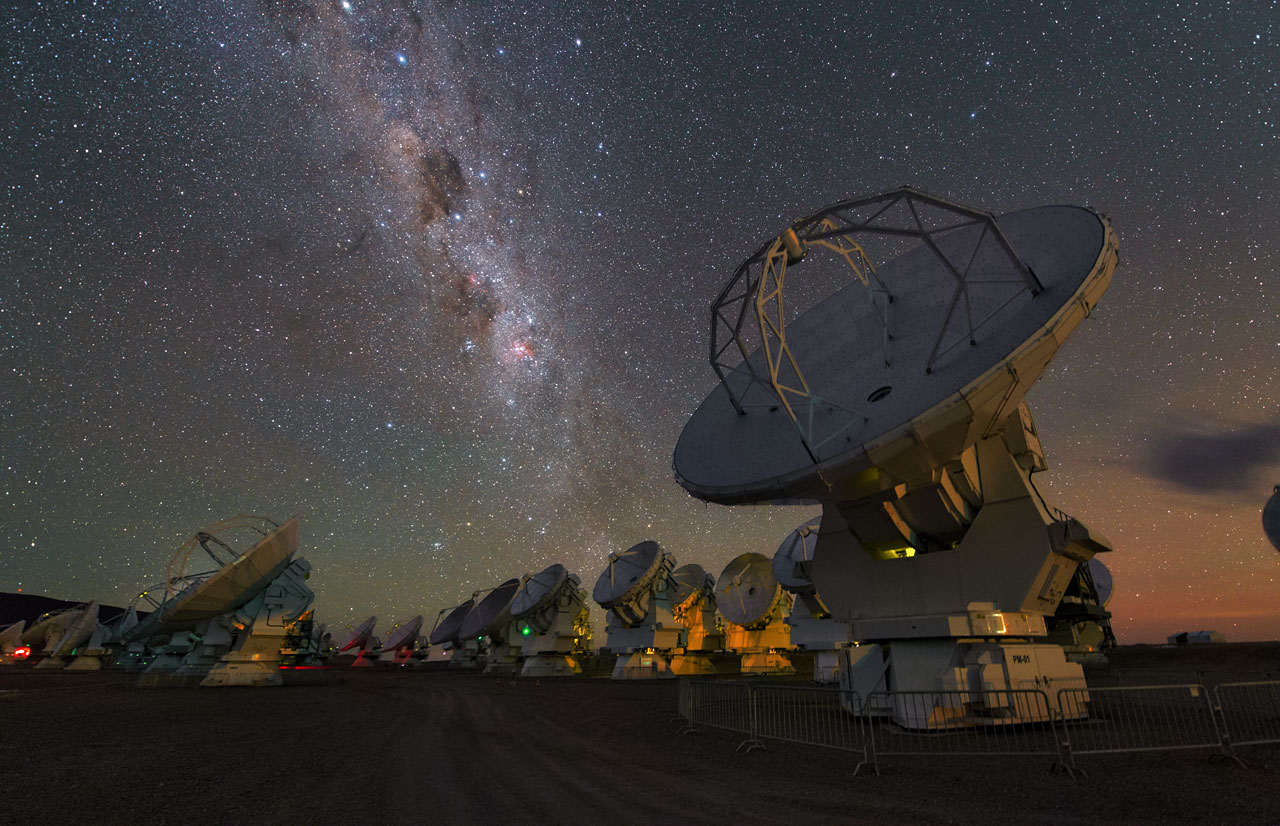
In der vorigen Woche unterzeichnete die ESO im Rahmen einer virtuellen Zeremonie eine Vereinbarung mit dem französischen Nationalen Zentrum für wissenschaftliche Forschung (CNRS) über die Entwicklung eines Breitband-Zwischenfrequenzprozessors (WIFP) für das Atacama Large Millimeter/submillimeter Array (ALMA). An der Zeremonie nahmen Eric Villard von der ESO, Martin Zwaan vom ALMA-Entwicklungsteam der ESO sowie Elizabeth Humphreys, die europäische ALMA-Programmmanagerin, teil. Aus Bordeaux (Frankreich) waren Sean Raymond, Benoit Lavraud und Benjamin Quertier-Dagorn bei der Unterzeichnung anwesend, zusammen mit Álvaro González, dem stellvertretenden ALMA-Entwicklungsleiter, der am Joint ALMA Observatory in Chile tätig ist.
ALMA, das sich in der chilenischen Atacama-Wüste befindet, wird derzeit einer umfassenden Modernisierung unterzogen, die als Wideband Sensitivity Upgrade bezeichnet wird und darauf abzielt, die Anlage auf dem neuesten Stand der Technik zu halten. Die Modernisierung umfasst die meisten Komponenten der Anlage, von Aktualisierungen der Elektronik in den 66 Antennenschüsseln bis hin zu Änderungen am Korrelator (dem Supercomputer, in dem die Signale der Antennen zusammengeführt werden) und an den Glasfasersystemen. Durch die Modernisierung wird die Beobachtungsbandbreite von ALMA – also der Frequenzbereich, in dem simultan beobachtet werden kann – in einer ersten Phase um den Faktor 2 und nach Abschluss der Arbeiten um den Faktor 4 erhöht. Zudem wird die Empfindlichkeit von ALMA deutlich verbessert, sodass Astronomen schwächere und weiter entfernte Objekte schneller untersuchen können.
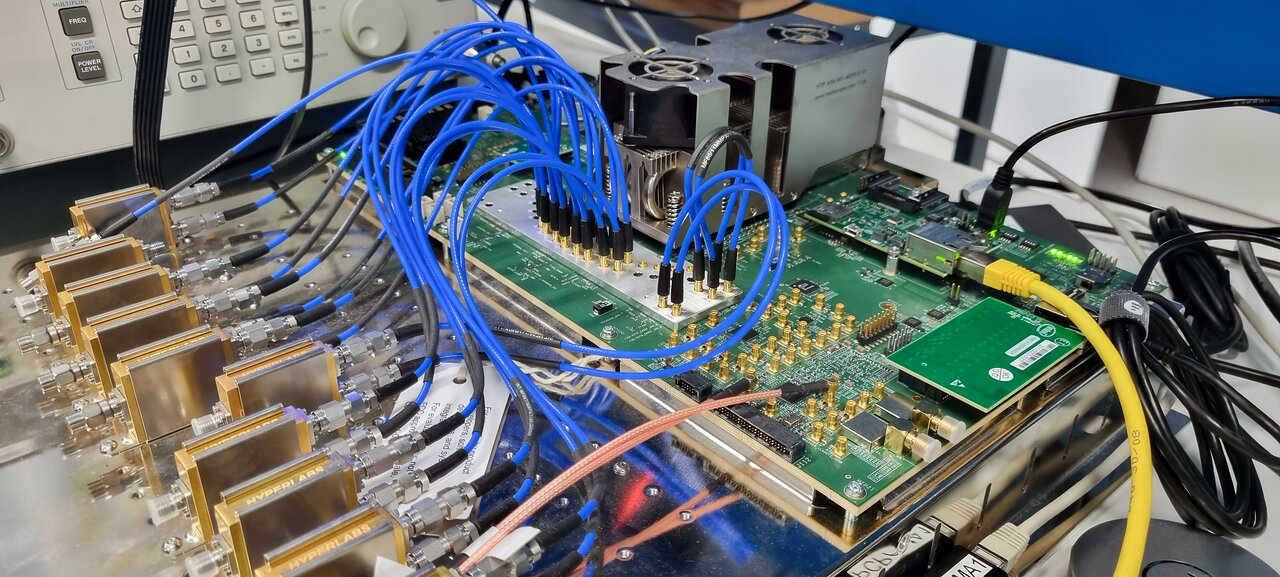
Die ALMA-Antennenschüsseln empfangen Signale aus dem Kosmos mit Wellenlängen im Millimeter- und Submillimeterbereich, was Frequenzen von einigen zehn Gigahertz bis zu einem Terahertz entspricht. Da diese Frequenzen sehr hoch sind, werden sie in niedrigere „Zwischenfrequenzen“ (IF) umgewandelt, die sich leichter verarbeiten lassen. Das WIFP-Projekt zielt darauf ab, die erforderlichen Geräte zu entwickeln und bereitzustellen, um die analogen IF-Signale der Antennen zu digitalisieren und für den Transport zum Korrelator vorzubereiten, wo die Signale zusammengeführt werden. Das WIFP ist daher ein entscheidender Bestandteil des „Wideband Sensitivity Upgrade“.
Als europäischer Partner bei ALMA ist die ESO für einen wesentlichen Teil der Modernisierung verantwortlich. Das WIFP-Projekt ist einer der bedeutendsten Beiträge Europas zu dieser Modernisierung. Dadurch werden alle ALMA-Antennenschüsseln mit einer Digitalisierung der Empfängersignale, digitaler Signalverarbeitung, hochpräziser Zeitstempelung der Signale und Gesamtleistungsmessung ausgestattet. Im Vergleich zum bestehenden System wird das Signal mit einer Rate von 40 Milliarden Abtastungen pro Sekunde abgetastet – das ist zehnmal höher als bisher.
Insgesamt wird das WIFP den Datendurchsatz und die Beobachtungseffizienz von ALMA erheblich steigern und ist hinsichtlich der Effizienz mit dem Hinzufügen von sechs Antennen vergleichbar. Der Prozessor wird in Zusammenarbeit zwischen der ESO und dem Laboratoire d’Astrophysique de Bordeaux, das zur Universität Bordeaux und zum CNRS gehört, entwickelt und soll voraussichtlich Mitte 2028 fertiggestellt sein.
Weitere Informationen
ALMA ist eine Partnerschaft zwischen der ESO (als Vertreterin ihrer Mitgliedstaaten), der NSF (USA), der NINS (Japan) sowie der NRC (Kanada), dem NSTC und der ASIAA (Taiwan) und der KASI (Republik Korea) in Zusammenarbeit mit der Republik Chile. Das gemeinsame ALMA-Observatorium wird von der ESO, der AUI/NRAO und der NAOJ betrieben.
Links
Kontaktinformationen
Bárbara Ferreira
ESO Media Manager
Garching bei München, Germany
Tel: +49 89 3200 6670
Email: press@eso.org
Über die Mitteilung
| ID: | ann26005 |
Bilder



Our use of Cookies
We use cookies that are essential for accessing our websites and using our services. We also use cookies to analyse, measure and improve our websites’ performance, to enable content sharing via social media and to display media content hosted on third-party platforms.
ESO Cookies Policy
The European Organisation for Astronomical Research in the Southern Hemisphere (ESO) is the pre-eminent intergovernmental science and technology organisation in astronomy. It carries out an ambitious programme focused on the design, construction and operation of powerful ground-based observing facilities for astronomy.
This Cookies Policy is intended to provide clarity by outlining the cookies used on the ESO public websites, their functions, the options you have for controlling them, and the ways you can contact us for additional details.
What are cookies?
Cookies are small pieces of data stored on your device by websites you visit. They serve various purposes, such as remembering login credentials and preferences and enhance your browsing experience.
Categories of cookies we use
Essential cookies (always active): These cookies are strictly necessary for the proper functioning of our website. Without these cookies, the website cannot operate correctly, and certain services, such as logging in or accessing secure areas, may not be available; because they are essential for the website’s operation, they cannot be disabled.
Functional Cookies: These cookies enhance your browsing experience by enabling additional features and personalization, such as remembering your preferences and settings. While not strictly necessary for the website to function, they improve usability and convenience; these cookies are only placed if you provide your consent.
Analytics cookies: These cookies collect information about how visitors interact with our website, such as which pages are visited most often and how users navigate the site. This data helps us improve website performance, optimize content, and enhance the user experience; these cookies are only placed if you provide your consent. We use the following analytics cookies.
Matomo Cookies:
This website uses Matomo (formerly Piwik), an open source software which enables the statistical analysis of website visits. Matomo uses cookies (text files) which are saved on your computer and which allow us to analyze how you use our website. The website user information generated by the cookies will only be saved on the servers of our IT Department. We use this information to analyze www.eso.org visits and to prepare reports on website activities. These data will not be disclosed to third parties.
On behalf of ESO, Matomo will use this information for the purpose of evaluating your use of the website, compiling reports on website activity and providing other services relating to website activity and internet usage.
Matomo cookies settings:
Additional Third-party cookies on ESO websites: some of our pages display content from external providers, e.g. YouTube.
Such third-party services are outside of ESO control and may, at any time, change their terms of service, use of cookies, etc.
YouTube: Some videos on the ESO website are embedded from ESO’s official YouTube channel. We have enabled YouTube’s privacy-enhanced mode, meaning that no cookies are set unless the user actively clicks on the video to play it. Additionally, in this mode, YouTube does not store any personally identifiable cookie data for embedded video playbacks. For more details, please refer to YouTube’s embedding videos information page.
Cookies can also be classified based on the following elements.
Regarding the domain, there are:
- First-party cookies, set by the website you are currently visiting. They are stored by the same domain that you are browsing and are used to enhance your experience on that site;
- Third-party cookies, set by a domain other than the one you are currently visiting.
As for their duration, cookies can be:
- Browser-session cookies, which are deleted when the user closes the browser;
- Stored cookies, which stay on the user's device for a predetermined period of time.
How to manage cookies
Cookie settings: You can modify your cookie choices for the ESO webpages at any time by clicking on the link Cookie settings at the bottom of any page.
In your browser: If you wish to delete cookies or instruct your browser to delete or block cookies by default, please visit the help pages of your browser:
Please be aware that if you delete or decline cookies, certain functionalities of our website may be not be available and your browsing experience may be affected.
You can set most browsers to prevent any cookies being placed on your device, but you may then have to manually adjust some preferences every time you visit a site/page. And some services and functionalities may not work properly at all (e.g. profile logging-in, shop check out).
Updates to the ESO Cookies Policy
The ESO Cookies Policy may be subject to future updates, which will be made available on this page.
Additional information
For any queries related to cookies, please contact: pdprATesoDOTorg.
As ESO public webpages are managed by our Department of Communication, your questions will be dealt with the support of the said Department.