Annuncio
BlueMUSE: ESO signs agreement for new instrument on the VLT
30 Gennaio 2026
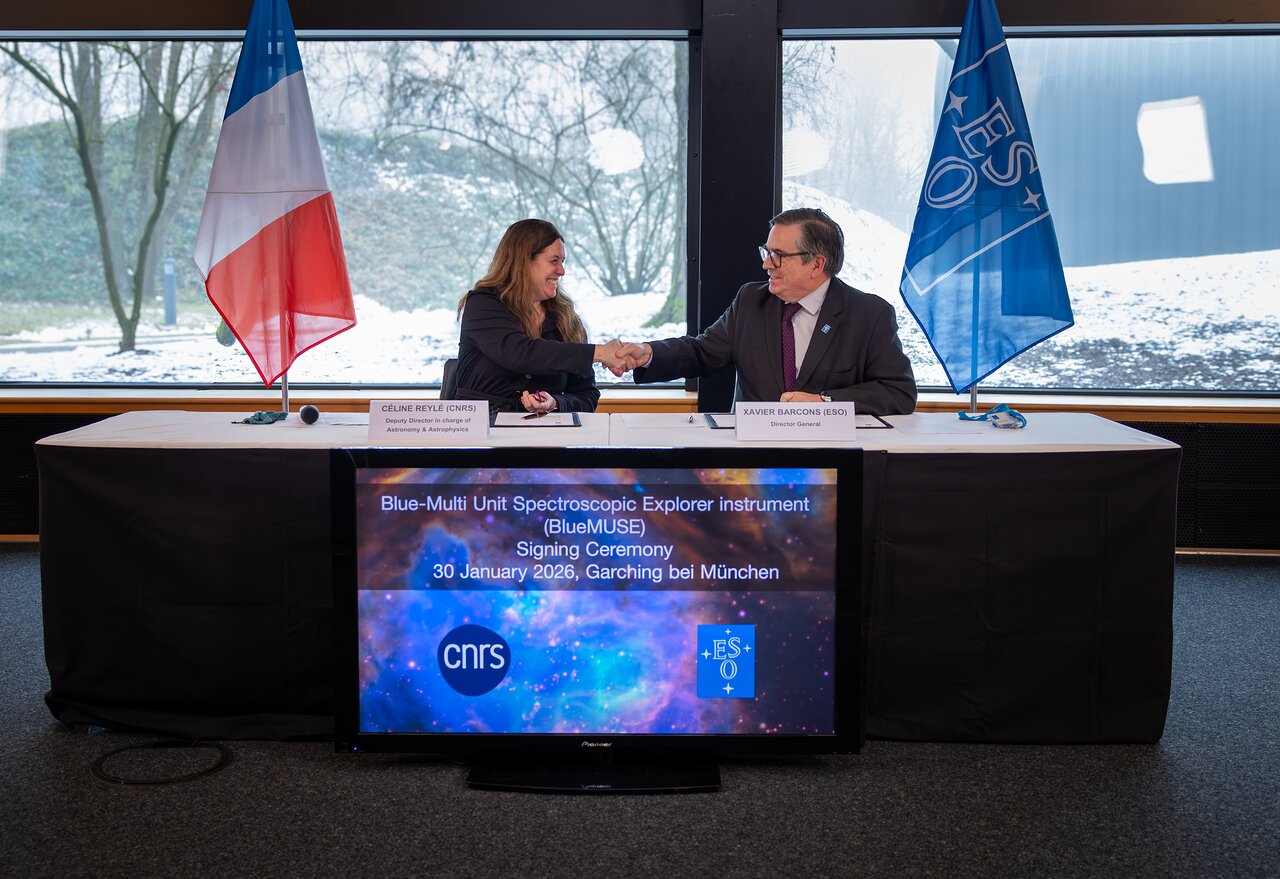
Today, ESO has signed the agreement for the construction of the Blue Multi Unit Spectroscopic Explorer (BlueMUSE), an upcoming instrument for ESO’s Very Large Telescope (VLT). The signing marks a major first step in the development of BlueMUSE , which will offer new and unique science opportunities to astronomers. Its evolved technology will enable detailed observations within our galaxy, helping study targets as varied as massive stars, nebulae and comets. It will also revolutionise the study of the distant Universe by allowing the detection of the diffuse material in the space between galaxies and helping us understand how matter moves within it.
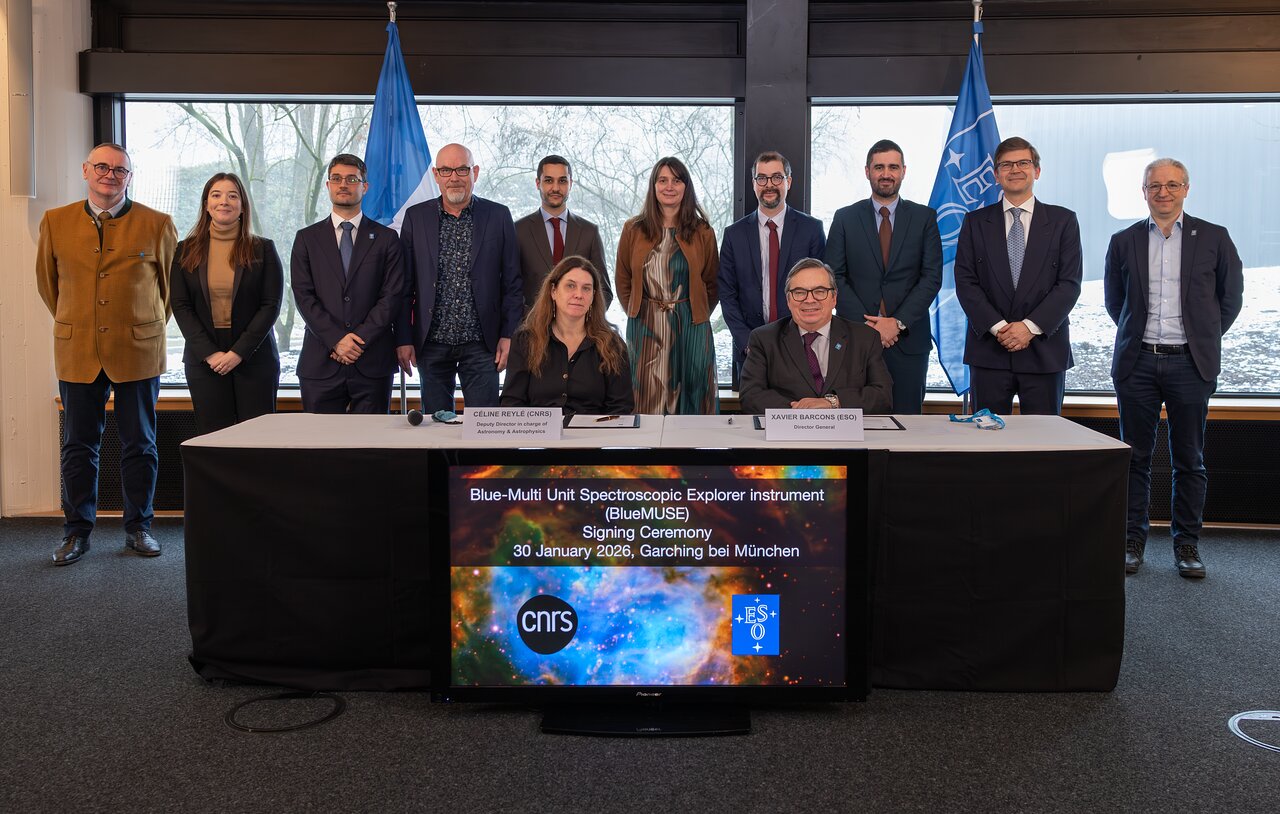
Earlier today, ESO’s Director General Xavier Barcons and Céline Reylé, the Deputy Director for Science for Astronomy and Astrophysics at the French National Centre for Scientific Research (CNRS), signed the BlueMUSE agreement at the ESO Headquarters in Garching, Germany. The CNRS’s Centre de Recherche Astrophysique de Lyon (CRAL – CNRS/ENS de Lyon/Claude Bernard Lyon 1 University) is the institution leading the instrument consortium, which consists of multiple institutes from Europe and Australia. Also in attendance were the French Science and Higher Education Attaché for Southern Germany, Emmanuel Delille, the Principal Investigator of BlueMUSE Johan Richard and the Project Manager Rémi Giroud, both from CRAL, in addition to other dignitaries of ESO and the BlueMUSE consortium [1], to commemorate the next step in the instrument’s construction.
Based on the successful technology of the MUSE instrument installed at the VLT, BlueMUSE is an integral-field spectrograph. It is designed to not only capture a 2D image of a target (or multiple targets) but also split the light into its component colours or wavelengths at each pixel, resulting in a full 3D dataset with comprehensive information on the target object. As MUSE has become one of the most productive and requested ESO instruments, the astronomical community has been hoping for a similar instrument for some time — this is now becoming a reality.
While like MUSE in many respects, BlueMUSE will observe in shorter and therefore bluer wavelengths, with higher spectral resolution (how finely it can distinguish between different wavelengths). This means it will strongly complement large ground- and space-based facilities, such as ESO’s upcoming Extremely Large Telescope and the James Webb Space Telescope, which are optimised to observe in the infrared.
Anticipated to see first-light in 2034, BlueMUSE will enable new science opportunities, beyond those possible with MUSE. It will survey larger samples of massive stars in the Milky Way and its galactic neighbourhood, helping answer key questions about stellar evolution. Further afield, it will be able to observe faint galaxies, as well as starburst galaxies, probing their extreme star-forming environment. BlueMUSE will also be ideally suited to study the distant Universe, in particular to detect the very diffuse, elusive matter that permeates the space between galaxies, as well as to probe the emergence of the first galaxy clusters.
Notes
[1] Attendees at the signing ceremony included Karine Perraut (French ESO Council delegate, from the Institut national des sciences de l’Univers (INSU), CNRS Earth & Space, France), Florence Laurent (BlueMUSE System Engineer at CNRS), Davor Krajnović (BlueMUSE Project Scientist, Leibniz-Institut für Astrophysik Potsdam, Germany), Alexandre Jeanneau (BlueMUSE Lead Optical Engineer at CNRS).
From ESO, in addition to Xavier Barcons, Frédéric Derie (Project Manager), Francesco Belfiore (Project Scientist), Reinhold Dorn (Project Engineer), Michele Cirasuolo (Instrumentation Programme Manager), Suzanne Ramsay (Deputy Instrumentation Programme Manager), Céline Péroux (Programme Scientist), Andrea Capardi (Programme Controller), Enrico Marchetti (Instrumentation Programme Engineer), Emanuela Ciattaglia (Instrumentation Programme Engineer), Diogo Rio Fernandes (Instrumentation Programme Engineer), Alain Delorme (Acting Head of Contracts & Procurement) and Cyrielle Blanc (Contract and Procurement Officer) were present.
More Information
The BlueMUSE project will be built by an international consortium composed of 9 research institutes in multiple countries and ESO. The consortium consists of
- Australia: Australian Astronomical Optics; Macquarie University
- France: Centre de Recherche Astrophysique de Lyon (CRAL - CNRS/ENS de Lyon/Claude Bernard Lyon 1 University; lead); Astrophysique, Instrumentation & Modélisation (AIM – CEA/CNRS/ Université Paris Cité); Institut de Recherche sur les lois Fondamentales de l’Univers (CEA/Saclay)
- Germany: Leibniz Institute for Astrophysics Potsdam (AIP) in association with University of Potsdam and University of Göttingen
- Portugal: Institute of Astrophysics and Space Sciences
- Sweden: Department of Astronomy, Stockholm University
- Switzerland: Observatoire astronomique de l’Université de Genève; Laboratory of Astrophysics, Ecole Polytechnique Fédérale de Lausanne (EPFL)
- United Kingdom: Centre for Advanced Instrumentation and Centre for Extragalactic Astronomy, Physics Department, Durham University
ESO also contributes to the project development.
Links
Contatti
Bárbara Ferreira
ESO Media Manager
Garching bei München, Germany
Tel: +49 89 3200 6670
Email: press@eso.org
Riguardo all'annuncio
| Identificazione: | ann26001 |
Immagini




Our use of Cookies
We use cookies that are essential for accessing our websites and using our services. We also use cookies to analyse, measure and improve our websites’ performance, to enable content sharing via social media and to display media content hosted on third-party platforms.
ESO Cookies Policy
The European Organisation for Astronomical Research in the Southern Hemisphere (ESO) is the pre-eminent intergovernmental science and technology organisation in astronomy. It carries out an ambitious programme focused on the design, construction and operation of powerful ground-based observing facilities for astronomy.
This Cookies Policy is intended to provide clarity by outlining the cookies used on the ESO public websites, their functions, the options you have for controlling them, and the ways you can contact us for additional details.
What are cookies?
Cookies are small pieces of data stored on your device by websites you visit. They serve various purposes, such as remembering login credentials and preferences and enhance your browsing experience.
Categories of cookies we use
Essential cookies (always active): These cookies are strictly necessary for the proper functioning of our website. Without these cookies, the website cannot operate correctly, and certain services, such as logging in or accessing secure areas, may not be available; because they are essential for the website’s operation, they cannot be disabled.
Functional Cookies: These cookies enhance your browsing experience by enabling additional features and personalization, such as remembering your preferences and settings. While not strictly necessary for the website to function, they improve usability and convenience; these cookies are only placed if you provide your consent.
Analytics cookies: These cookies collect information about how visitors interact with our website, such as which pages are visited most often and how users navigate the site. This data helps us improve website performance, optimize content, and enhance the user experience; these cookies are only placed if you provide your consent. We use the following analytics cookies.
Matomo Cookies:
This website uses Matomo (formerly Piwik), an open source software which enables the statistical analysis of website visits. Matomo uses cookies (text files) which are saved on your computer and which allow us to analyze how you use our website. The website user information generated by the cookies will only be saved on the servers of our IT Department. We use this information to analyze www.eso.org visits and to prepare reports on website activities. These data will not be disclosed to third parties.
On behalf of ESO, Matomo will use this information for the purpose of evaluating your use of the website, compiling reports on website activity and providing other services relating to website activity and internet usage.
Matomo cookies settings:
Additional Third-party cookies on ESO websites: some of our pages display content from external providers, e.g. YouTube.
Such third-party services are outside of ESO control and may, at any time, change their terms of service, use of cookies, etc.
YouTube: Some videos on the ESO website are embedded from ESO’s official YouTube channel. We have enabled YouTube’s privacy-enhanced mode, meaning that no cookies are set unless the user actively clicks on the video to play it. Additionally, in this mode, YouTube does not store any personally identifiable cookie data for embedded video playbacks. For more details, please refer to YouTube’s embedding videos information page.
Cookies can also be classified based on the following elements.
Regarding the domain, there are:
- First-party cookies, set by the website you are currently visiting. They are stored by the same domain that you are browsing and are used to enhance your experience on that site;
- Third-party cookies, set by a domain other than the one you are currently visiting.
As for their duration, cookies can be:
- Browser-session cookies, which are deleted when the user closes the browser;
- Stored cookies, which stay on the user's device for a predetermined period of time.
How to manage cookies
Cookie settings: You can modify your cookie choices for the ESO webpages at any time by clicking on the link Cookie settings at the bottom of any page.
In your browser: If you wish to delete cookies or instruct your browser to delete or block cookies by default, please visit the help pages of your browser:
Please be aware that if you delete or decline cookies, certain functionalities of our website may be not be available and your browsing experience may be affected.
You can set most browsers to prevent any cookies being placed on your device, but you may then have to manually adjust some preferences every time you visit a site/page. And some services and functionalities may not work properly at all (e.g. profile logging-in, shop check out).
Updates to the ESO Cookies Policy
The ESO Cookies Policy may be subject to future updates, which will be made available on this page.
Additional information
For any queries related to cookies, please contact: pdprATesoDOTorg.
As ESO public webpages are managed by our Department of Communication, your questions will be dealt with the support of the said Department.