
Comunicato Stampa
Strani venti rivelano gli indizi più forti finora di attività magnetica negli esopianeti
02 Giugno 2026
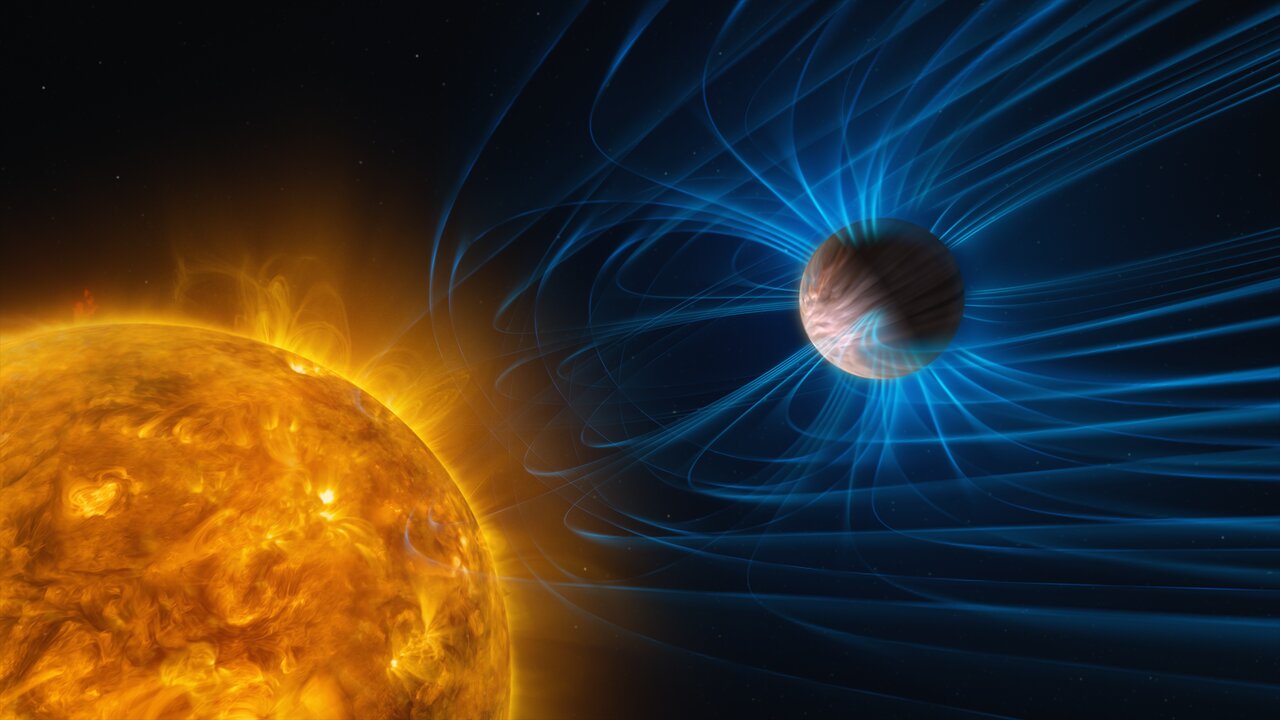
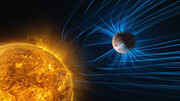
Un gruppo di astronomi ha trovato la prova finora più convincente che alcuni pianeti al di fuori del Sistema Solare potrebbero avere dei campi magnetici. Utilizzando il VLT (Very Large Telescope) dell'Osservatorio Europeo Australe (ESO) e il telescopio Gemini Nord, i ricercatori hanno misurato la velocità del vento su sette esopianeti molto caldi, simili a Giove. Le osservazioni hanno rivelato che i venti su questi pianeti sono molto probabilmente governati da campi magnetici, fornendo la prima misura affidabile dei campi magnetici su pianeti esterni al Sistema Solare.
"Questa scoperta rivoluzionaria apre una prospettiva completamente nuova sulla ricerca sugli esopianeti. È la prima volta che possiamo confrontare la presenza di campi magnetici nell'ambiente di altri mondi: un passo fondamentale per comprendere quali pianeti possono rimanere abitabili, conservare l'acqua e forse, un giorno, ospitare la vita come la conosciamo", afferma Julia Seidel, astronoma del Laboratoire Lagrange, Observatoire de la Côte d’Azur, in Francia, e autrice principale dello studio pubblicato oggi su Nature Astronomy.
Il campo magnetico terrestre agisce come uno scudo: aiuta a impedire che le radiazioni cosmiche disperdano la nostra atmosfera, mantenendo il pianeta adatto alla presenza di vita. I campi magnetici sono presenti anche in altri pianeti del Sistema Solare, come Giove e Saturno. Tuttavia, negli ultimi 15 anni, nessuno era riuscito a misurare direttamente l'intensità del campo magnetico degli esopianeti. Fino ad ora.
Il gruppo di lavoro, in realtà, non si era prefissato di misurare il campo magnetico, bensì i venti. Hanno misurato la velocità del vento su sette esopianeti in orbita intorno a diverse stelle: giganti gassosi come Giove, ma ciascuno in rotazione sincrona con la propria stella e molto vicino a essa. Proprio come noi vediamo sempre lo stesso lato della Luna, questi pianeti mantengono sempre la stessa faccia rivolta verso la stella, per cui il lato diurno risulta rovente e quello notturno gelido. La notevole differenza di temperatura crea un clima completamente diverso da quello del nostro pianeta, con venti estremamente forti. La velocità dei venti nel campione analizzato varia da circa 7200 km/h a oltre 25 000 km/h; a titolo di confronto, i venti più veloci misurati su Giove raggiungono velocità di circa 1500 km/h.
"Inizialmente ci eravamo proposti di verificare se i venti atmosferici si comportassero nello stesso modo su tutti i pianeti caldi", spiega Seidel, in passato astronoma dell'ESO in Cile. Per le misure, il gruppo ha utilizzato i dati dello strumento ESPRESSO installato sul VLT dell'ESO, nel deserto di Atacama in Cile, e di uno strumento simile installato sul telescopio Gemini Nord alle Hawaii, negli Stati Uniti d'America. (Il VLT è un telescopio dell'ESO, mentre Gemini North è una delle due metà dell'Osservatorio Internazionale Gemini, finanziato in parte dalla National Science Foundation (NSF) statunitense e gestito da NSF NOIRLab).
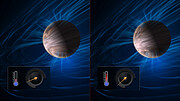
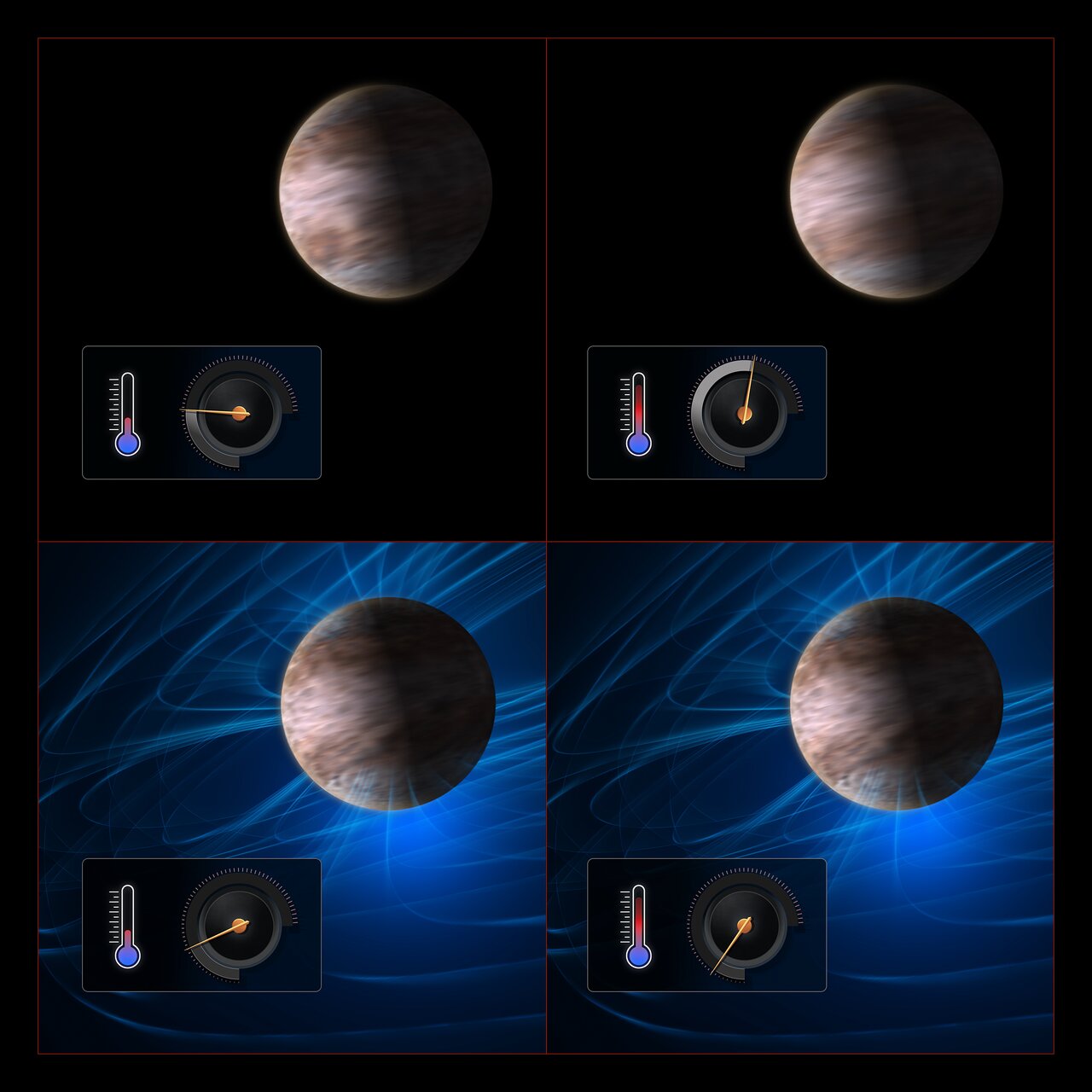
Ma, analizzando la variazione della velocità dei venti in funzione della temperatura del pianeta, hanno notato uno schema molto interessante: più il pianeta è caldo, più il vento è lento. "Questo è totalmente controintuitivo perché, a parità di altre condizioni, i pianeti caldi hanno più energia per accelerare i venti! Ci dev'essere qualcosa che rallenta la velocità del vento negli oggetti più caldi", aggiune Vivien Parmentier, professore presso il Laboratoire Lagrange e coautore dello studio.
Gli autori hanno concluso che la spiegazione più plausibile per questo mistero è la presenza di campi magnetici che permeano il pianeta, poiché questi campi possono agire da freno, rallentando il moto delle particelle cariche nell'atmosfera. I dati hanno quindi permesso ai ricercatori di dedurre l'intensità del campo magnetico in ciascuno dei pianeti studiati. Hanno scoperto che la loro intensità è paragonabile a quella dei campi magnetici del Sistema Solare: circa quattro volte più forte di quello di Saturno o circa la metà di quello di Giove.
Campi magnetici così intensi potrebbero influenzare non solo il vento su questi pianeti lontani. "Qui, sulla Terra, conosciamo la bellezza delle aurore boreali e australi, che si producono quando particelle provenienti dal Sole colpiscono il campo magnetico terrestre e vengono guidate verso i poli, collidendo con i gas nell'atmosfera per produrre questi spettacoli colorati di verde, rosa e viola", spiega Bibiana Prinoth, coautrice dello studio, ex dottoranda presso l'Università di Lund, in Svezia, ora astronoma dell'ESO a Garching, in Germania. Sugli esopianeti studiati, le aurore generate dai campi magnetici potrebbero essere ancora più spettacolari. Il gruppo attende con impazienza l'arrivo dell'ELT, l'Extremely Large Telescope dell'ESO, che aiuterà a caratterizzare non solo gli esopianeti di grandi dimensioni, simili a Giove, ma anche quelli più piccoli, simili alla Terra, e forse persino a rivelare i gas che potrebbero produrre aurore su questi mondi lontani. Prinoth afferma: "Mi piace immaginare che alcuni di questi mondi abbiano un cielo pieno non solo di stelle, ma di immense cortine di luce colorata che danzano su un pianeta che è per metà in un giorno perpetuo e per metà in una notte senza fine".
Ulteriori Informazioni
Questo studio è stato presentato in un articolo pubblicato dalla rivista Nature Astornomy (doi: )
L'equipe è composta da Julia V. Seidel (European Southern Observatory, Santiago, Cile [ESO Chile]; Université Côte d’Azur, Observatoire de la Côte d’Azur, CNRS, Laboratoire Lagrange, Francia [Lagrange]), Vivien Parmentier (Lagrange), Bibiana Prinoth (Lund Observatory, Division of Astrophysics, Department of Physics, Lund University, Lund, Svezia [LU]), Thea Hood (Lagrange), Nishil Mehta (Lagrange), Brian Thorsbro (Lagrange, LU), Konstantin Batygin (Division of Geological and Planetary Sciences, California Institute of Technology, USA), Tristan Guillot (Lagrange), Ragnar van den Broeck (Lagrange), Florian Debras (IRAP, Université de Toulouse, Toulouse, Francia), Daniel D. B. Koll (School of Physics, Peking University), Thaddeus Komacek (Department of Physics -Atmospheric, Oceanic and Planetary Physics-, University of Oxford, Oxford, Regno Unito [Oxford]), Hayley Beltz (Department of Astronomy, University of Maryland, College Park, USA), Emily Rauscher (Department of Astronomy and Astrophysics, University of Michigan, MI, USA), Lorenzo Pino (INAF - Osservatorio Astrofisico di Arcetri, Firenze, Italia), Matteo Brogi (Dipartimento di Fisica, Università di Ferrara, Ferrara, Italy; INAF – Osservatorio Astrofisico di Torino, Torino, Italia), Joost P. Wardenier (Département de Physique, Institut Trottier de Recherche sur les Exoplanètes, Université de Montréal, Canada [iREx]), Jacob L. Bean (Department of Astronomy & Astrophysics, University of Chicago, Chicago, USA [Chicago]), Björn Benneke (iREx e Department of Earth, Planetary, and Space Sciences, University of California, Los Angeles, CA 90095, USA), Jean-Michel L. B. Desert (Anton Pannekoek Institute for Astronomy, University of Amsterdam, Amsterdam, Paesi Bassi), Pablo Drake (Lagrange), Siddharth Gandhi (Department of Physics, University of Warwick, Coventry, Regno Unito e Centre for Exoplanets and Habitability, University of Warwick, Coventry, Regno Unito), Mark Hammond (Oxford), David Kasper (Chicago), Michael R. Line (School of Earth and Space Exploration, Arizona State University, Tempe, USA [SESE]), Elspeth Lee (Center for Space and Habitability, University of Bern, Bern, Svizzera), Stefan Pelletier (Observatoire astronomique de l’Université de Genève, Versoix, Svizzera), Andreas Seifahrt (International Gemini Observatory/NSF NOIRLab, Tucson, USA), Adrien Simonnin (Lagrange), Peter Smith (SESE), e Kevin B. Stevenson (JHU Applied Physics Laboratory, Laurel, USA).
L'ESO (European Southern Observatory o Osservatorio Europeo Australe) consente agli scienziati di tutto il mondo di scoprire i segreti dell'Universo a beneficio di tutti. Progettiamo, costruiamo e gestiamo da terra osservatori di livello mondiale - che gli astronomi utilizzano per affrontare temi interessanti e diffondere il fascino dell'astronomia - e promuoviamo la collaborazione internazionale per l'astronomia. Fondato come organizzazione intergovernativa nel 1962, oggi l'ESO è sostenuto da 16 Stati membri (Austria, Belgio, Danimarca, Francia, Finlandia, Germania, Irlanda, Italia, Paesi Bassi, Polonia, Portogallo, Regno Unito, Repubblica Ceca, Spagna, Svezia e Svizzera), insime con il paese che ospita l'ESO, il Cile, e l'Australia come partner strategico. Il quartier generale dell'ESO e il Planetario e Centro Visite Supernova dell'ESO si trovano vicino a Monaco, in Germania, mentre il deserto cileno di Atacama, un luogo meraviglioso con condizioni uniche per osservare il cielo, ospita i nostri telescopi. L'ESO gestisce tre siti osservativi: La Silla, Paranal e Chajnantor. Sul Paranal, l’ESO gestisce il VLT (Very Large Telescope) e il VLTI (Very Large Telescope Interferometer), così come due telescopi per survey, VISTA, che lavora nell'infrarosso, e VST (VLT Survey Telescope) in luce visibile. Sempre a Paranal l'ESO ospiterà e gestirà la schiera meridionale di telescopi di CTA, il Cherenkov Telescope Array Sud, il più grande e sensibile osservatorio di raggi gamma del mondo. Insieme con partner internazionali, l’ESO gestisce APEX e ALMA a Chajnantor, due strutture che osservano il cielo nella banda millimetrica e submillimetrica. A Cerro Armazones, vicino a Paranal, stiamo costruendo "il più grande occhio del mondo rivolto al cielo" - l'ELT (Extremely Large Telescope, che significa Telescopio Estremamente Grande) dell'ESO. Dai nostri uffici di Santiago, in Cile, sosteniamo le operazioni nel paese e collaboriamo con i nostri partner e la società cileni.
La traduzione dall'inglese dei comunicati stampa dell'ESO è un servizio dalla Rete di Divulgazione Scientifica dell'ESO (ESON: ESO Science Outreach Network) composta da ricercatori e divulgatori scientifici da tutti gli Stati Membri dell'ESO e altri paesi. Il nodo italiano della rete ESON è gestito da Anna Wolter.
Links
- Articolo scientifico
- Fotografie del VLT
- Scoprite ulteriori informazioni sull'ELT (Extremely Large Telescope) dell'ESO's sul sito dedicato e nella cartella stampa
- Per i giornalisti: iscrivetevi per ricevere i nostri comunicati sotto embargo nella vostra lingua
- Per i ricercatori: avete una storia da raccontare? Promuovete il vostro articolo scientifico
Contatti
Julia Victoria Seidel
Lagrange Laboratory, Observatoire de la Côte d'Azur
Nice, France
Tel.: +33 743 32 79 73
E-mail: jseidel@oca.eu
Vivien Parmentier
Lagrange Laboratory, Observatoire de la Côte d'Azur
Nice, France
E-mail: Vivien.PARMENTIER@univ-cotedazur.fr
Bibiana Prinoth
European Southern Observatory (ESO)
Garching bei München, Germany
E-mail: bibiana.prinoth@eso.org
Bárbara Ferreira
ESO Media Manager
Garching bei München, Germany
Tel.: +49 89 3200 6670
Cell.: +49 151 241 664 00
E-mail: press@eso.org
Joerg Gasser (press contact Svizzera)
Rete di divulgazione scientifica dell'ESO
E-mail: eson-switzerland@eso.org
Sul Comunicato Stampa
| Comunicato Stampa N": | eso2606it-ch |
| Legacy ID: | eso26-Seidel |
| Tipo: | Milky Way : Star : Circumstellar Material : Planetary System |
| Science data: | 2026NatAs..10.1145S |
Immagini
Video
Our use of Cookies
We use cookies that are essential for accessing our websites and using our services. We also use cookies to analyse, measure and improve our websites’ performance, to enable content sharing via social media and to display media content hosted on third-party platforms.
ESO Cookies Policy
The European Organisation for Astronomical Research in the Southern Hemisphere (ESO) is the pre-eminent intergovernmental science and technology organisation in astronomy. It carries out an ambitious programme focused on the design, construction and operation of powerful ground-based observing facilities for astronomy.
This Cookies Policy is intended to provide clarity by outlining the cookies used on the ESO public websites, their functions, the options you have for controlling them, and the ways you can contact us for additional details.
What are cookies?
Cookies are small pieces of data stored on your device by websites you visit. They serve various purposes, such as remembering login credentials and preferences and enhance your browsing experience.
Categories of cookies we use
Essential cookies (always active): These cookies are strictly necessary for the proper functioning of our website. Without these cookies, the website cannot operate correctly, and certain services, such as logging in or accessing secure areas, may not be available; because they are essential for the website’s operation, they cannot be disabled.
Functional Cookies: These cookies enhance your browsing experience by enabling additional features and personalization, such as remembering your preferences and settings. While not strictly necessary for the website to function, they improve usability and convenience; these cookies are only placed if you provide your consent.
Analytics cookies: These cookies collect information about how visitors interact with our website, such as which pages are visited most often and how users navigate the site. This data helps us improve website performance, optimize content, and enhance the user experience; these cookies are only placed if you provide your consent. We use the following analytics cookies.
Matomo Cookies:
This website uses Matomo (formerly Piwik), an open source software which enables the statistical analysis of website visits. Matomo uses cookies (text files) which are saved on your computer and which allow us to analyze how you use our website. The website user information generated by the cookies will only be saved on the servers of our IT Department. We use this information to analyze www.eso.org visits and to prepare reports on website activities. These data will not be disclosed to third parties.
On behalf of ESO, Matomo will use this information for the purpose of evaluating your use of the website, compiling reports on website activity and providing other services relating to website activity and internet usage.
Matomo cookies settings:
Additional Third-party cookies on ESO websites: some of our pages display content from external providers, e.g. YouTube.
Such third-party services are outside of ESO control and may, at any time, change their terms of service, use of cookies, etc.
YouTube: Some videos on the ESO website are embedded from ESO’s official YouTube channel. We have enabled YouTube’s privacy-enhanced mode, meaning that no cookies are set unless the user actively clicks on the video to play it. Additionally, in this mode, YouTube does not store any personally identifiable cookie data for embedded video playbacks. For more details, please refer to YouTube’s embedding videos information page.
Cookies can also be classified based on the following elements.
Regarding the domain, there are:
- First-party cookies, set by the website you are currently visiting. They are stored by the same domain that you are browsing and are used to enhance your experience on that site;
- Third-party cookies, set by a domain other than the one you are currently visiting.
As for their duration, cookies can be:
- Browser-session cookies, which are deleted when the user closes the browser;
- Stored cookies, which stay on the user's device for a predetermined period of time.
How to manage cookies
Cookie settings: You can modify your cookie choices for the ESO webpages at any time by clicking on the link Cookie settings at the bottom of any page.
In your browser: If you wish to delete cookies or instruct your browser to delete or block cookies by default, please visit the help pages of your browser:
Please be aware that if you delete or decline cookies, certain functionalities of our website may be not be available and your browsing experience may be affected.
You can set most browsers to prevent any cookies being placed on your device, but you may then have to manually adjust some preferences every time you visit a site/page. And some services and functionalities may not work properly at all (e.g. profile logging-in, shop check out).
Updates to the ESO Cookies Policy
The ESO Cookies Policy may be subject to future updates, which will be made available on this page.
Additional information
For any queries related to cookies, please contact: pdprATesoDOTorg.
As ESO public webpages are managed by our Department of Communication, your questions will be dealt with the support of the said Department.