PoET
The Paranal solar ESPRESSO Telescope
The hunt for other Earths is a key objective of modern day astrophysics, but faces considerable challenges. Our ability to detect and characterise exoplanets is severely impacted by astrophysical ‘noise’ originating from their host stars, which distorts observed spectra.
With that in mind, the Paranal solar ESPRESSO Telescope (PoET) was envisioned. Funded by the FIERCE project (FInding Exo-eaRths: tackling the ChallengEs of stellar activity, funded by the European Union, ERC, 101052347), and led by the Instituto de Astrofísica e Ciências do Espaço (IA), Portugal, the telescope aims to study the Sun to understand how other stars can hide their orbiting planets, advancing the search for exoplanets.
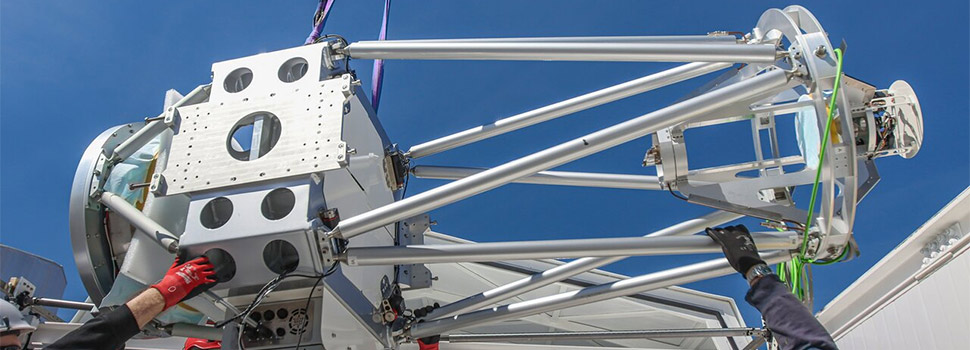
PoET, which is located at ESO’s Paranal Observatory, consists of a main telescope and a pointing telescope. The main one, with a diameter of 60 centimetres, is designed to observe small areas of the solar disc, and can make observations of stellar features on different spatial scales. The pointing telescope consists of two simple refractors, known as the ‘science’ and the ‘imaging’ telescopes, and collects light from the entire solar disc, identifying regions to be observed by the main telescope.
PoET, which is housed behind the Very Large Telescope (VLT) Interferometer Lab at the centre of the VLT platform, is linked through optical fibres to ESPRESSO, a spectrograph that normally operates as a VLT instrument. As ESPRESSO can be fed by two fibres at once, it can simultaneously capture the light emitted from stellar features and from the entire solar disc, something unprecedented on ground-based telescopes. Making observations during the day, the telescope won’t disrupt the VLT’s night-time use of ESPRESSO. PoET is operated remotely from IA's University of Porto pole, at the Centro de Astrofísica da Universidade do Porto (CAUP), Portugal.
PoET achieved first light in April 2026, and its data is available to other researchers through the ESO Science Archive Facility.
Science with PoET
PoET’s mission is to contribute to the detection and characterisation of exoplanets, by analysing the Sun to understand how the spectra of solar-type stars can mimic or disguise exoplanets’ signatures.
High-resolution spectroscopy is one of the main methods employed in the search and study of other worlds, detecting the subtle motions of a star and thus inferring the presence of a planet, complemented by transit photometry, which detects the periodic dimming of a star's light as an orbiting body passes in front of it. However, Sun-like stars have surface activity that can subtly distort the light detected by spectrographs used for exoplanet research, incorrectly hinting at an orbiting planet’s properties or disguising a exoplanet’s presence altogether. Different methods are currently used to correct this ‘noise’, but none have yet reached the required precision levels to observe other terrestrial worlds. Our incomplete knowledge of stellar physics is a key factor in the inability to solve this problem, as we cannot precisely model the effects we observe on the Sun and other stars.
The Sun is the only star for which we can resolve the stellar disc to the level of detail required, and, for that reason, it was chosen as a guide to understand the exact contribution of different regions to an overall stellar spectrum. PoET allows us to point to any region in the solar disc and inject its light, simultaneously with that coming from the entire disc, into ESPRESSO. In doing so, we can identify the different physical processes that result in stellar variations in solar-type stars, and understand, as well as possibly correct, their effects, which is fundamental to the success of exoplanet research.
More about PoET
Read more about this telescope on the PoET Webpage and in The Messenger.
PoET
| Name | Paranal solar Espresso Telescope |
| Site | Cerro Paranal |
| Altitude | 2635 m |
| Type | Solar telescope |
| Diameter. Primary M1: | 60 cm |
| Spectral resolution | Same as ESPRESSO: R ~ 140,000 (HR) and 190,000 (UHR) |
| Spatial resolution | 1, 2, 5, 10, 16, 30 and 55 arcseconds |
| First Light date: | 09 April 2026 |
| Images of PoET: | Link |
| Press Releases with PoET: | Link |