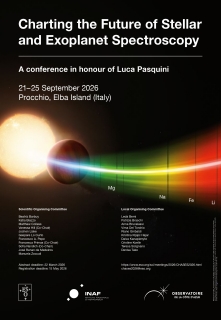
CHARTING THE FUTURE OF STELLAR AND EXOPLANET SPECTROSCOPY (CHASES 2026)
A conference in honour of Luca Pasquini
ESO–INAF–OCA Joint Conference
21 – 25 September 2026
Procchio, Elba Island, Italy
2026 will mark 25 years since the first light in Europe of the FLAMES instrument on the Very Large Telescope (VLT) of the European Southern Observatory (ESO). Its advent started the era of massive stellar spectroscopy with ESO instrumentation, while a few years earlier the FEROS and UVES spectrographs had instead initiated the flourishing of precision spectroscopy.
Indeed, over the past decades, high-resolution and multi-object spectroscopy have become very powerful tools in astrophysics, enabling transformative insights into stars, stellar systems and populations, our Galaxy, and extrasolar planets. The possibility to measure precise radial velocities and detailed elemental abundances has revolutionised our understanding of how stars evolve, and interact with their environments, and how these processes shape the chemical evolution of galaxies. Through the combination of precise abundances and modelling, we now better understand the formation and evolution of the Milky Way Galaxy and its components, we uncover subtle variations in light-element abundances and use them to trace stellar physics, to infer stellar ages, and to unveil the assembly history of globular clusters and other stellar populations. The same spectroscopic precision has opened new frontiers for the detection and characterisation of exoplanets, even in challenging environments such as star clusters, and for the study of solar twins as benchmarks for both stellar and planetary evolution.
Looking ahead, a new generation of instruments (some of which already operational like ESPRESSO and DESI) will soon start (WEAVE, 4MOST), is planned (MOONS), or proposed — from ultra-stable high-resolution spectrographs to massively multiplexed facilities on large telescopes- which are pushing the boundaries of both precision and scale.
These developments will enable the study of fainter and more distant systems with unprecedented detail and/or statistical power, opening new windows in our understanding of the exoplanet population, galactic archaeology, and fundamental physics. Indeed, by September 2026 we expect that many new results will be already emerging, while new instruments, such as 4MOST, will be starting operations and possibly delivering early science. The new instrumentation is also introducing new challenges, such as calibration at the cm/s level, uniform abundance scales across surveys, use of artificial intelligence for data analysis.
This conference will explore all these themes, bringing together communities working on instrumentation, stellar and exoplanet astrophysics, and chemical evolution. Some time will also be dedicated to complementary topics that benefit from high-precision spectroscopy. The conference will serve as a launchpad for reviewing the scientific landscape, new challenges, and priorities. 2026 indeed represents an interesting point in ESO’s timeline: a moment when the legacy of VLT instrumentation is since many years at its scientific peak, while the astronomical community is looking ahead to the next generation of telescopes and spectrographs, including the upcoming MOONS and CUBES, and, of course, the Extremely Large Telescope. 2026 is also important for the more distant future, considering the call for new VLT instrumentation within the VLT2030 roadmap and the Expanding Horizons initiative.
Finally, this conference will bring us together also to celebrate the career of Luca Pasquini, who has given a major contribution to all these research areas, pioneering and enabling many of these advances through his leadership within the ESO instrumentation group and as Head of the Paranal Instrumentation Programme. His career embodies the spirit of curiosity and rigor that continues to drive the field forward.
We hope to see many of you in Elba Island, to share your exciting science and to celebrate Luca’s achievement and legacy!
Sofia Randich (INAF), Vanessa Hill (OCA) and Francesca Primas (ESO)
E-mail: chases2026@eso.org

Quick links