



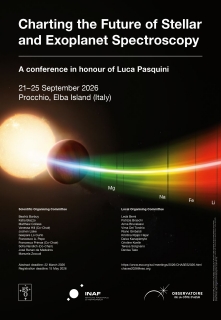
Conference Programme
(R) = Review talks (30min); (I) = Invited talks (20min); (C) = Contributed talks (15min)
Monday, 21 September
Chair: Vanessa Hill
| Time | Title | Speaker |
| 14:30 - 14:45 | Welcome | Randich/Primas/Hill |
| 14:45 - 15:05 | Tribute to Luca | Molaro / D'Odorico |
| 15:05 - 15:35 | A general perspective on ESO Instrumentation (R) | Kaufer |
| 15:35 - 15:50 | Results and lessons learned from the Near Infra-Red Planet Searcher NIRPS (C) | Bouchy |
| 15:50 - 16:05 | First light of the NIGHT spectrograph at the 152cm telescope of OHP (C) | Farret Jentink |
| 16:05 - 16:35 | Coffee break | |
| 16:35 - 16:55 | High Resolution Spectrographs (I) | Sbordone |
| 16:55 - 17:15 | Fundamental constants and ESO spectrographs (I) | Milakovic |
| 17:15 - 17:30 | High-fidelity extraction and calibration of high-resolution spectra for tests of fundamental physics (C) | Ristea |
| 17:30 - 17:50 | Constraining Newtonian dynamics with Wide Binaries (I) | Saglia |
| 17:50 - 18:10 | The intergalactic medium at high resolution: present results and future perspectives (I) | D'Odorico |
| 19:00 | Welcome Cocktail |
Tuesday, 22 September
Chairs: Francesca Primas & Francesco Pepe (sharing AM+PM)
| Time | Title | Speaker |
| 09:00 - 09:30 | Chemical evolution of the light elements Li, Be, and B (R) | Smiljanic |
| 09:30 - 09:45 | Galactic Li evolution with correction from stellar evolution: Milky Way discs and Gaia-Sausage-Enceladus (C) | Nguyen |
| 09:45 - 10:05 | Abundances of Li in clusters (I) | Bonifacio |
| 10:05 - 10:20 | Lithium-rich stars in globular clusters: a new perspective (C) | Mucciarelli |
| 10:20 - 10:35 | Detectability of deuterium in spectra of A-type stars (C) | Mitrokhina |
| 10:35 - 11:05 | Coffee break | |
| 11:05 - 11:35 | Exoplanets: in the prime of life, looking forward to a bright future (R) | Udry |
| 11:35 - 11:50 | Laser Frequnecy Combs in Astronomy (C) | Lo Curto |
| 11:50 - 12:10 | Calibrating spectrographs with laser frequency combs (I) | Obrzud |
| 12:10 - 12:25 | Optimizing the HARPS LFC-based wavelength solutions for science use (C) | Tavella |
| 12:30 - 15:30 | Lunch break | |
| 15:30 - 15:50 | Abundances and chemical evolution from a modelling point of view (I) | Kobayashi |
| 15:50 - 16:10 | Stellar elemental abundances: an observational view of the chemical revolution (I) | Feuillet |
| 16:10 - 16:25 | Chemical abundances as fossil records of dwarf galaxy evolution (C) | de Brito Silva |
| 16:25 - 16:40 | Chemical decoding the Galactic halo with large-scale surveys (C) | Mori |
| 16:40 - 17:15 | Coffee break | |
| 17:15 - 17:35 | Radial-velocity for exoplanet detection and stellar characterisation (I) | Dumusque |
| 17:35 - 17:50 | Mitigation techniques for OH contamination in NIR radial velocities, applied to faint NIRPS targets (C) | Frensch |
| 17:50 - 18:10 | Chasing stellar noise in the quest for other Earths: the PoET approach (I) | Santos |
| 18:10 - 18:25 | Using the Sun to benchmark stellar activity models for cm/s radial-velocity exoplanet detection (C) | Barka |
| 18:25 - 18:40 | Toward Earth Analog Detection: Constraining Granulation Noise with Disk-Resolved Solar Spectroscopy (C) | San Nicolas Martinez |
| 18:40 | END of DAY |
Wednesday, 23 September
Chairs: Katia Biazzo (AM) & Joe Liske (PM)
| Time | Title | Speaker |
| 09:00 - 09:20 | Beyond the surface: Chemical signatures of internal transport processes in stars (I) | Lagarde |
| 09:20 - 09:35 | The diffus(iv)e border between stellar atmospheres and stellar structure and evolution (C) | Korn |
| 09:35 - 09:50 | CNO abundances as probes of stellar and Galactic evolution (C) | Tautvaisiene |
| 09:50 - 10:05 | Binary Stars as Laboratories for detailed Stellar Abundance Studies (C) | Berni |
| 10:05 - 10:20 | Time domain high-resolution spectroscopy: investigating the magnetic star-disk interaction in young stars (C) | Bouvier |
| 10:20 - 10:35 | The first high-resolution view of Type II Cepheids: from stellar properties to the distance scale (C) | Sicignano |
| 10:35 - 11:05 | Coffee break | |
| 11:10 - 11:25 | The Gaia spectroscopic catalogue of exoplanet and host star parameters (C) | de Laverny |
| 11:25 - 11:40 | Accurate, Precise, and Homogeneous Exoplanet Host Star Parameters and Elemental Abundances (C) | McCreery |
| 11:40 - 11:55 | Is lithium in planet-host stars affected by the presence of their planets? (C) | Tsantaki |
| 11:55 - 12:10 | Be and Li as tracers of stellar depletion and planet engulfment (C) | Rathsam |
| 12:10 - 12:30 | Solar twins: Probing Planetary Systems, Stellar Evolution, and Galactic Archaeology (I) | Melendez |
| 12:30 - 12:45 | Poster Flash Talks | Ernandes, Posiłek, Hernández-Araya, Köhler, Cristi-Cambiaso |
| 12:45 - 15:30 | Lunch break | |
| 15:30 - 15:45 | Revisiting r-process signatures with 3D non-LTE stellar spectroscopy (C) | Racca |
| 15:45 - 16:00 | Tracing Ba and Eu abundances across the Galactic disc from Gaia-ESO FLAMES/GIRAFFE spectra using the Cannon (C) | Das |
| 16:00 - 16:15 | Barium Isotope Fractions as Reliable Tracers of Nucleosynthesis Processes (C) | Giribaldi |
| 16:15 - 16:30 | The r-process dominates neutron-capture elements production in the oldest SMC stars (C) | Santarelli |
| 16:30 - 16:45 | Neutron-capture elements in Gaia-Sausage-Enceladus: From Sr to Th (C) | Jameela |
| 16:45 - 17:15 | Coffee break | |
| 17:15 - 17:30 | Tracing Cosmic Enrichment Through Metal‑Poor Stars (C) | Saraf |
| 17:30 - 17:45 | Echoes of the Underdogs: unveiling the origin of the earliest Galactic disc stars with UVES (C) | Gonzalez Rivera |
| 17:45 - 18:00 | The oldest and most metal-poor stars in the Galactic disc: unveiling the Milky Way’s chemo-dynamical evolution (C) | Sestito |
| 18:00 - 18:15 | The impact of the first stars in two ultra-faint dwarf galaxies: Grus II and Tucana IV (C) | Verdiani |
| 18:15 - 18:30 | Unveiling Oxygen’s Past with Subaru/IRD: Oxygen Abundance of Very Metal-Poor Stars (C) | Budi |
| 18:30 | END of DAY |
Thursday, 24 September
Chairs: Gaspare Lo Curto (AM) & Beatriz Barbuy (PM)
| Time | Title | Speaker |
| 09:00 - 09:20 | The new generation of MOS at ESO and the future of spectroscopic surveys (I) | Mainieri |
| 09:20 - 09:40 | Towards Physically Realistic Stellar Spectroscopy across Cosmic Scales (I) | Lind |
| 09:40 - 09:55 | 3D non-LTE Na Abundances for the 1 Million Stars of GALAH DR4 (C) | Canocchi |
| 09:55 - 10:10 | Survey of Surveys: project status (C) | Avdeeva |
| 10:10 - 10:25 | The GAIA benchmark stars (C) | Vitali |
| 10:25 - 11:00 | Coffee break | |
| 11:00 - 11:20 | Exoplanet meteorology: charting the climate of exoplanets with high-resolution spectroscopy (I) | Seidel |
| 11:20 - 11:35 | Pushing the limits of high-resolution transmission spectroscopy with eccentric gas giants (C) | Prinoth |
| 11:35 - 11:50 | Time-Resolved Stellar Contamination in High-Resolution Transmission Spectroscopy (C) | Cristo |
| 11:50 - 12:05 | Impact of stellar spots on high-resolution transmission spectra of an Earth-like planet around a Sun-like star (C) | Peralta Lucero |
| 12:05 - 12:25 | Exoplanets in open clusters (I) | Nardiello |
| 12:25 - 12:40 | Poster Flash Talks | Cuadra, Sestito, Vitali, Niemczura |
| 12:45 - 15:30 | Lunch break | |
| 15:30 - 15:50 | Beyond Na–O: What Li, Be and He Tell Us About Globular Cluster Formation (I) | Lardo |
| 15:50 - 16:05 | GLIMPSE-C01: A Galactic Relic Hidden in the Dust (C) | Mura Guzmán |
| 16:05 - 16:20 | The Bulge Cluster Origin (BulCO) survey with CRIRES+ at the ESO-VLT: a chemical screening of the Globular Cluster NGC 6553 (C) | Bartolomei |
| 16:20 - 16:35 | HST+IGRINS synergy to characterise the newly discovered metal-rich bulge globular cluster Patchick 126 (C) | Garro |
| 16:35 - 16:50 | The Bulge Cluster Origin (BulCO) survey: results in Liller 1 (C) | Chiappino |
| 16:50 - 17:30 | Coffee break | |
| 17:30 - 17:45 | Chemical abundances and chemical evolution of the Galactic Center from high-resolution near-IR spectra (C) | Ryde |
| 17:45 - 18:00 | Uncovering the Milky Way bulge's neutron-capture dimension (C) | Rojas-Arriagada |
| 18:00 - 18:15 | Investigating the Milky Way's Origins: A Spectroscopic Survey of the Galactic Bulge (C) | Anacleto |
| 18:15 - 18:30 | First observations of dwarf galaxies with 4MOST (C) | Lucchesi |
| 20:00 | CONFERENCE Dinner |
Friday, 25 September
Chair: Sofia Randich
| Time | Title | Speaker |
| 09:30 - 09:55 | Instrumentation panorama (beyond ESO) (I) | Bernstein |
| 09:55 - 10:10 | Beyond Lenses: Computational Optics Empowers Observational Astronomy (C) | Wang |
| 10:10 - 10:25 | Small-ELF: A prototype telescope for future exoplanet life detection (C) | Lodieu |
| 10:25 - 11:00 | Coffee break | |
| 11:00 - 11:15 | CUBES: a UV spectrograph for the future (C) | Covino |
| 11:15 - 11:30 | Discovery of a Beryllium Anomaly in the Accreted Galaxy Thamnos-2 (C) | Molaro |
| 11:30 - 11:45 | Heavy Elements with HRMOS: Constraining Stellar Ages and Nucleosynthesis in the High-Resolution Era (C) | Magrini |
| 11:45 - 12:15 | Perspectives (R) | Pasquini |
| 12:15 - 12:30 | Closing | |
| 12:30 | END of CONFERENCE |
Quick links
E-mail: chases2026@eso.org