Mitteilung
2025 wurden mehr als 1100 Studien mit ESO-Daten veröffentlicht
10. März 2026
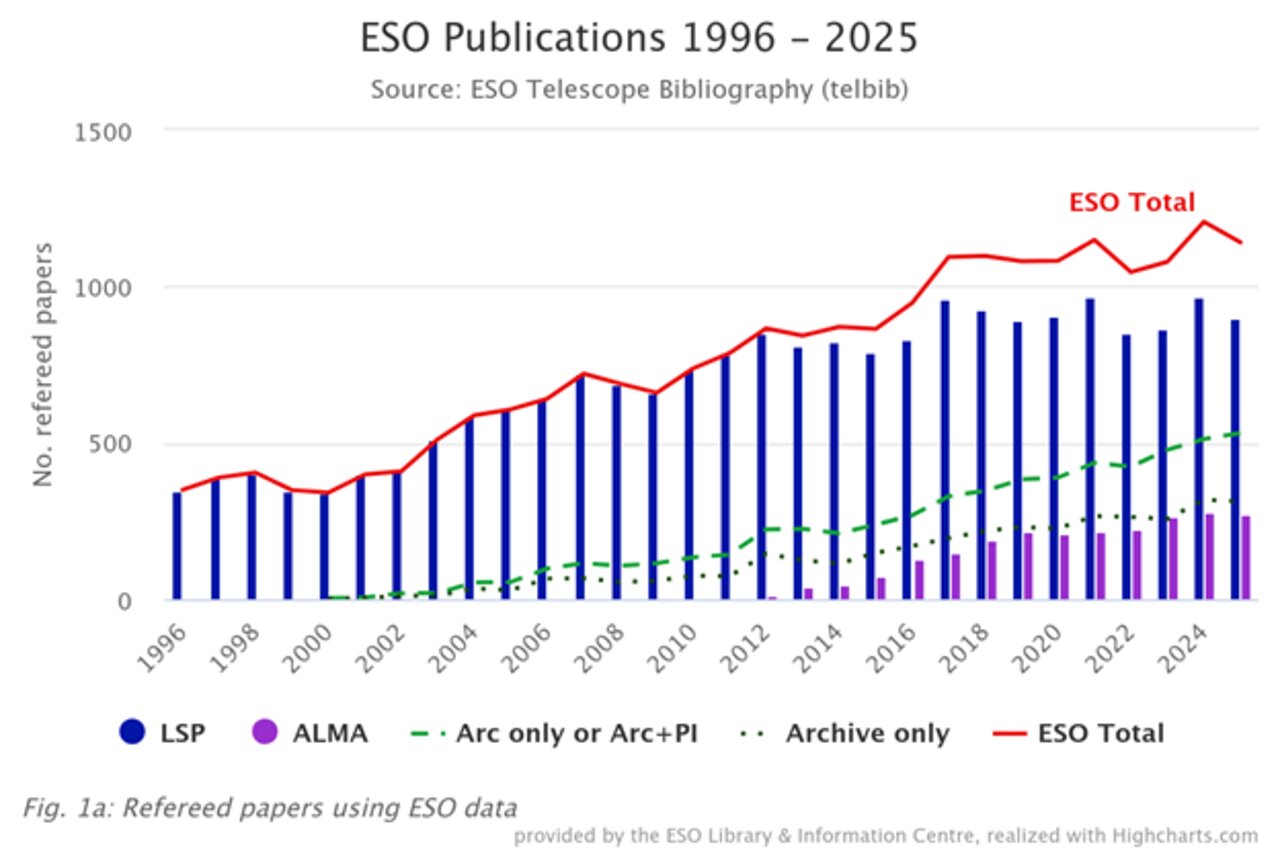
Im vergangenen Jahr wurden rund 1150 Studien veröffentlicht, die auf Daten basieren, die an den Observatorien der ESO gesammelt wurden – damit wurden zum zweiten Mal in Folge mehr als 1100 Publikationen veröffentlicht. Es ist außerdem das neunte Jahr in Folge, in dem Beobachtungen an den Einrichtungen der ESO zu mehr als 1000 veröffentlichten Studien geführt haben. Die Abteilung Bibliothek, Dokumentation und Informationsdienste der ESO hat ihre Publikationsstatistik um das Jahr 2025 ergänzt und eine detaillierte Aufschlüsselung der Beiträge der einzelnen ESO-Einrichtungen vorgenommen [1].
Wie in den Vorjahren dominierten Daten des Very Large Telescope (VLT) und des VLT-Interferometers (VLTI) der ESO die Veröffentlichungen und trugen 2025 zu rund 670 Studien bei. Die breite Palette an Instrumenten der Einrichtungen sowie der Standort im Paranal-Observatorium in der chilenischen Atacama-Wüste – ein Ort mit einzigartigen Beobachtungsbedingungen, darunter ein makelloser dunkler Himmel – machen sie zu einem Flaggschiff der bodengebundenen Astronomie. Der Multi Unit Spectroscopic Explorer (MUSE) ist mit Daten in über 200 Artikeln seit sechs Jahren in Folge das produktivste Instrument des VLT/I. Ein Highlight von MUSE im letzten Jahr war die Veröffentlichung eines ultra-detaillierten Tausend-Farben-Bildes der Sculptor-Galaxie. Ein weiteres Highlight des VLT, das im letzten Jahr veröffentlicht wurde, nutzte Daten des Ultraviolet and Visual Echelle Spectrograph (UVES), dem zweitproduktivsten VLT-Instrument mit über 120 Veröffentlichungen im Jahr 2025, um einen Planeten in einer senkrechten Umlaufbahn zu einem Sternenpaar zu finden.
Die Durchmusterungseinrichtungen, das Visible and Infrared Survey Telescope for Astronomy (VISTA) und das VLT Survey Telescope (VST) [2] der ESO, die sich ebenfalls im Paranal-Observatorium befinden, lieferten Daten für über 100 wissenschaftliche Veröffentlichungen. Daten aus dem ersten Observatorium der ESO, La Silla, flossen im vergangenen Jahr in etwa 200 Studien ein, ein Anstieg gegenüber 177 im Jahr 2024. Dies zeigt, dass das Observatorium weiterhin an der Spitze der Forschung steht, insbesondere dank Instrumenten wie HARPS, dem High Accuracy Radial velocity Planet Searcher, auf dem 3,6-Meter-Teleskop der ESO.
Das Atacama Large Millimeter/Submillimeter Array (ALMA), an dem die ESO beteiligt ist, lieferte im Jahr 2025 Daten für über 550 Veröffentlichungen. Etwa die Hälfte dieser Arbeiten basierte auf Beobachtungszeit, die Astronomen mit Sitz in Europa gewährt wurde. Zu den Höhepunkten der im letzten Jahr veröffentlichten ALMA-Studien zählen die Entdeckung von Sauerstoff in der entferntesten bekannten Galaxie und Beobachtungen zur Entstehung eines neuen Sonnensystems. Die Beobachtungen des Atacama Pathfinder Experiment (APEX), das bis Ende 2025 von der ESO betrieben und gehostet wurde und sich neben ALMA befindet, führten im letzten Jahr zu rund 45 Artikeln. Davon verwendeten fast 20 Daten, die während der ESO-Beobachtungszeit gewonnen wurden.
Eine Rekordzahl von Publikationen verwendete Daten aus dem ESO Science Archive Facility, wobei rund 530 Artikel teilweise oder ausschließlich auf Archivdaten zurückgriffen. Damit war 2025 mit 46 % auch das Jahr mit dem höchsten Anteil an ESO-Publikationen, die das Archiv nutzten, was den Wert älterer Beobachtungen für die Spitzenforschung in der Astronomie unterstreicht. Darüber hinaus stützten sich mehr als ein Viertel aller Veröffentlichungen aus dem Jahr 2025 ausschließlich auf Archivdaten, ohne dass die Autoren selbst Beobachtungen der ESO durchgeführt hatten.
Die beeindruckenden Veröffentlichungszahlen unterstreichen die bedeutende Rolle, die die ESO dabei spielt, Astronominnen und Astronomen dabei zu unterstützen, unser Verständnis des Universums zu erweitern. Möglich wird dies durch die Arbeit der gesamten astronomischen Gemeinschaft und der ESO-Mitarbeitenden, die fortschrittliche Technologie der ESO-Einrichtungen und die kontinuierliche Unterstützung durch die ESO-Mitgliedstaaten und Chile.
Hinweise
[1] Die Arbeiten können Daten aus mehr als einer Einrichtung verwenden, daher kann die Gesamtzahl nicht durch Addition aller Veröffentlichungen der einzelnen Standorte berechnet werden.
[2] Das VST-Projekt war ein Gemeinschaftsprojekt der ESO und der Sternwarte Capodimonte, die zum italienischen Nationalinstitut für Astrophysik (INAF) gehört. Seit dem 1. Oktober 2022 ist dies ein alleiniges Projekt des INAF, das von der ESO in Paranal betreut wird. In die Statistik fließen nur Veröffentlichungen ein, die (ganz oder teilweise) auf ESO-VST-Zeit basieren.
Weitere Informationen
Die hier dargestellten Statistiken stammen aus der ESO Telescope Bibliography (telbib), einer Datenbank mit Fachartikeln, die von der ESO-Nutzergemeinschaft veröffentlicht wurden. Telbib wird von der Abteilung Bibliothek, Dokumentation und Informationsdienste der ESO entwickelt und gepflegt. Bei der Sichtung der Literatur für ESO-Datenpublikationen werden zwar Text-Mining-Skripte eingesetzt, doch werden die Artikel von den Kuratoren sorgfältig geprüft, bevor sie in die Datenbank aufgenommen werden, um sicherzustellen, dass alle Telbib-Publikationen teilweise oder ausschließlich Daten von ESO-Einrichtungen verwenden, für die die ESO Beobachtungszeit empfohlen hat. Die öffentliche Telbib-Schnittstelle bietet Visualisierungen der Suchergebnisse, darunter On-the-Fly-Grafiken und vordefinierte Diagramme.
Links
- Grundlegende ESO-Publikationsstatistiken
- ESO-Teleskop-Bibliografie (telbib)
- Telbib-Methodik
- ESO-Richtlinie zur Zitierung von Daten
Kontaktinformationen
Uta Grothkopf
Head of ESO’s Library, Documentation, and Information Services Department
Garching bei München, Deutschland
Tel: +49 89 3200 6280
E-Mail: uta.grothkopf@eso.org
Bárbara Ferreira
ESO Media Manager
Garching bei München, Deutschland
Tel: +49 89 3200 6670
E-Mail: press@eso.org
Über die Mitteilung
| ID: | ann26002 |
Bilder
nur auf Englisch
Our use of Cookies
We use cookies that are essential for accessing our websites and using our services. We also use cookies to analyse, measure and improve our websites’ performance, to enable content sharing via social media and to display media content hosted on third-party platforms.
ESO Cookies Policy
The European Organisation for Astronomical Research in the Southern Hemisphere (ESO) is the pre-eminent intergovernmental science and technology organisation in astronomy. It carries out an ambitious programme focused on the design, construction and operation of powerful ground-based observing facilities for astronomy.
This Cookies Policy is intended to provide clarity by outlining the cookies used on the ESO public websites, their functions, the options you have for controlling them, and the ways you can contact us for additional details.
What are cookies?
Cookies are small pieces of data stored on your device by websites you visit. They serve various purposes, such as remembering login credentials and preferences and enhance your browsing experience.
Categories of cookies we use
Essential cookies (always active): These cookies are strictly necessary for the proper functioning of our website. Without these cookies, the website cannot operate correctly, and certain services, such as logging in or accessing secure areas, may not be available; because they are essential for the website’s operation, they cannot be disabled.
Functional Cookies: These cookies enhance your browsing experience by enabling additional features and personalization, such as remembering your preferences and settings. While not strictly necessary for the website to function, they improve usability and convenience; these cookies are only placed if you provide your consent.
Analytics cookies: These cookies collect information about how visitors interact with our website, such as which pages are visited most often and how users navigate the site. This data helps us improve website performance, optimize content, and enhance the user experience; these cookies are only placed if you provide your consent. We use the following analytics cookies.
Matomo Cookies:
This website uses Matomo (formerly Piwik), an open source software which enables the statistical analysis of website visits. Matomo uses cookies (text files) which are saved on your computer and which allow us to analyze how you use our website. The website user information generated by the cookies will only be saved on the servers of our IT Department. We use this information to analyze www.eso.org visits and to prepare reports on website activities. These data will not be disclosed to third parties.
On behalf of ESO, Matomo will use this information for the purpose of evaluating your use of the website, compiling reports on website activity and providing other services relating to website activity and internet usage.
Matomo cookies settings:
Additional Third-party cookies on ESO websites: some of our pages display content from external providers, e.g. YouTube.
Such third-party services are outside of ESO control and may, at any time, change their terms of service, use of cookies, etc.
YouTube: Some videos on the ESO website are embedded from ESO’s official YouTube channel. We have enabled YouTube’s privacy-enhanced mode, meaning that no cookies are set unless the user actively clicks on the video to play it. Additionally, in this mode, YouTube does not store any personally identifiable cookie data for embedded video playbacks. For more details, please refer to YouTube’s embedding videos information page.
Cookies can also be classified based on the following elements.
Regarding the domain, there are:
- First-party cookies, set by the website you are currently visiting. They are stored by the same domain that you are browsing and are used to enhance your experience on that site;
- Third-party cookies, set by a domain other than the one you are currently visiting.
As for their duration, cookies can be:
- Browser-session cookies, which are deleted when the user closes the browser;
- Stored cookies, which stay on the user's device for a predetermined period of time.
How to manage cookies
Cookie settings: You can modify your cookie choices for the ESO webpages at any time by clicking on the link Cookie settings at the bottom of any page.
In your browser: If you wish to delete cookies or instruct your browser to delete or block cookies by default, please visit the help pages of your browser:
Please be aware that if you delete or decline cookies, certain functionalities of our website may be not be available and your browsing experience may be affected.
You can set most browsers to prevent any cookies being placed on your device, but you may then have to manually adjust some preferences every time you visit a site/page. And some services and functionalities may not work properly at all (e.g. profile logging-in, shop check out).
Updates to the ESO Cookies Policy
The ESO Cookies Policy may be subject to future updates, which will be made available on this page.
Additional information
For any queries related to cookies, please contact: pdprATesoDOTorg.
As ESO public webpages are managed by our Department of Communication, your questions will be dealt with the support of the said Department.