


Press Releases

Subscribe to receive news from ESO in your language!
Search results for ‘SPHERE’

eso0329 — Press Release
Optical Detection of Anomalous Nitrogen in Comets
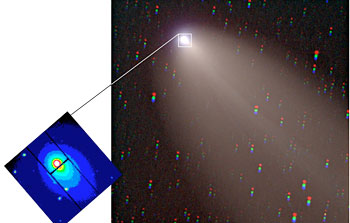
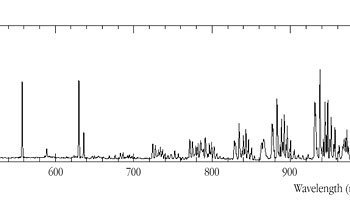
12 September 2003: A team of European astronomers [1] has used the UVES spectrograph on the 8.2-m VLT KUEYEN telescope to perform a uniquely detailed study of Comet LINEAR (C/2000 WM1) . This is the first time that this powerful instrument has been employed to obtain high-resolution spectra of a comet. At the time of the observations in mid-March 2002, Comet LINEAR was about 180 million km from the Sun, moving outwards after its perihelion passage in January. As comets are believed to carry "pristine" material - left-overs from the formation of the solar system, about 4,600 million years ago - studies of these objects are important to obtain clues about the origins of the solar system and the Earth in particular. The high quality of the data obtained of this moving 9th-magnitude object has permitted a determination of the cometary abundance of various elements and their isotopes [2]. Of particular interest is the unambiguous detection and measurement of the nitrogen-15 isotope. The only other comet in which this isotope has been observed is famous Comet Hale-Bopp - this was during the passage in 1997, when it was much brighter than Comet LINEAR. Most interestingly, Comet LINEAR and Comet Hale-Bopp display the same isotopic abundance ratio, about 1 nitrogen-15 atom for each 140 nitrogen-14 atoms ( 14 N/ 15 N = 140 ± 30) . That is about half of the terrestrial value (272). It is also very different from the result obtained by means of radio measurements of Comet Hale-Bopp ( 14 N/ 15 N = 330 ± 75). Optical and radio measurements concern different molecules (CN and HCN, respectively), and this isotopic anomaly must be explained by some differentiation mechanism. The astronomers conclude that part of the cometary nitrogen is trapped in macromolecules attached to dust particles.
Read more
eso0326 — Press Release
New Insight into the Cosmic Renaissance Epoch
21 August 2003: Using the ESO Very Large Telescope (VLT) , two astronomers from Germany and the UK [2] have discovered some of the most distant galaxies ever seen. They are located about 12,600 million light-years away. It has taken the light now recorded by the VLT about nine-tenths of the age of the Universe to traverse this huge distance. We therefore observe those galaxies as they were at a time when the Universe was very young, less than about 10% of its present age . At this time, the Universe was emerging from a long period known as the "Dark Ages," entering the luminous "Cosmic Renaissance" epoch. Unlike previous studies which resulted in the discovery of a few, widely dispersed galaxies at this early epoch, the present study found at least six remote citizens within a small sky area, less than five per cent the size of the full moon! This allowed understanding the evolution of these galaxies and how they affect the state of the Universe in its youth. In particular, the astronomers conclude on the basis of their unique data that there were considerably fewer luminous galaxies in the Universe at this early stage than 500 million years later. There must therefore be many less luminous galaxies in the region of space that they studied, too faint to be detected in this study. It must be those still unidentified galaxies that emit the majority of the energetic photons needed to ionise the hydrogen in the Universe at that particularly epoch.
Read more
eso0316 — Press Release
Flattest Star Ever Seen
11 June 2003: To a first approximation, planets and stars are round. Think of the Earth we live on. Think of the Sun, the nearest star, and how it looks in the sky. But if you think more about it, you realize that this is not completely true. Due to its daily rotation, the solid Earth is slightly flattened ("oblate") - its equatorial radius is some 21 km (0.3%) larger than the polar one. Stars are enormous gaseous spheres and some of them are known to rotate quite fast, much faster than the Earth. This would obviously cause such stars to become flattened. But how flat? Recent observations with the VLT Interferometer (VLTI) at the ESO Paranal Observatory have allowed a group of astronomers [1] to obtain by far the most detailed view of the general shape of a fast-spinning hot star, Achernar (Alpha Eridani) , the brightest in the southern constellation Eridanus (The River). They find that Achernar is much flatter than expected - its equatorial radius is more than 50% larger than the polar one! In other words, this star is shaped very much like the well-known spinning-top toy, so popular among young children. The high degree of flattening measured for Achernar - a first in observational astrophysics - now poses an unprecedented challenge for theoretical astrophysics . The effect cannot be reproduced by common models of stellar interiors unless certain phenomena are incorporated, e.g. meridional circulation on the surface ("north-south streams") and non-uniform rotation at different depths inside the star. As this example shows, interferometric techniques will ultimately provide very detailed information about the shapes, surface conditions and interior structure of stars.
Read more
eso0313 — Press Release
Sharper and Deeper Views with MACAO-VLTI
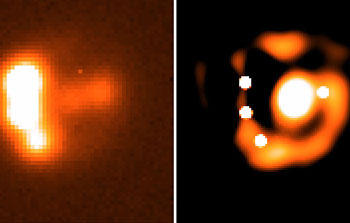
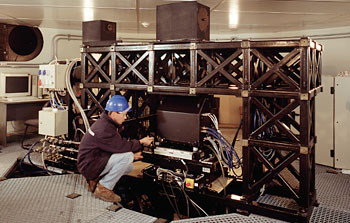
13 May 2003: On April 18, 2003, a team of engineers from ESO celebrated the successful accomplishment of "First Light" for the MACAO-VLTI Adaptive Optics facility on the Very Large Telescope (VLT) at the Paranal Observatory (Chile). This is the second Adaptive Optics (AO) system put into operation at this observatory, following the NACO facility. The achievable image sharpness of a ground-based telescope is normally limited by the effect of atmospheric turbulence. However, with Adaptive Optics (AO) techniques, this major drawback can be overcome so that the telescope produces images that are as sharp as theoretically possible, i.e., as if they were taken from space. The acronym "MACAO" stands for "Multi Application Curvature Adaptive Optics" which refers to the particular way optical corrections are made which "eliminate" the blurring effect of atmospheric turbulence. The MACAO-VLTI facility was developed at ESO. It is a highly complex system of which four, one for each 8.2-m VLT Unit Telescope, will be installed below the telescopes (in the Coudé rooms). These systems correct the distortions of the light beams from the large telescopes (induced by the atmospheric turbulence) before they are directed towards the common focus at the VLT Interferometer (VLTI). The installation of the four MACAO-VLTI units of which the first one is now in place, will amount to nothing less than a revolution in VLT interferometry. An enormous gain in efficiency will result, because of the associated 100-fold gain in sensitivity of the VLTI. Put in simple words, with MACAO-VLTI it will become possible to observe celestial objects 100 times fainter than now . Soon the astronomers will be thus able to obtain interference fringes with the VLTI of a large number of objects hitherto out of reach with this powerful observing technique, e.g. external galaxies. The ensuing high-resolution images and spectra will open entirely new perspectives in extragalactic research and also in the studies of many faint objects in our own galaxy, the Milky Way. During the present period, the first of the four MACAO-VLTI facilties was installed, integrated and tested by means of a series of observations. For these tests, an infrared camera was specially developed which allowed a detailed evaluation of the performance. It also provided some first, spectacular views of various celestial objects, some of which are shown here.
Read more
eso0311 — Press Release
Glowing Hot Transiting Exoplanet Discovered
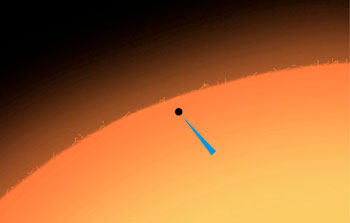
22 April 2003: More than 100 exoplanets in orbit around stars other than the Sun have been found so far. But while their orbital periods and distances from their central stars are well known, their true masses cannot be determined with certainty, only lower limits. This fundamental limitation is inherent in the common observational method to discover exoplanets - the measurements of small and regular changes in the central star's velocity, caused by the planet's gravitational pull as it orbits the star. However, in two cases so far, it has been found that the exoplanet's orbit happens to be positioned in such a way that the planet moves in front of the stellar disk, as seen from the Earth. This "transit" event causes a small and temporary dip in the star's brightness, as the planet covers a small part of its surface, which can be observed. The additional knowledge of the spatial orientation of the planetary orbit then permits a direct determination of the planet's true mass. Now, a group of German astronomers [1] have found a third star in which a planet, somewhat larger than Jupiter, but only half as massive, moves in front of the central star every 28.5 hours . The crucial observation of this solar-type star, designated OGLE-TR-3 [2] was made with the high-dispersion UVES spectrograph on the Very Large Telescope (VLT) at the ESO Paranal Observatory (Chile). It is the exoplanet with the shortest period found so far and it is very close to the star, only 3.5 million km away. The hemisphere that faces the star must be extremely hot, about 2000 °C and the planet is obviously losing its atmosphere at high rate.
Read more
eso0305 — Press Release
Distant World in Peril Discovered from La Silla
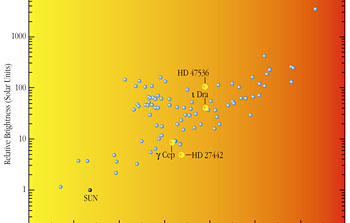
22 January 2003: When, in a distant future, the Sun begins to expand and evolves into a "giant" star, the surface temperature on the Earth will rise dramatically and our home planet will eventually be incinerated by that central body. Fortunately for us, this dramatic event is several billion years away. However, that sad fate will befall another planet, just discovered in orbit about the giant star HD 47536, already within a few tens of millions of years. At a distance of nearly 400 light-years from us, it is the second-remotest planetary system discovered to date [1]. This is an interesting side-result of a major research project, now carried out by a European-Brazilian team of astronomers [2]. In the course of a three-year spectroscopic survey, they have observed about 80 giant stars in the southern sky with the advanced FEROS spectrograph on the 1.52-m telescope installed at the ESO La Silla Observatory (Chile). It is one of these stars that has just been found to host a giant planet. This is only the fourth such case known and with a diameter of about 33 million km (or 23.5 times that of our Sun), HD 47536 is by far the largest of those giant stars [1]. The distance of the planet from the star is still of the order of 300 million km (or twice the distance of the Earth from the Sun), a safe margin now, but this will not always be so. The orbital period is 712 days, i.e., somewhat less than two Earth years, and the planet's mass is 5 - 10 times that of Jupiter. The presence of exoplanets in orbit around giant stars, some of which will eventually perish into their central star (be "cannibalized"), provides a possible explanation of the anomalous abundance of certain chemical elements that is observed in the atmospheres of some stars. This interesting discovery bodes well for coming observations of exoplanetary systems with new, more powerful instruments, like HARPS to be installed next year at the ESO 3.6-m telescope on La Silla, and also the Very Large Telescope Interferometer (VLTI) now being commissioned at Paranal.
Read more
eso0304 — Press Release
Isolated Star-Forming Cloud Discovered in Intracluster Space
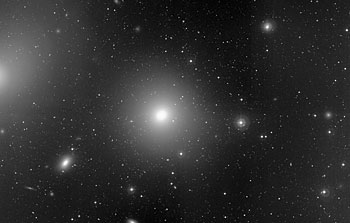
16 January 2003: At a distance of some 50 million light-years, the Virgo Cluster is the nearest galaxy cluster. It is located in the zodiacal constellation of the same name (The Virgin) and is a large and dense assembly of hundreds of galaxies. The "intracluster" space between the Virgo galaxies is permeated by hot X-ray emitting gas and, as has become clear recently, by a sparse "intracluster population of stars". So far, stars have been observed to form in the luminous parts of galaxies. The most massive young stars are often visible indirectly by the strong emission from surrounding cocoons of hot gas, which is heated by the intense radiation from the embedded stars. These "HII regions" (pronounced "Eitch-Two" and so named because of their content of ionized hydrogen) may be very bright and they often trace the beautiful spiral arms seen in disk galaxies like our own Milky Way. New observations by the Japanese 8-m Subaru telescope and the ESO Very Large Telescope (VLT) have now shown that massive stars can also form in isolation, far from the luminous parts of galaxies [1]. During a most productive co-operation between astronomers working at these two world-class telescopes, a compact HII region has been discovered at the very boundary between the outer halo of a Virgo cluster galaxy and Virgo intracluster space. This cloud is illuminated and heated by a few hot and massive young stars. The estimated total mass of the stars in the cloud is only a few hundred times that of the Sun. Such an object is rare at the present epoch. However, there may have been more in the past, at which time they were perhaps responsible for the formation of a fraction of the intracluster stellar population in clusters of galaxies. Massive stars in such isolated HII regions will explode as supernovae at the end of their short lives, and enrich the intracluster medium with heavy elements. Observations of two other Virgo cluster galaxies, Messier 86 and Messier 84, indicate the presence of other isolated HII regions, thus suggesting that isolated star formation may occur more generally in galaxies. If so, this process may provide a natural explanation to the current riddle why some young stars are found high up in the halo of our own Milky Way galaxy, far from the star-forming clouds in the main plane.
Read more
eso0303 — Press Release
Discovery of Nearest Known Brown Dwarf
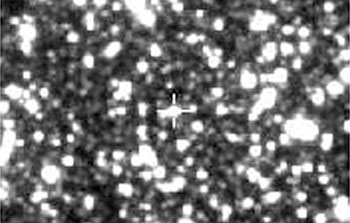
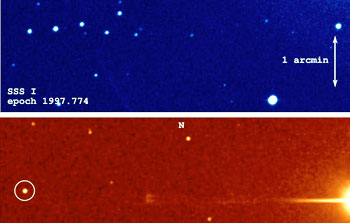
13 January 2003: A team of European astronomers [1], [2] has discovered a Brown Dwarf object (a 'failed' star) less than 12 light-years from the Sun. It is the nearest yet known. Now designated Epsilon Indi B, it is a companion to a well-known bright star in the southern sky, Epsilon Indi (now "Epsilon Indi A"), previously thought to be single. The binary system is one of the twenty nearest stellar systems to the Sun. The brown dwarf was discovered from the comparatively rapid motion across the sky which it shares with its brighter companion : the pair move a full lunar diameter in less than 400 years. It was first identified using digitised archival photographic plates from the SuperCOSMOS Sky Surveys (SSS) and confirmed using data from the Two Micron All Sky Survey (2MASS). Follow-up observations with the near-infrared sensitive SOFI instrument on the ESO 3.5-m New Technology Telescope (NTT) at the La Silla Observatory confirmed its nature and has allowed measurements of its physical properties. Epsilon Indi B has a mass just 45 times that of Jupiter, the largest planet in the Solar System, and a surface temperature of only 1000 °C. It belongs to the so-called 'T dwarf' category of objects which straddle the domain between stars and giant planets. Epsilon Indi B is the nearest and brightest T dwarf known. Future studies of the new object promise to provide astronomers with important new clues as to the formation and evolution of these exotic celestial bodies, at the same time yielding interesting insights into the border zone between planets and stars.
Read more
eso0236 — Press Release
New Vistas Open with MIDI at the VLT Interferometer
18 December 2002: Following several weeks of around-the-clock work, a team of astronomers and engineers from Germany, the Netherlands, France and ESO [2] has successfully performed the first observations with the MID-Infrared interferometric instrument (MIDI), a new, extremely powerful instrument just installed in the underground laboratory of the VLT Interferometer (VLTI) at the Paranal Observatory (Chile). In the early morning of December 15, 2002, two of the 8.2 m VLT unit telescopes (ANTU and MELIPAL) were pointed towards the southern star Epsilon Carinae and the two light beams were directed via the complex intervening optics system towards MIDI. After a few hours of tuning and optimization, strong and stable interferometric fringes were obtained, indicating that all VLTI components - from telescopes to the new instrument - were working together perfectly. Two more stars were observed before sunrise, further proving the stability of the entire system. The first observations with MIDI mark one more important step towards full and regular operation of the VLT Interferometer [3]. They are a result of five years of determined efforts within a concerted technology project, based on a close collaboration between ESO and several European research institutes (see below). Now opening great research vistas, they also represent several "firsts" in observational astrophysics, together amounting to a real breakthrough in the field of astronomical interferometry.
Read more
eso0232 — Press Release
How Small are Small Stars Really?
29 November 2002: At a distance of only 4.2 light-years, Proxima Centauri is the nearest star to the Sun currently known [2]. It is visible as an 11-magnitude object in the southern constellation of Centaurus and is the faintest member of a triple system, together with Alpha Centauri, the brightest (double) star in this constellation. Proxima Centauri is a very-low-mass star, in fact barely massive enough to burn hydrogen to helium in its interior. It is about seven times smaller than the Sun, and the surface temperature is "only" about 3000 degrees, about half of that of our own star. Consequently, it is also much fainter - the intrinsic brightness is only 1/150th of that of our Sun. Low-mass stars are very interesting objects , also because the physical conditions in their interiors have much in common with those of giant planets, like Jupiter in our solar system. A determination of the sizes of the smallest stars has been impossible until now because of their general faintness and lack of adequate instrumentation. However, astronomers have long been keen to move forward in this direction, since such measurements would provide indirect, crucial information about the behaviour of matter under extreme conditions. When the first observations with the VLT Interferometer (VLTI), combining the light from two of the 8.2-m VLT Unit Telescopes (ANTU and MELIPAL), were made one year ago, interferometric measurements were also obtained of Proxima Centauri . They formed part of the VLTI commissioning and the data were soon released to the ESO community, cf. the special website. Now, an international team of astronomers from Switzerland, France and ESO/Chile has successfully analysed these observations by means of newly developed, advanced software. For the first time ever, they obtained a highly accurate measurement of the size of such a small star. Three other small stars were also measured and the results are in excellent agreement with stellar theory, indicating that our present understanding of the structure and composition of very small stars is reasonably correct . More VLTI observations are soon to follow, eventually also of even smaller objects, like Brown Dwarfs.
Read more
eso0225 — Press Release
Four Eyes Are Better
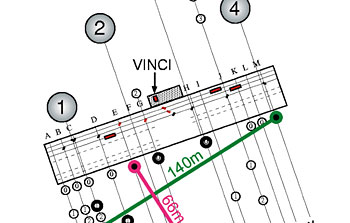
26 September 2002: During the nights of September 15/16 and 16/17, 2002, preliminary tests were successfully carried out during which the light beams from all four VLT 8.2-m Unit Telescopes (UTs) at the ESO Paranal Observatory were successively combined, two by two, to produce interferometric fringes . This marks a next important step towards the full implementation of the VLT Interferometer (VLTI) that will ultimately provide European astronomers with unequalled opportunities for exciting front-line research projects. It is no simple matter to ensure that the quartet of ANTU, KUEYEN, MELIPAL and YEPUN , each a massive giant with a suite of computer-controlled active mirrors, can work together by sending beams of light towards a common focal point via a complex system of compensating optics. Yet, in the span of only two nights, the four VLT telescopes were successfully "paired" to do exactly this, yielding a first tantalizing glimpse of the future possibilities with this new science machine. While there is still a long way ahead to the routine production of extremely sharp, interferometric images, the present test observations have allowed to demonstrate directly the 2D-resolution capacity of the VLTI by means of multiple measurements of a distant star. Much valuable experience was gained during those two nights and the ESO engineers and scientists are optimistic that the extensive test observations with the numerous components of the VLTI will continue to progress rapidly. Five intense, technical test periods are scheduled during the next six months; some of these with the Mid-Infrared interferometric instrument for the VLTI (MIDI) which will soon be installed at Paranal. Later in 2003, the first of the four moveable VLTI 1.8-m Auxiliary Telescopes (ATs) will be put in place on the top of the mountain; together they will permit regular interferometric observations, also without having to use the large UTs.
Read more
Showing 261 to 280 of 398
Send us your comments!
Subscribe to receive news from ESO in your language
Accelerated by CDN77
Terms & Conditions
Cookie Settings and Policy

Our use of Cookies

We use cookies that are essential for accessing our websites and using our services. We also use cookies to analyse, measure and improve our websites’ performance, to enable content sharing via social media and to display media content hosted on third-party platforms.

You can manage your cookie preferences and find out more by visiting 'Cookie Settings and Policy'.

ESO Cookies Policy


The European Organisation for Astronomical Research in the Southern Hemisphere (ESO) is the pre-eminent intergovernmental science and technology organisation in astronomy. It carries out an ambitious programme focused on the design, construction and operation of powerful ground-based observing facilities for astronomy.

This Cookies Policy is intended to provide clarity by outlining the cookies used on the ESO public websites, their functions, the options you have for controlling them, and the ways you can contact us for additional details.

What are cookies?

Cookies are small pieces of data stored on your device by websites you visit. They serve various purposes, such as remembering login credentials and preferences and enhance your browsing experience.

Categories of cookies we use

Essential cookies (always active): These cookies are strictly necessary for the proper functioning of our website. Without these cookies, the website cannot operate correctly, and certain services, such as logging in or accessing secure areas, may not be available; because they are essential for the website’s operation, they cannot be disabled.

Cookie ID/Name
Description/Purpose
Provider (1st party or 3rd party)
Browser session cookie or Stored cookie?
Duration
csrftoken
XSRF protection token. We use this cookie to protect against cross-site request forgery attacks.
1st party
Stored
1 year
user_privacy
Your privacy choices. We use this cookie to save your privacy preferences.
1st party
Stored
6 months
_grecaptcha
We use reCAPTCHA to protect our forms against spam and abuse. reCAPTCHA sets a necessary cookie when executed for the purpose of providing its risk analysis. We use www.recaptcha.net instead of www.google.com in order to avoid unnecessary cookies from Google.
3rd party
Stored
6 months

Functional Cookies: These cookies enhance your browsing experience by enabling additional features and personalization, such as remembering your preferences and settings. While not strictly necessary for the website to function, they improve usability and convenience; these cookies are only placed if you provide your consent.

Cookie ID/Name
Description/Purpose
Provider (1st party or 3rd party)
Browser session cookie or Stored cookie?
Duration
Settings
preferred_language
Language settings. We use this cookie to remember your preferred language settings.
1st party
Stored
1 year
ON | OFF
sessionid
ESO Shop. We use this cookie to store your session information on the ESO Shop. This is just an identifier which is used on the server in order to allow you to purchase items in our shop.
1st party
Stored
2 weeks
ON | OFF

Analytics cookies: These cookies collect information about how visitors interact with our website, such as which pages are visited most often and how users navigate the site. This data helps us improve website performance, optimize content, and enhance the user experience; these cookies are only placed if you provide your consent. We use the following analytics cookies.

Matomo Cookies:

This website uses Matomo (formerly Piwik), an open source software which enables the statistical analysis of website visits. Matomo uses cookies (text files) which are saved on your computer and which allow us to analyze how you use our website. The website user information generated by the cookies will only be saved on the servers of our IT Department. We use this information to analyze www.eso.org visits and to prepare reports on website activities. These data will not be disclosed to third parties.

On behalf of ESO, Matomo will use this information for the purpose of evaluating your use of the website, compiling reports on website activity and providing other services relating to website activity and internet usage.

ON | OFF

Matomo cookies settings:

Cookie ID/Name
Description/Purpose
Provider (1st party or 3rd party)
Browser session cookie or Stored cookie?
Duration
Settings
_pk_id
Stores a unique visitor ID.
1st party
Stored
13 months
_pk_ses
Session cookie temporarily stores data for the visit.
1st party
Stored
30 minutes
_pk_ref
Stores attribution information (the referrer that brought the visitor to the website).
1st party
Stored
6 months
_pk_testcookie
Temporary cookie to check if a visitor’s browser supports cookies (set in Internet Explorer only).
1st party
Stored
Temporary cookie that expires almost immediately after being set.

Additional Third-party cookies on ESO websites: some of our pages display content from external providers, e.g. YouTube.

Such third-party services are outside of ESO control and may, at any time, change their terms of service, use of cookies, etc.

YouTube: Some videos on the ESO website are embedded from ESO’s official YouTube channel. We have enabled YouTube’s privacy-enhanced mode, meaning that no cookies are set unless the user actively clicks on the video to play it. Additionally, in this mode, YouTube does not store any personally identifiable cookie data for embedded video playbacks. For more details, please refer to YouTube’s embedding videos information page.

Cookies can also be classified based on the following elements.

Regarding the domain, there are:

As for their duration, cookies can be:

How to manage cookies

Cookie settings: You can modify your cookie choices for the ESO webpages at any time by clicking on the link Cookie settings at the bottom of any page.

In your browser: If you wish to delete cookies or instruct your browser to delete or block cookies by default, please visit the help pages of your browser:

Please be aware that if you delete or decline cookies, certain functionalities of our website may be not be available and your browsing experience may be affected.

You can set most browsers to prevent any cookies being placed on your device, but you may then have to manually adjust some preferences every time you visit a site/page. And some services and functionalities may not work properly at all (e.g. profile logging-in, shop check out).

Updates to the ESO Cookies Policy

The ESO Cookies Policy may be subject to future updates, which will be made available on this page.

Additional information

For any queries related to cookies, please contact: pdprATesoDOTorg.

As ESO public webpages are managed by our Department of Communication, your questions will be dealt with the support of the said Department.