


Instrument Description
4MOST is a wide-field, fibre-fed, optical spectroscopic survey facility mounted on VISTA and it is entirely dedicated to observations for ESO Public Surveys.
Apart from the instrument itself, the facility include the Operations and Data Management Systems necessary for the planning, scheduling and execution of the observations, and for the reduction, analysis, validation and publication of the data and high-level data products.
4MOST features a 2.5-degree diameter field-of-view with 2436 science fibres in the focal plane. The fibres are configured by a fibre positioner based on the tilting spine principle, enabling extremely short reconfiguration times. The fibres feed three, fixed-configuration spectrographs: one third of the fibres (i.e. 812) will go to a single high-resolution spectrograph (HRS) with resolution R ≈ 18000 – 21000, while the remaining 1624 fibres will feed two low-resolution spectrographs (LRS) with resolution R ≈ 4000 – 7500. In each spectrograph the light is split into three different wavelength channels (blue, green and red) before being dispersed by VPH gratings and recorded by identical 6k × 6k E2V CCDs with low readout noise.
The instrument also features a Wide Field Corrector with an Atmospheric Dispersion Corrector, an Acquisition & Guiding and Wavefront Sensor system, as well as Metrology and Calibration systems.
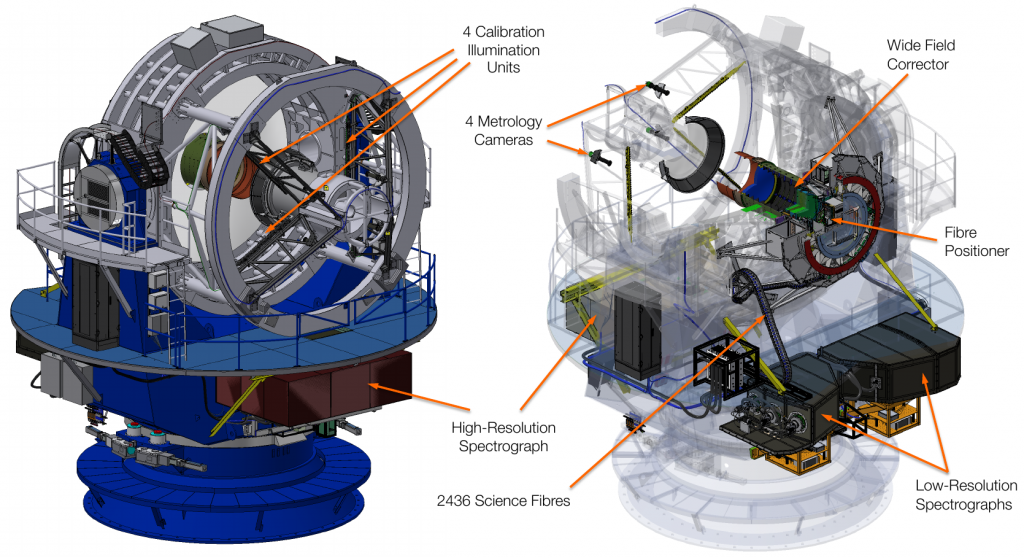
A detailed description of all subsystems can be found in the 4MOST Consortium webpage.
Baseline Specification
| Requirement | Baseline Specification |
| Field-of-View in hexagon | 4.1 degree2 |
| Fibre multiplex per pointing | 2436 |
| Smallest target separation | <17″ |
| Low-Resolution Spectrographs (LRS) | |
| Fibre multiplex | 1624 |
| Spectral resolution | R>4000–7800 |
| Wavelength coverage | 370–950 nm |
| High-Resolution Spectrographs (HRS) | |
| Fibre multiplex | 812 |
| Spectral resolution | R>18,500 |
| Wavelength coverage | 392.6–435.5, 516–573 & 610–679 nm |
Operation model
4MOST has some peculiarities compared to what normally done at ESO.
The survey is divided in 15 Community Surveys (30% of the observing time) and 10 Consortium Surveys (70% of the observing time).
A distinctive advantage of 4MOST lies in the capability to carry out many different science programs in parallel, thereby allowing not only unprecedented sample sizes, but also making it possible to observe programs that would otherwise be too expensive due to low target densities. In parallel mode, data for different surveys are taken simultaneously at the telescope, optimised by position in the sky and minimising the slewing time of the telescope. In order to run the telescope efficiently in parallel mode, the Instrument Consortium takes a service role for the user community of 4MOST, in particular this include the prepartion of Observing Blocks (with a Remote Scheduler that constantly reads the current weather conditions and provides an optimised next Observing Block while the current one is being executed), and data processing.