UV to K-band single target intermediate resolution spectrograph - X-Shooter
Contents
Summary
X-shooter is a single target spectrograph for the Cassegrain focus of one of the VLT UTs. The instrument covers in a single exposure the spectral range from the UV to the K' band. It is designed to maximize the sensitivity in this spectral range through the splitting in three arms with optimized optics, coatings, dispersive elements and detectors. It operates at intermediate resolutions (R=4000-14000, depending on wavelength and slit width) with fixed echelle spectral format (with prism cross-dispersers) in the three arms. The layout and the small number of moving functions (and therefore instrument modes) make the instrument simple and easy to operate and permit a fast response. The possibility to observe in a single shot at the sky limit faint sources with an unknown flux distribution has inspired the name of the instrument.
The instrument received first light in November 2008 and will start operating in October 2009. When in operation, its wide spectral range observing capability will be unique at very large telescopes.
| Built by: | The X-shooter Consortium: the Copenhagen University Observatory, Niels Bohr Institute (DK), the Institute for Physics and Astronomy in Aarhus (DK), the Astronomical Institute 'Anton Pannekoek' from the University of Amsterdam (NL), the Department of Astrophysics from the University of Nijmegen (NL), the Netherlands Foundation of Research in Astronomy (ASTRON, NL), the Osservatorio Astronomico di Brera (INAF, IT), the Osservatorio Astronomico di Trieste (INAF, IT), the Osservatorio Astronomico di Palermo (INAF, IT), the Osservatorio Astrofisico di Catania (INAF, IT), the GEPI, Paris Observatory (FR), the AstroParticule et Cosmologie institute (Universite Paris 7, CNRS and CEA, FR), the European Sourthern Observatory (ESO) |
| P.I. Board: | Sandro D'Odorico (Chair), Francois Hammer, Lex Kaper, Per Kjaergaard Rasmussen, Roberto Pallavicini, Sofia Randich (since Jan 09) |
| ESO Instrument Responsible: | Sandro D'Odorico |
| Work Package Manager: | Hans Dekker |
| Instrument Scientist: | Joël Vernet |
| Instrument Science Team: | Robert Fosbury (ESA ST-ECF, Chair), Corinne Charbonnel (Obs. Midi-Pyrenees), Livia Origlia (INAF - Oss. di Bologna), Nial Tanvir (Univ. of Hertfordshire), Lutz Wisotzski (AIP, Potsdam) |
| Location: | VLT Cassegrain |
| Schedule: | Start of opertations in October 2009 |
Scientific Objectives
With its capability to observe single objects in a wide spectral range at the sky limit, the X-shooter will be a cornerstone facility for the VLT. The main scientific objectives are:
- Spectral properties and gas kinematics of protostars
- Properties of cool white dwarfs
- The nature of neutron stars in close binary systems
- Physical processes in the atmospheres of brown dwarfs
- Properties of core-collapse supernovae; Type Ia supernovae to z =1.7
- Gamma-ray bursts as high-energy laboratories and cosmological probes of the intergalactic medium
- The role of faint emission line galaxies in the redshift interval z = 1.6-2.6
- Properties of high mass star formation and massive galaxies at high z
- Metal enrichment in the early universe through the study of high z absorption systems
- Tomography of the Intergalactic Medium through the observations of faint background QSOs
Instrument Description
Overview

Fig. 1 A view of X-shooter attached to the Cassegrain focus of the VLT UT2. The near-IR spectrograph cryostat is mounted at the bottom, the UV-Blue and Visual-Red ones at the side. Electronic cabinets and detector control systems are attached to the outer structure.
| Wavelength range | 300-2500 nm split in 3 arms |
| UV-Blue arm | Range: 300-550 nm in 12 orders
Resolution: 5100 (1" slit) Detector: 4k x 2k E2V CCD | Visual-red arm | Range: 550-1000 nm in 14 orders
Resolution: 8800 (0.9" slit) Detector: 4k x 2k MIT/LL CCD |
Near-IR arm | Range: 1000-2500 nm in 16 orders
Resolution: 5100 (0.9" slit) Detector: 2k x 1k Hawaii 2RG |
| Slit length | 11" |
| Beam separation | Two high efficiency dichroics |
| Atmospheric dispersion compensation | In the UV-Blue and Visual-red arms |
| Integral field unit | 1.8" x 4" reformatted into 0.6" x 12" |
Instrument Concept
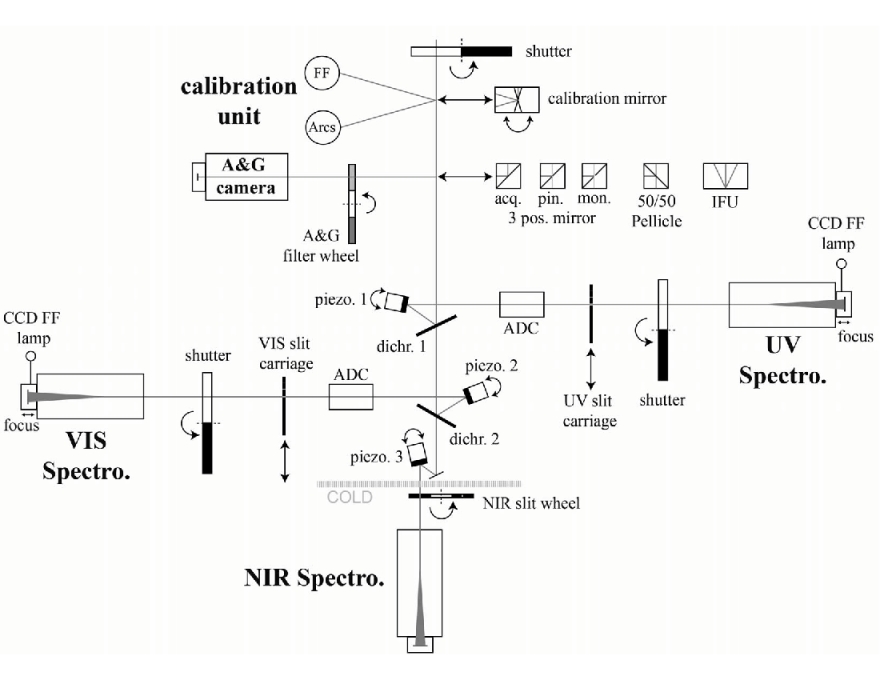
The instrument concept is illustrated in the schematic view below (Fig 2). The calibration lamps are located in the upper section of the instrument. Mechanical slides can insert above or at the focal plane calibration lamp mirrors, a small integral field unit reformatting a 1.8" x 4" area into a slit of 0.6" x 12" or mirrors feeding an acquisition and guiding camera. After the telescope focal plane the light beam is split in three spectral ranges (UV-Blue, Visual-Red and Near-IR) by two dichroics and focused by auxiliary optics on three separate slits. The maximum slit length is 11 arcsec for all arms. The transfer optics in the UV-Blue and Visual-Red arms include atmospheric dispersion correctors. All three arms include piezo mirrors for flexure compensation. The three spectrograph arms each include fixed echelle grating and prisms cross-dispersers, providing full spectral coverage in a single exposure with a spectral resolution between 4000 and 14000 depending on the slit width and the spectral arm. Each arm has optimized optics, coatings, dispersive elements and detectors to maximize efficiency.
The small number of moving functions and
instrument modes and the fixed spectral formats make the instrument
simple and easy to operate and permit a fast response. With its
capability to observe single objects over a wide spectral range at the
sky limit, the X-shooter will be an unique facility among 10-8m
telescopes.
Efficiency
The expected efficiency of the instrument over its global spectral range is shown in Figure 3. It is higher than for high dispersion spectrographs like UVES at the VLT and HIRES at Keck, while providing parallel coverage of the all spectral range from UV to K'. Taking into account the various sources of noise, we have computed the expected limiting AB magnitudes for the regions between sky emission and listed in the table below.
| band | U | B | V | R | I | J | H | K' |
| mag | 21.4 | 21.7 | 21.5 | 21.0 | 20.8 | 20.4 | 20.5 | 18.7 |
Limiting AB magnitudes (1 hr exposure, S/N=10 per spectral bin, see Fig. 3 caption for details).

Fig. 3 Limiting AB magnitude of X-shooter per spectral bin (using 2 pixels binning in the spectral direction) at S/N=10 in a 1 hour exposure. Other parameters: air mass 1.2, 0.8” seeing, 3 days from new moon, 1” slit for UVB, 0.9” slit for VIS and NIR. The ESO ETC was used to compute these values. The model uses overall efficiencies measured during commissioning. Note that these performance estimates assume no degradation of the SNR in the extraction process or in the sky subtraction. The decrease in efficiency to the blue side of the UVB range is due to the atmospheric absorption, at the red side of the VIS band it is due to the decrease in efficiency of the CCD, while on the longwavelength side of the NIR range it is due to the rise of the thermal background.
Recent News
- 10/07/2009: Commissioning data public release.
- 14/03/2008: The full instrument is now on sky!
- 09/11/2008: X-shooter first light on UT3 with UVB and VIS spectrographs.
- 21/05/2008: The full instrument is mounted on the telescope simulator in Garching.
- 14/04/2008: The NIR spectrograph safely arrived in Garching.
- 21/12/2007: UV and VIS spectrographs safely arrived in Garching.
- 17/12/2007: The near-IR arm of X-shooter had first light in the laboratory at ASTRON.
- 30/11/2007: The UV arm of X-shooter had first light in the laboratory in Merate.
- 28/11/2007: The backbone of X-shooter arrived safely in ESO Garching.
- 19/07/2007: The Visual-Red arm of X-shooter had first light in the laboratory in Merate.
Documentation
- X-shooter User Manual
- Marseille 2008 SPIE papers
- Kjaergaard et al., X-shooter: Backbone and UV-Blue and Visible spectrographs. Final AIV and Measured Performance.
- Navarro et al., X-shooter Near-IR Spectrograph Arm Realisation.
- Goldoni et al., Results of X-shooter data reduction software on laboratory frames.
- Bristow et al., X-shooter Physical Model.
- Kerber et al., Wavelength calibration sources for the near-infrared arm of X-shooter.
- Vernet et al., Building-up a database of spectro-photometric standard stars from the UV to the near-IR: a status report.
- Orlando 2006 SPIE papers
- D'Odorico et al., X-shooter, UV to K band, intermediate resolution, high efficiency spectrograph for the VLT: status after the Final Design Review.
- Spano et al., The Optical Design of X-shooter for the VLT.
- Michaelsen et al., The X-shooter spectrograph: a new concept of mechanical assembly for a multiple-arm Cassegrain instrument.
- Navarro et al., X-shooter Near-IR Spectrograph Arm: Design and Manufacturing Methods.
- Guinouard et al., An Intergal Field Unit for X-shooter.
- Goldoni et al., Data Reduction Software of the X-shooter Spectrograph