


Instrument's Characteristics
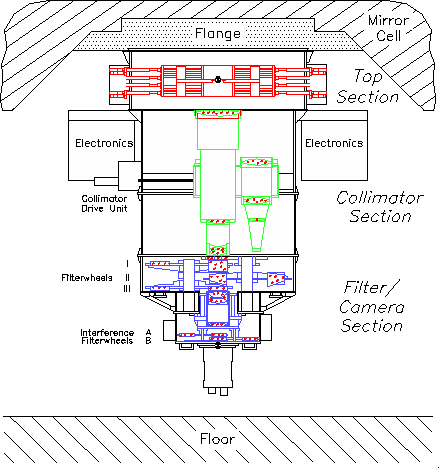
FORS is designed as focal reducer multi mode instruments for the Very Large Telescope. The wavelength range of operation is between 330nm and 1100nm. Two spatial resolutions and hence field sizes can be selected by exchange of the collimators. The resulting field of view is 7.1'x7.1' with the standard resolution collimator (SR) and 4.2'x4.2' with the high resolution collimator (HR) for the mosaiced CCDs. It must be noted the available FoV with the SR collimator, which is not vignetted by the MOS arms is actually ~ 6.8' x 6.8', representing the actual area available to the users.
Instrument Optics
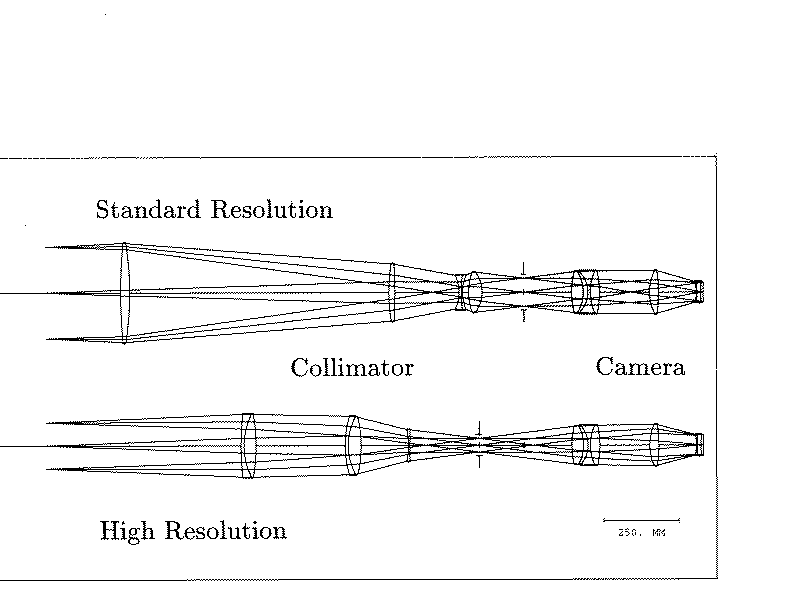
The main instrument optics consists of two remotely exchangeable F/15 collimators of focal length f1233mm (COLL_SR) and f616 mm (COLL_HR) giving a 90 mm and a 44.5 mm diameter pupil. Together with the f280mm, F/3.1 camera the reduction factors are 4.4 and 2.2 respectively. The plate scales on the detectors are 0".25 and 0".125 for the SR and HR collimators with the standard 2x2 binned readout modes. There are no significant differences in image quality between unbinned SR mode and binned HR mode (both would provide plate scales of 0".125), but for seeing of 0".3 and better the HR collimator is expected to improve the image quality.
Detectors
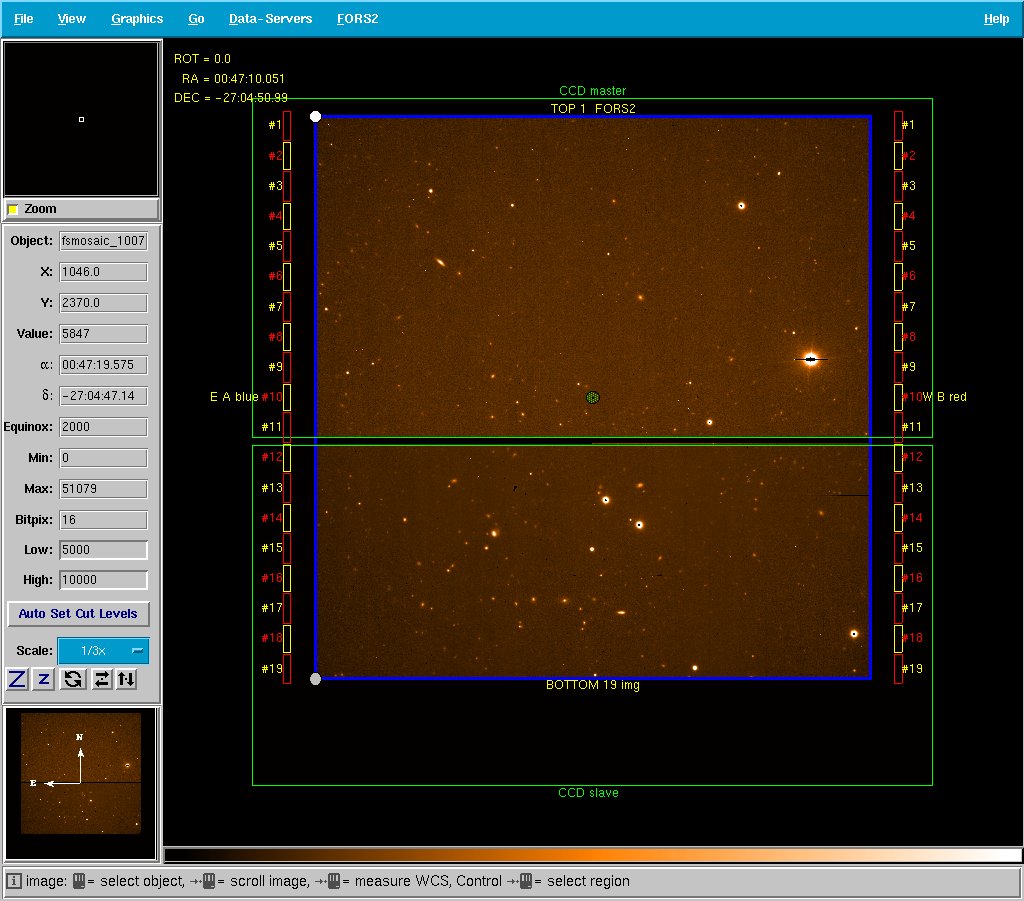
With the decommissioning of FORS1, its detector can now be used with FORS2 for science cases requiring good blue sensitivity. The detector system consists of two 2kx4k E2V CCDs (15µm pixel size). The E2V CCDs provide much higher response in the blue and UV wavelength range below 600 nm, but suffer from strong fringing above 650 nm. More details can be found in the FORS1 upgrade page.
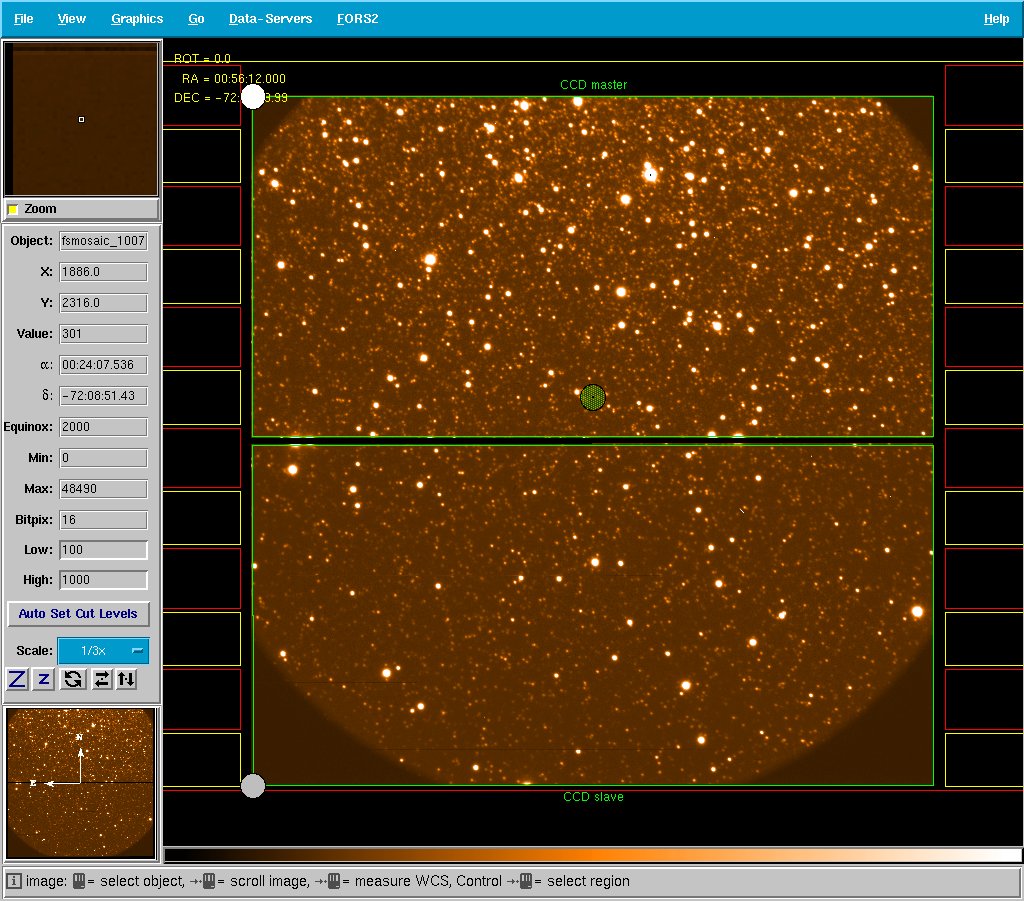
Most of the time FORS2 is working with its red sensitive detector. This system consists of two 2kx4k MIT CCDs (15µm pixel size). The MIT CCDs provide much higher response in the red wavelength range beyond 650nm, with impressively low fringe amplitudes. The response in the UV below 400nm drops however significantly. In standard resolution SR-mode the CCD mosaic will be larger than the unvignetted field in the focal plane. In high resolution HR-mode the corners of theCCDs are vignetted by thecamera optics.
FORS2 components
| Filters | Grisms | Polarimetry | MOS | MXU | LADC | ECU |
Standard Instrument Configuration
The instrument is operated in the pre-defined configuration as specified in the FORS User Manual for the 3 broad band filter wheels. The configuration is fixed for the subsequent observing periods and only filters and grisms which arei nstalled can be requested in proposals, setup requests of visiting astronomers or service mode observing blocks. Filter/grism combinations can be requested if the filter and the grism is not in the same wheel. Narrow and Intermediate band filters will be installed into the interference filter wheels and can be requested at any time.
Observing Modes
All modes are offered in visitor and service mode.
| FORS2 observing modes: | ||
|---|---|---|
| IMA | imaging | fast |
| OCC | imaging with occulting bars | FIMS |
| LSS | longslit spectroscopy | fast |
| MOS | multi-object spectroscopy (movable slits) | FIMS - SR collimator only |
| MXU | multi-object spectroscopy (masks) | FIMS - SR collimator only |
| IPOL | imaging polarimetry | fast - SR collimator only |
| PMOS | multi-object spectropolarimetry | FIMS & fast** - SR collimator only |
| ** fast mode PMOS observations are only possible for a single target on 1 slit | ||
All observing modes marked with "FIMS" will require interactive mask preparation with the FORS Instrument Mask Simulator fims.. All modes marked with "fast" can be directly prepared with the phase 2 proposal preparation tool p2. In some cases both options can be selected. IPOL, MXU, MOS, and PMOS modes are only supported with the standard resolution (SR) collimator. The maximum spectral resolution of FORS2 using a 1.0 arcsecond slit is 2600; see the Overview page for more details.