


UVES - Ultraviolet and Visual Echelle Spectrograph
Summary
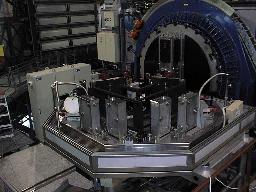 UVES is the high-resolution optical spectrograph of the VLT located at the Nasmyth B focus of UT2. It is a cross-dispersed echelle spectrograph designed to operate with high efficiency from the atmospheric cut-off at 300 nmto the long wavelength limit of the CCD detectors (about 1100 nm). To this aim, the light beam from the telescope is split in two arms (UV to Blue,and Visual to Red) within the instrument. The two arms can be operated separately, or in parallel via a dichroic beam splitter. The resolving power is about 40,000 when a 1-arcsec slit is used. The maximum (two-pixel) resolution is 80,000 or 110,000 in the Blue- and the Red Arm, respectively. Three image slicers are also available to obtain high resolving power without excessive slit loss. The instrument is built for maximum mechanical stability and allows for accurate wavelength calibration. An iodine cell can be inserted in the light beam for observations requiring extremely high accuracy for radial velocity measurements.
Publications based on data obtained with the UVES instrument should quote the following reference paper: Dekker, H. et al. 2000, SPIE, 4008, 534.
Contact Information
- Questions related to proposal preparation, service mode, and visitor mode observations should be addressed via the contact form at ESO Operations Helpdesk.
- Please, send us your general feedback, comments, suggestions, or report errors and inaccurate statements in the web pages and manuals also via this contact form.
Content of these pages
The following items are available on all the UVES pages, using the bar on the left.
- Overview: a short description of the instrument
- News: list of changes affecting the instrument and/or its pages.
- Instrument Description: all the important parameters of the instrument.
- Manuals: links to all the documents related to UVES.
- Tools: a collection of useful tools and informations for preparing and analyzing the UVES observations.
- Instrument Operations Team
- Visitor Instructions: Instrument specific instructions for Visiting Astronomers